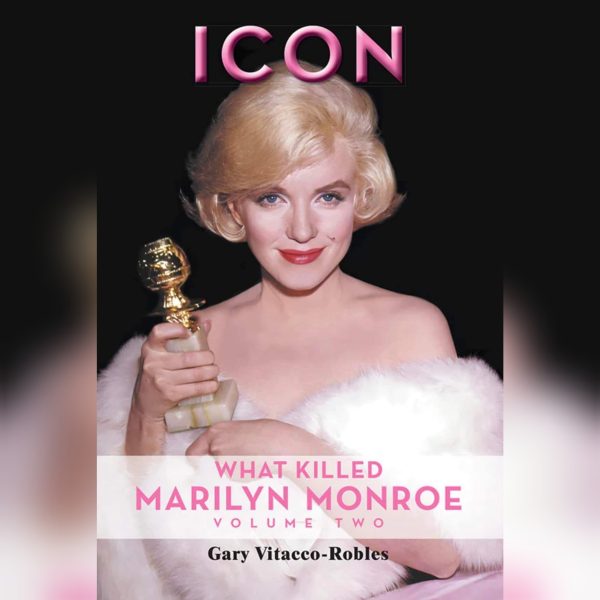
The concluding volume in Gary Vitacco-Robles’ two-part series, Icon: What Killed Marilyn Monroe, is available now in hardcover, paperback and digital formats, which can be ordered direct from the publisher or via Amazon.
A colourised photo of Marilyn clutching her ‘Best Actress in a Musical or Comedy’ award for Some Like It Hot at the 1960 Golden Globes graces the front cover, while a still photo from Remi Gangarossa’s upcoming short film, Marilyn’s Dark Paradise (recreating the distinctive crest at the doorway of her last home at Fifth Helena Drive in Brentwood, LA) is featured on the back cover. (The insignia, ‘Cursum Perficio,’ is a Latin phrase denoting a journey’s end.)
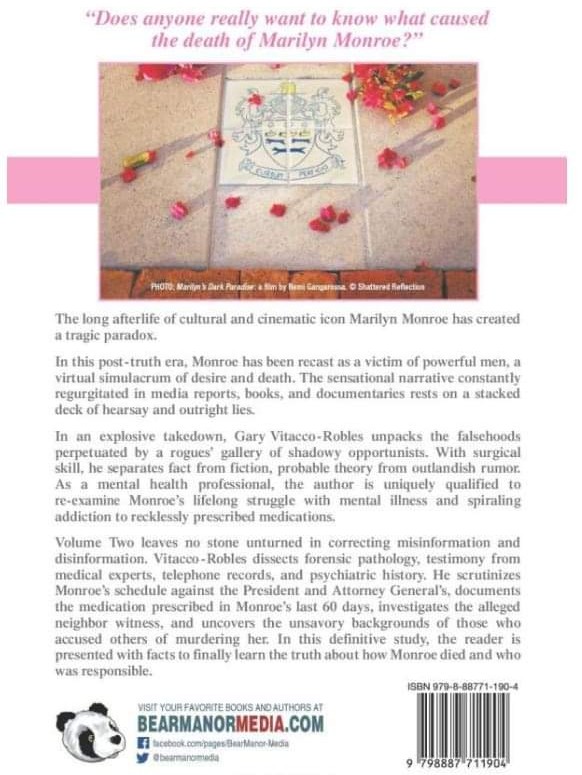
Whereas the first volume focused on Marilyn’s medical history, the official investigations into her death and emerging conspiracy theories, Part Two explores topics including the forensic pathology of Marilyn’s death, and a broader mental health perspective.
“Volume Two will be nearly 800 pages. It explores the critics of the original investigation and their surprising, hidden backstories largely ignored or unknown, which impacts their credibility, and the medical evidence. I detail the prescriptions given to Monroe in her last sixty days. I provide the legal documents of Robert Slatzer, Frank Capell and William Fowler demonstrating their collaboration in creating a murder narrative and the motivation for doing so. I also thoroughly investigate Monroe’s contacts with Robert Kennedy and John Kennedy and confront discrepancies in what has been alleged by sloppy journalists or propagandists. I even present an entire chapter on all of Monroe’s neighbors, getting to the truth about if there really was an eyewitness who claimed Robert Kennedy visited her on the day of her death.
Readers are used to sound bites presented out of context and selected to support a position. I present the elements, and I separate fact from fiction, probable theory from outlandish rumour. I uncover how the narrative and rumours originated, the credibility of those introducing them. I acknowledge blind spots for which we cannot ascertain accuracy. Most of all, I lay it out objectively so that the reader can draw an educated conclusion.” – via Bearmanor Media
 The Marilyn Report