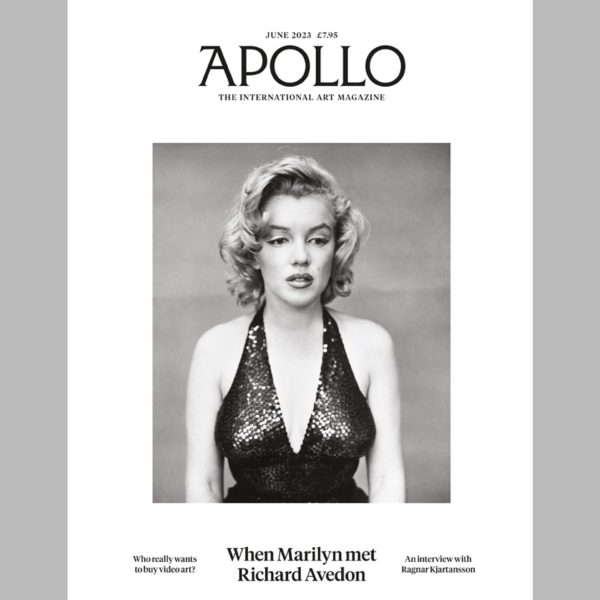
In a cover story for Apollo magazine, Phillip Prodger takes a closer look at Richard Avedon’s 1957 photograph, nicknamed ‘Sad Marilyn,’ which has become almost as iconic in the art world and beyond as Andy Warhol’s silkscreens.
“Avedon portrays Monroe as a wistful, distant figure – eyes lowered and fixed on the distance, one brow gently arched, and shoulders slumped. Through Avedon’s lens she has become a fallen angel: down, even absent; contemplative, yet drained … Here such artifice loses much of its allure, heightening the contradiction between the actress’s public appearance and her private self. The real Monroe is clearly stronger, deeper and more complex than her persona, yet her emotional state is hard to read. Is she simply tired, worn down or stressed? Is she lost in thought, or trapped in some dark existential labyrinth?
The famous photograph was one of a number made on 6 May 1957, when – still only 30 years of age – Monroe arrived at Avedon’s studio on Madison Avenue to pose for publicity shots for her new romantic comedy, The Prince and the Showgirl. She wore a favourite dress – a shimmering plum-coloured sequinned gown with plunging neckline, which she had also worn to the premiere of Baby Doll the year before and more recently at the Waldorf-Astoria’s annual ‘April in Paris’ charity ball.
Given the nuance of Avedon’s picture, and considering it was never used as a publicity shot for the film, its status as an advertising or fashion photograph is open to question … Avedon was at the forefront of those who challenged the distinction between commercial and art photography, exhibiting his work in museums and galleries while at the same time publishing in magazines.
The celebrated picture was evidently not quite as spontaneous as he suggested, since a number of variant exposures are preserved in the Avedon Archive. However, the fateful picture does contain clues reinforcing his account that it was made away from the main studio set-up. The light is full but soft, as if Monroe is positioned away from the direct glare of the studio lamps. Only tiny spots of reflected studio light (known as catch light) are visible in each eye.
During the session Avedon almost certainly used strobe lights, with which he had begun experimenting at this time, and which later became his stock-in-trade … Consequently, in Avedon’s photograph Monroe’s expression is impossibly fragile, suspended in surreal transience, as if sandwiched between inescapable layers of time. In fact, it is a moment so fleeting that it is beyond the threshold of unassisted vision.
The thin veneer of glamour momentarily lifted, Avedon found not only a compelling individual but also a person trapped in a predicament she felt powerless to escape … Yet for one brief instant – one fraction of a second in time – the whole story in all its complexity was exposed. Sad? We may never know. But she was utterly, unmistakably human. And so was Avedon.”
FYI: The article also shows a poster for The Prince and the Showgirl, in which Marilyn wore the same dress. However, as explained here, the artwork was based on an earlier sitting with Milton Greene. Nonetheless, another Avedon photograph (sans gown) was also used to promote the movie.

 The Marilyn Report
1 Comment
Comments are closed.