
The Misfits has been cited as a key influence on Wes Anderson’s latest movie, Asteroid City (see here) – and as noted by some critics, Marilyn was reportedly an inspiration for Scarlett Johansson’s role as actress Midge Campbell. Like Roslyn, Marilyn’s character in The Misfits, Midge is also a divorcee hiding out in the desert. She alludes to a troubled past and mental illness, and is typecast in tragic parts despite being, in her own words, ‘a gifted comedienne’ (rather like Marilyn’s plight in reverse.) When a photographer impulsively takes a snapshot in a diner, Midge insists on image approval.
However, Midge is not a carbon copy of Marilyn. With her cropped, black hair, she looks more like Elizabeth Taylor (although Johansson also plays a blonde actress in a parallel storyline.) Her abrupt manner is more suggestive of Kim Stanley or Joanne Woodward, who also influenced Wes Anderson’s vision of the character.
Anderson spoke about Marilyn in a recent interview for Indiewire …
“I can’t say that Marilyn Monroe has been a special fixation for me, especially knowing the struggle it sometimes was to get through the experience of making a movie with her. I love her in Some Like It Hot and The Prince and the Showgirl. Billy Wilder made two movies with her and he knew there was just no other way to get Marilyn Monroe than to go through the whole thing, to have Paula Strasberg telling her what to do behind his back. She’s this most vulnerable kind of talent where there’s something real happening in front of the camera. She’s a movie actress who goes back the other way. I don’t know that she ever played on the New York stage, but she went into the Actors Studio and tried to dig deep in that way … You know, in the end, there’s always this kind of thing around mental health. No matter how much talent somebody has, in the end, they’re still subject to however the brain works and God knows, brain trauma can come in so many forms. It’s one thing to play a scene. In a way, being an actor is pretty straightforward. But it’s an unbelievably difficult thing to find your way to being magical, to aspire to something, and find your way to it. There’s just no recipe. It’s a mixture of things you have to discover.”

A new anthology accompanying the release of Asteroid City – entitled DO NOT DETONATE – includes two chapters on The Misfits. The first, ‘Black Desert, White Desert,’ previously appeared in Serge Toubiana’s book, The Misfits: Story of a Shoot, and explores how the Magnum Photos agency documented the film’s turbulent production.

Eve Arnold and Bruce Davidson’s iconic photos of Marilyn on the set are also featured, while a second, shorter chapter reprints cult filmmaker Jonas Mekas‘s 1961 review of The Misfits for The Village Voice, headlined, ‘Marilyn Monroe and the Loveless World.’
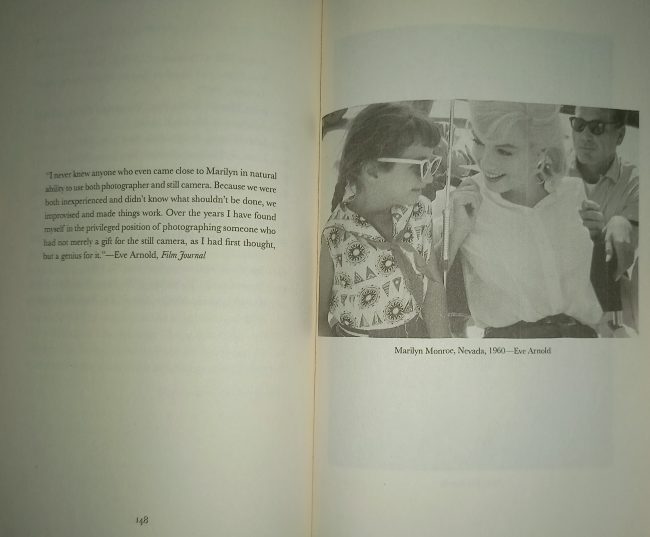
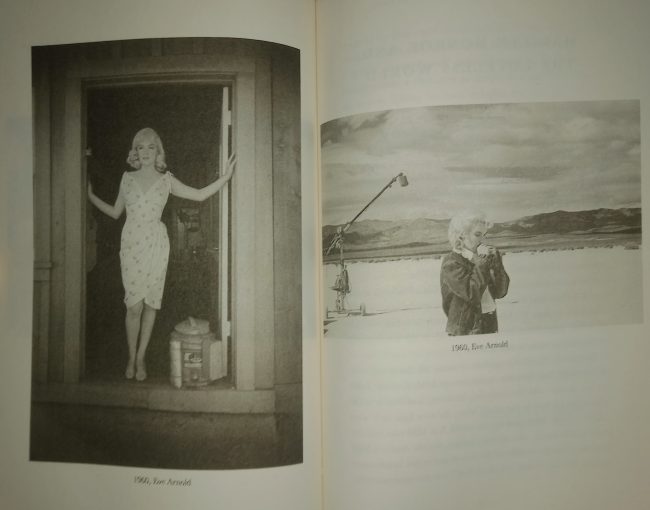
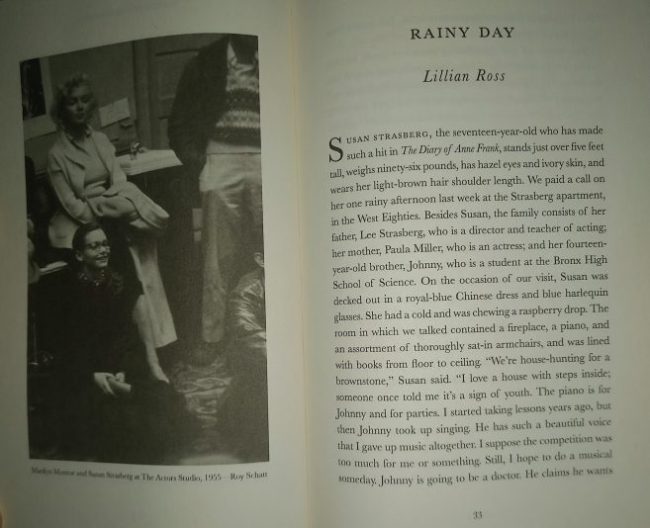
As well as the American West, the post-war New York theatre is another important influence on Asteroid City – and as Anderson relates to editor Jake Perlin, Marilyn bridged both worlds with her Hollywood background and Actors Studio years. In an extract from his autobiography, Elia Kazan recalls founding the Actors Studio with Lee Strasberg; and Roy Schatt’s 1955 photo of Marilyn in class accompanies a New Yorker profile of Susan Strasberg from the same year.
And in a new essay, ‘By the Time I Get to Phoenix,’ Thora Siemsen considers Marilyn’s first ‘Method’ movie, situated between a young Bette Davis (in The Petrified Forest, 1936) and an Oscar-winning performance by Actors Studio alumni Ellen Burstyn.
“What’s worse: being rudderless, or having a fixed but unlikely goal? Joshua Logan’s 1956 film, Bus Stop, featuring Davis’s All About Eve co-star Marilyn Monroe, is another Arizona picture about chasing the mirage. Here, the desert is no longer in black and white but photographed in CinemaScope and Deluxe Color by cinematographer Milton Krasner. Monroe plays a saloon singer named Cherie, who says at the film’s beginning, ‘If you don’t have a direction, you just keep going around in circles.’ For most of the movie, she carries around a map to remind her of her destination. Her goal is always out of reach, Phoenix as close to Hollywood as she’ll get … You could, if you like, synopsise Bus Stop and Martin Scorsese’s Alice Doesn’t Live Here Anymore (1974) the same way: a singer bound for California gets waylaid as a lounge act in Arizona before setting down with an infatuated rancher.”

 The Marilyn Report
1 Comment
Comments are closed.