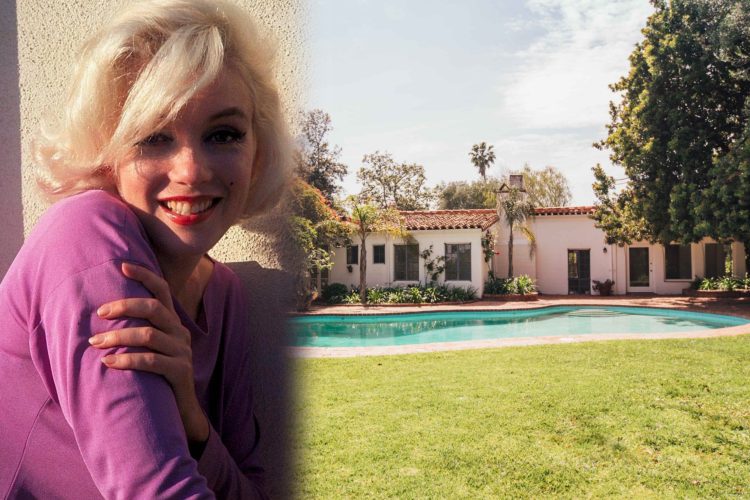
In September, it was revealed that Marilyn’s final home at Fifth Helena Drive in Brentwood, Los Angeles, had been sold, and that the buyer – who also owns an adjacent property – had filed a request to the LA City Council for permission to demolish the site. Amid widespread public outrage, the demolition has been postponed.
Since then, members of the Monroe fan community have joined the ongoing effort to save the only home Marilyn ever owned – and they have found evidence that the property’s notable connections to Los Angeles architectural history were forged long before her short-lived residency, as People reports.
“The recently formed Monroe Preservation Group are working to ensure it becomes a protected historic landmark — and they’ve made a significant discovery that could aid their cause.
PEOPLE spoke with several members — Scott Fortner, April VeVea and Elisa Jordan — who explained the group formed with a common interest: to preserve the home and the Brentwood neighbourhood’s rich history. They researched the process of protecting the property, and after many hours, realized the home bears a strong connection to the famous local architect Harbin Hunter.
‘I was going through old newspapers and ads because we knew that there was a connection to the Hunter family,’ Jordan tells PEOPLE. ‘And [April and I] both discovered at the same time that Hunter was the co-architect on the first house in Hollywoodland.’
Architect John DeLario is commonly given credit for much of Hollywood’s architectural stylings, they say. However, Hunter contributed quite a bit as well — particularly in the Spanish Colonial Revival homes that still stand today in the community that was originally erected with the iconic Hollywood (formerly Hollywoodland) sign. And much of his design is evident throughout Monroe’s house.
‘They planned the entire neighborhood together, from the layout and the housing styles and everything,’ VeVea explains of Hunter and DeLario. ‘Their most famous actual building in the Hollywoodland development was the Kanst Art Gallery, which is still standing. And when you look at that, you can see a lot of elements that were also used in the 5th Helena address.’
Records show Hunter actually lived in the home, along with his brother Asa, according to VeVea. And his parents owned the home from 1929 until 1949, before it was purchased by Deborah and Richard Pagan, from whom Monroe ultimately purchased the home in 1962.
Hunter is still an esteemed and highly respected architect in the area. Jordan adds that he has a number of landmarks in the Southern California area, including Santa Monica’s Lido Hotel Apartments, as well as Madonna’s iconic home in the Hills. Therefore, they say, tearing down a home that he styled and lived in would be a huge disservice to Los Angeles history.
‘People think this house should be saved because Marilyn lived there for six months and died there,’ Jordan says. ‘But what we’re hoping this shows is that this house actually has deep ties to the Los Angeles community. It’s actually a pristine example of the architectural styles that were popular in the 1920s.’
‘(Hunter) really defined the style for the decade,’ she adds. ‘So we want to show that this house has much more significance than [the fact that] somebody died here.’
The next step, they say, is to present their case to the city.
‘We’ve been working on a pretty extensive document that covers all of the history of the home,’ Fortner explains. ‘And our plan at this point is to submit it to officials within specific agencies throughout the city of Los Angeles who would have any influence or final decision in determining whether or not the house is going to be listed as a protected site.’
‘It’s our intention to share all of this information with those individuals making that decision so they’re fully aware of the full history of the property,’ he adds. Jordan and Fortner also go into great detail about their mission on their podcast, All Things Marilyn.”

Regular readers of this blog may already be familiar with Scott Fortner (owner of the Marilyn Monroe Collection); Elisa Jordan (author of Rockhaven Sanatorium and the forthcoming Hello, Norma Jeane: The Marilyn Monroe You Didn’t Know); and April VeVea (author of Marilyn Monroe: A Day in the Life.)
April has responded to some of the most frequently asked questions from Monroe fans in a recent Facebook post…
- The house was already saved! This seems pointless? “The house has a temporary stay as it goes through the landmarking process. This doesn’t prevent demolition, nor does it designate the home a historical landmark. If we strengthen the case for the home’s historical status, the home is more likely to get designated a historical landmark.”
- Why isn’t it enough that it was Marilyn’s home? “Because that’s not how the city works. If LA County declared every locale where someone famous passed away a historical location, there would be a whole lot more buildings still standing in Los Angeles. By showing the home’s deep ties to the community, we’re able to strengthen the case for the home’s preservation.”
- Why can’t it become a museum? “We’re big on museums, but zoning laws won’t allow it. On top of that, it’s a private neighbourhood that cannot handle the traffic. Finally, there are already complaints about unruly fans (trust me, some stories make me cringe). We need the neighbourhood on our side, not working against us. Keeping it a private residence as Marilyn intended is our best bet for preservation.”
“There’s a lot more work behind the scenes still going on both from our group and others. This is a very long process, and we’re simply at the tip of the iceberg.”
 The Marilyn Report
3 Comments
Comments are closed.