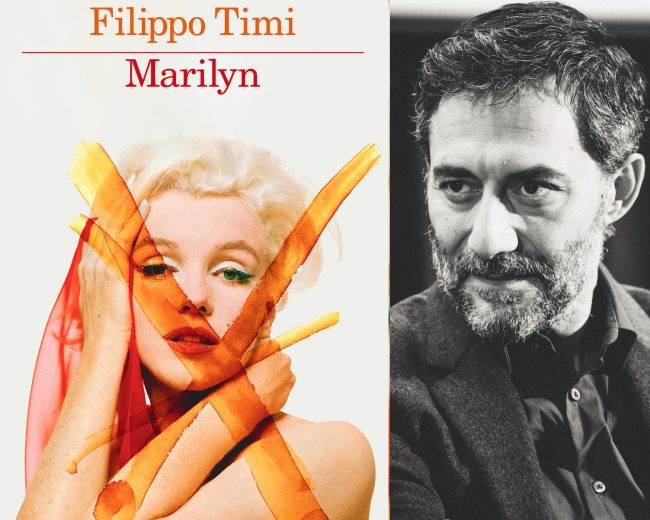
Filippo Timi is an Italian actor, writer and director, recently seen in The Eight Mountains. His latest novel, Marilyn, features a photo by Bert Stern on the cover, taken just over a month before her death. The orange ‘X’ was drawn by Marilyn herself, to signify her disapproval.
Here’s the rather florid synopsis, though it doesn’t really explain much – perhaps the meaning is lost in translation…
“Timi’s Marilyn is the uncovered dream we hide behind. A work of extraordinary and bold beauty. But also a hymn to freedom, precious in these uncertain times. Marilyn: life as a daydream.
I am Marilyn, every page of this heartbreaking story seems to say, made up of extraterrestrial and wasted beauty, of infinite and exhausted love, of the most beautiful woman who ever existed, of the saddest woman who ever lived. Marilyn is a journey between the scented sheets of a fragile soul in an atomic bomb body. Marilyn icon, Marilyn desired by men of power because she is coveted and unattainable, Marilyn lover and never wife, Marilyn whore and saint, Marilyn who survived her mother. Marilyn, life like a waking dream. Filippo Timi is Marilyn, we are all Marilyn, always between prayer and supplication. A compassionate hallucination, this book is the ultimate irruption into the mind of Marilyn Monroe. It is as if Filippo, in the moment preceding the diva’s death, said to her: ‘I’ll tell you about life as it is in some other universe. There are worlds in which goddesses are immortal and pain is impossible. You know the life you abandon, I’ll tell you about your saved life.'”
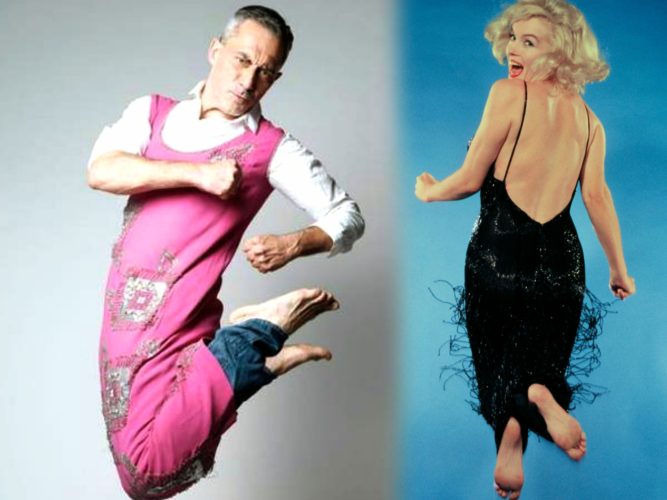
The author paid homage to Marilyn’s famous ‘Jump’ pose in a recent photo published by Corriere – possibly inspired by the current Philippe Halsman retrospective in Rome – and Timi also discusses her in the accompanying article. (Somewhat predictably, it seems that the novel also focuses on President Kennedy – although their rumoured affair is based more on fantasy than fact …)
“And so, the man who has conquered audiences in drag (‘in Italy we continue to take the damned model of the patriarchal family for granted: all discrimination originates from there and it is convenient for us men not to see certain things’), undresses the woman par excellence, Norma Jeane Mortenson Baker Monroe, to the point of leaving her lifeless and gaunt but – spoiler – alive: with a final twist Marilyn, Timi’s Marilyn, survives herself and, in disguise, leaves for Rome.
Why a book about Marilyn today, Filippo?
I perceived that there was a need to talk about a new feminine in a new way.Which new feminine? Isn’t Marilyn, with her exhibited and poignant sensuality, the eternal recurrence of a stereotype and, at the same time, an unattainable point of reference?
Marilyn doesn’t burn with current events but for the time it’s as if Barack Obama told a lie to Michelle to sneak out and take Beyoncé to bed. Boom!And what do we do with stereotypes?
With feminine sensitivity, I get where I can … We really are all Marilyn: the dress changes but the basic existential insecurity is always the same.Even the request for love, perhaps, remains unchanged forever and ever.
Every creature on the planet asks for love and understanding. What if Marilyn and Kennedy hadn’t used each other? What if it was really a great love? After all, we are talking about a man and a woman, certainly the most beautiful woman in the world and the president of the United States of America, but still two human beings … Marilyn is more the embodiment of something extraordinary, she is exhibited by men like a figurehead on a ship’s mast. It must not have been easy at all to be Marilyn: from the Big Bang, through toxic clouds and dinosaurs, think with how much haste she was born…From what signs do we realise that Marilyn is alive in 2023?
The living are the immortality of the dead. As long as my mother Luciana’s smile is present in me, she will be here with me. I have the great power to make her live forever: this thought alleviates my sense of helplessness.”
And finally, another interview for La Stampa…
“Why the title?
We are all a bit of Monroe, the blonde diva and the duckling Norma Jean. Under all the glitter in the world you will always find that desire to be loved and be happy.Why did you choose Marilyn?
She is to the cinema what Hamlet is to the theatre: everything. I wanted to give her a little revenge: to free her from the reductive image and gratuitous prejudices. She is an icon and the opposite of her, a normal person … Of such evident fragility that you feel compelled to protect it, but there is also a much more carnal desire. It is empathy, attraction and pain. Exactly: she is everything, like Hamlet.Another female presence looms large in the book, Jackie, the wife of the man she loves. Why do you attribute the big twist in the finale to her?
Can I say that I like that ending? There is dignity in them. I could never choose between Marilyn and Jackie. Only a woman can understand another woman.Marilyn was the victim of quite a bit of violence, psychological and otherwise. One thing that doesn’t change, unfortunately. How come?
I think that women have always suffered too much violence. The difference is that we talk about it more. And this is good because it can lead to a gradual awareness. It is true, certain declarations condemning violence are banal, but they must be reiterated … What is happening politically in the country, certain positions taken not only by men, seem to belittle women, almost as if there is fear that power will slip out of the hands of those who have it and pass to others.You talk about a Marilyn who gets back up.
It is a healthy and natural attitude, learning from what happens to us and getting back up. I do it: I stop, I cry, I vent and then I get up on my own. It’s what makes you grow. Pain can flatten time, but at the end of a long night there is always the light of day.”
 The Marilyn Report
2 Comments
Comments are closed.