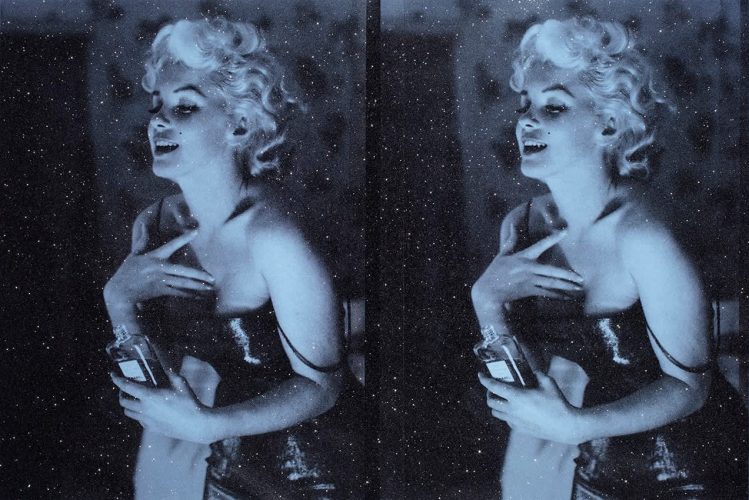
Marilyn is among the 20th century icons featured in pop artist Russell Young’s latest exhibition, Dreamland, now open at London’s Maddox Gallery until February 7, 2024. Seen above, ‘Marilyn Chanel Diptych’ is an acrylic, oil based ink and diamond dust hand-pulled screenprint on linen. It is based on a 1955 photo of the star dabbing her favourite perfume, and influenced by Andy Warhol’s ‘Marilyn Diptych’ created after her death in 1962.
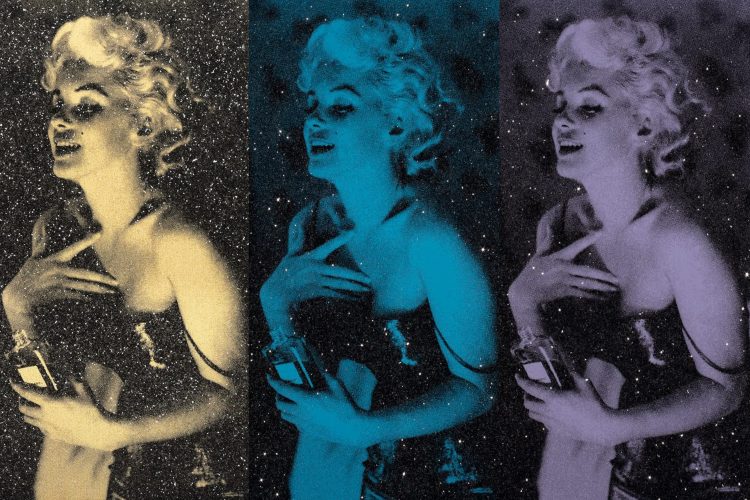
The ‘Marilyn Chanel’ image features in three other works: ‘Hollywood Chalk White’; ‘Superstar Ocean Blue’; and ‘Superstar Wysteria’. Although the original photo seems to epitomise Hollywood glamour, it was actually taken shortly after Marilyn’s departure to New York, as she fought against a restrictive studio contract.

Working on a magazine assignment, photographer Ed Feingersh captured the moment in Marilyn’s Ambassador Hotel suite. However, many images from the shoot remained unpublished for decades – and Russell Young’s recolouring of this grainy black-and-white photo transforms its subject into a proto-Warhol superstar.
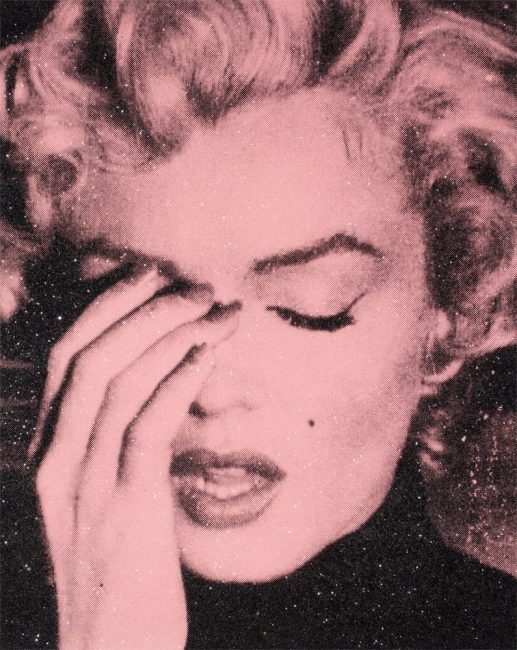
The exhibition also features a new rendition of Young’s best-known portrait, ‘Marilyn Crying’ – based on a photo taken by George Silk in 1954 during a press conference outside Marilyn’s Hollywood home, as she announced her separation from husband Joe DiMaggio. A bruise is visible on her forehead, as previously seen on the cover of Anthony Summers’ controversial bestseller, Goddess: The Secret Lives of Marilyn Monroe (1985.)
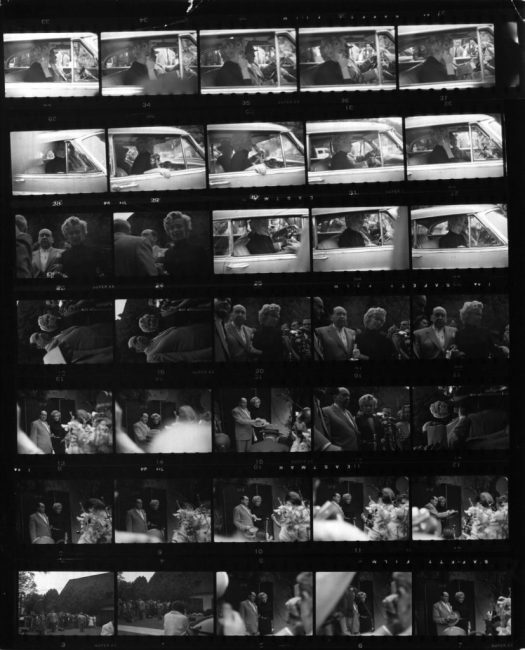
“She looks stunning, but that is a small section of a huge photograph,” Russell told the Evening Standard. “In the original you can see paparazzi, there’s a car and her lawyer in the background; it’s pure chaos … The deeper you delve into an image, the bigger the story is, and I wanted to capture Marilyn’s beauty and pain in that moment.”
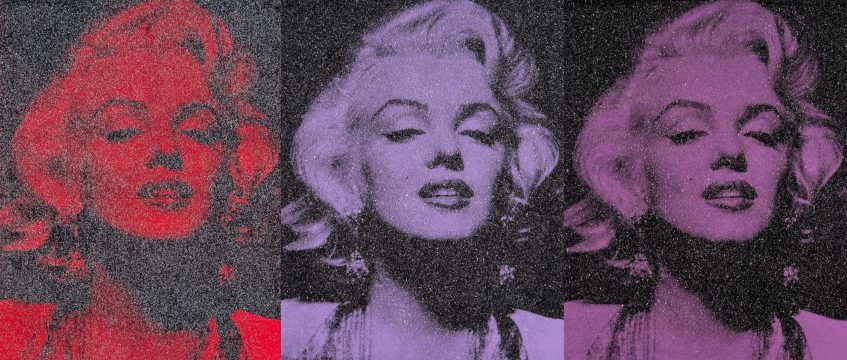
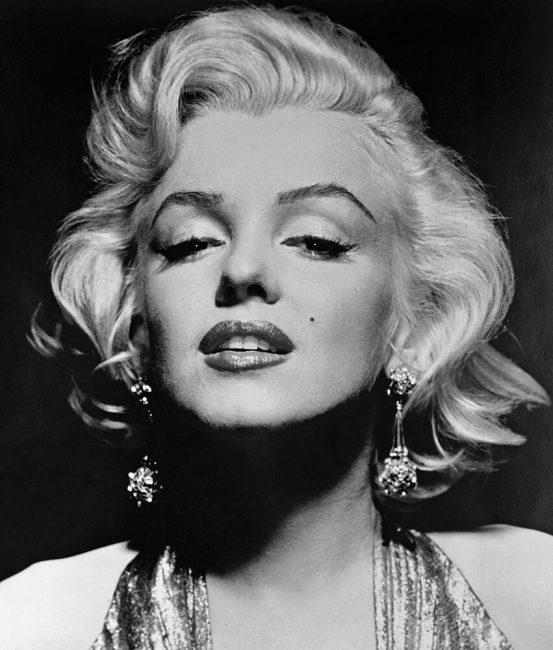
And finally, Gene Kornman’s headshot of Marilyn in her famous gold lamé dress (while promoting 1953’s Gentlemen Prefer Blondes) is featured in another series, ‘Marilyn Portrait California’, titled separately, ‘Sunset Scarlet & Black’; ‘San Vincente Lavender & Black’; and ‘Beverly Lavender & Black.’ Unfortunately, the original photo has been flipped. This is a common error and may not have been deliberate, but it speaks to how frequently Marilyn’s image has been remade – and perhaps distorted – in life and death.
‘Sunset’ recalls Sunset Boulevard, both geographically and cinematically, as Marilyn’s best director, Billy Wilder, used the name for his dark satire on fading stardom; while ‘Scarlet & Black’ evokes Maurice Stendhal’s classic novel, featuring a protagonist who rises to greatness from humble origins, but ultimately self-destructs. ‘Beverly’ may allude to the Beverly Hills Hotel, where Marilyn frequently stayed; and San Vincente Boulevard is close to her final home in Los Angeles, while the two lavender shades highlight her posthumous status as a gay icon.
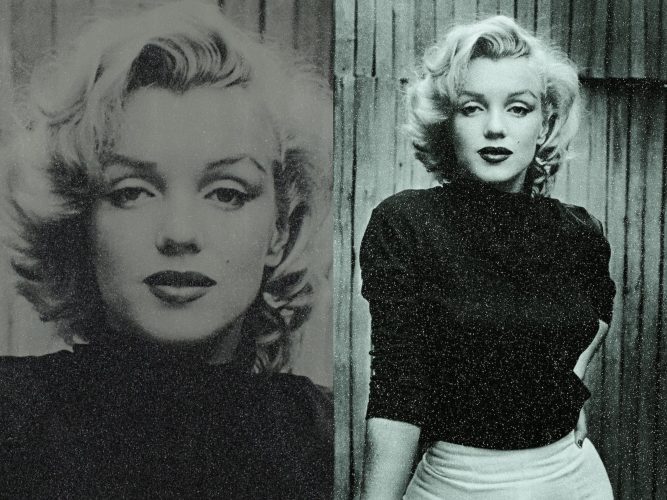
Further screenprints available for purchase include ‘Marilyn Hollywood’ (2021) and ‘Marilyn Bombshell’ (2019), both featuring an image from LIFE photographer Alfred Eisenstaedt’s 1953 shoot at Marilyn’s Doheny Drive apartment.
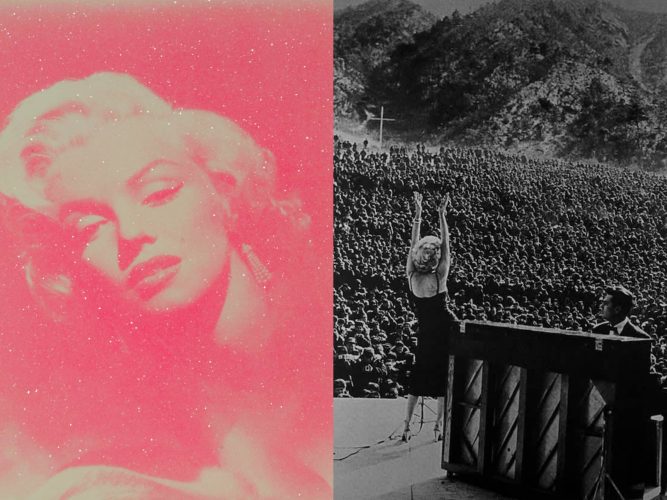
‘Marilyn Glamour’ (2010) is based on a 1953 studio portrait, usually attributed to Frank Powolny; while ‘Marilyn in Korea’ (2011) shows Marilyn singing for the troops during her 1954 tour.
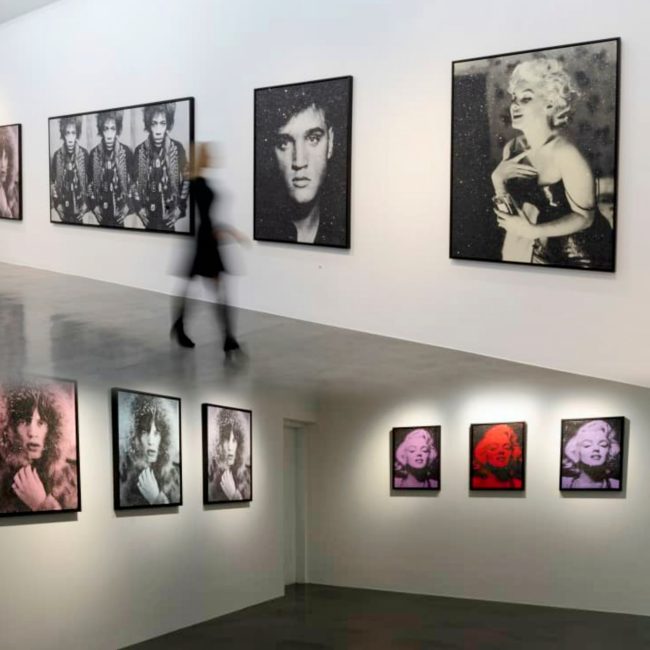
Marilyn appears alongside other movie icons, including Audrey Hepburn, Marlon Brando, James Dean, Brigitte Bardot, and the Magnificent Seven cast; rock stars from Elvis Presley and the Beatles to Mick Jagger, Jimi Hendrix, and David Bowie in The Man Who Fell to Earth; prizefighter Muhammad Ali; and supermodel Kate Moss.
“It is often those who are born without a history who feel the most compelled to explore it. This is one explanation for British-American artist Russell Young’s obsession with the American Southwest, and California in particular. Adopted at a young age, his knowledge of his ancestry is vague. Yet rather than dwelling on this fact, it has empowered Young to create a career, an identity and a home on the California coast, and evolve as an artist without obstacles to become the pre-eminent interpreter of images in American film and music history.
‘Dreamland’ at our new Berkeley Street gallery in Mayfair marks the next chapter in Young’s exploration of celebrity … Exploring themes of seduction, desire and beauty, simmering just below the glossy facade of his diamond-dusted works is a dissection of the American Dream and the dark side of fame. At the height of their stardom, these icons seemingly had it all, yet their lives were tinged with tragedy and, for many, the fame they chased proved to be their downfall.
When Young discovers images that draw him in, he devours them, appropriates them, alters them, colours them, translates them and transforms them to such an extent that they become his. Depicted in the sun-drenched colours of California, his art is hand-pulled on canvas or linen using a Warholian silkscreen printing technique, with the artist mixing the paints himself from pigments he has gathered from all over the world. Where there are a series of impressions of a given work, each is a unique piece, with the quality and and quantity of the layers of paint, and the application of diamond dust, differing for every impression.”
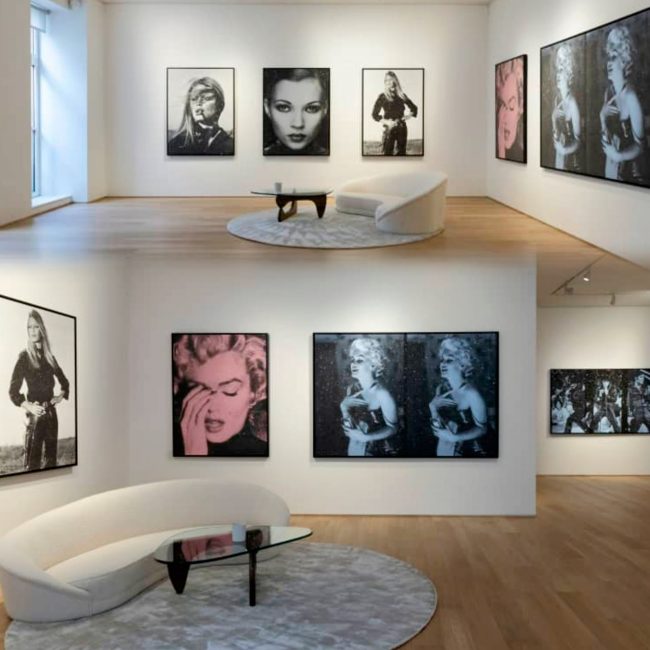
You can read more about Russell Young’s art here and at The Marilyn Archive.
 The Marilyn Report
1 Comment
Comments are closed.