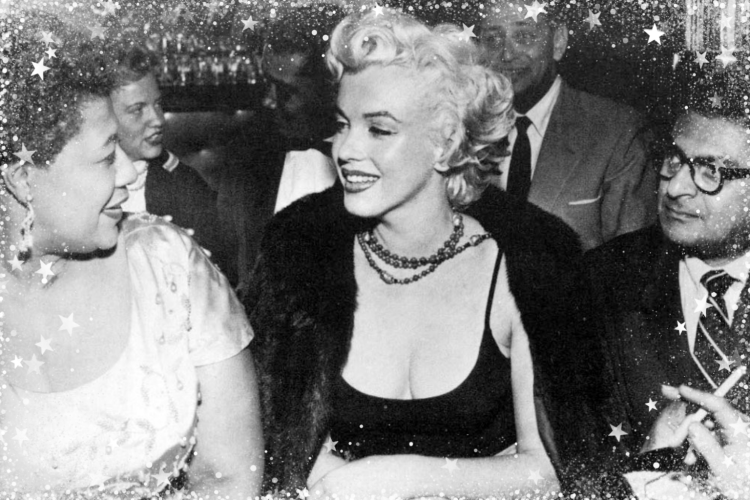
The friendship between Marilyn and Ella Fitzgerald has inspired plays, children’s books, and even an episode of TV’s Drunk History. However, the true story of how they met has often been exaggerated. In her new biography, Becoming Ella Fitzgerald, author Judith Tick sets the record straight.
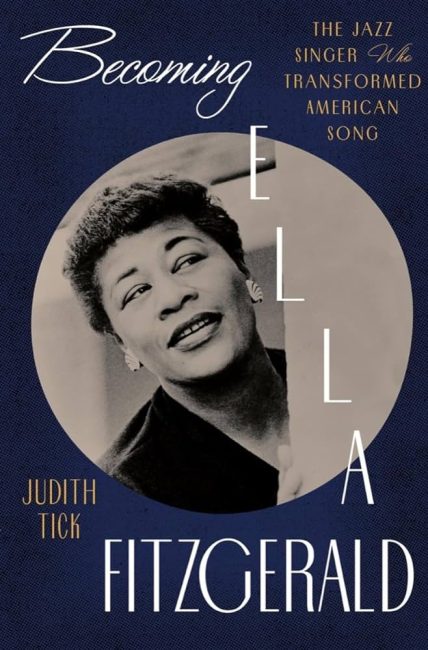
Born in 1917, Ella made her stage debut in 1934; by the 1940s, she was America’s most eminent jazz singer. Like other black artists, however, she encountered discrimination at every turn; and despite her success, was unable to secure more lucrative engagements outside the jazz club circuit.
In 1954 Ella hired a new manager, Norman Granz, and performed at the first Newport Jazz Festival, followed by a tour with Jazz at the Philharmonic (JATP) – and that’s where Marilyn comes in…
“‘Breaking through’ meant confronting the stigma around jazz, not only as Black music but as a lower-class form of expression … Granz had weathered this kind of criticism in producing his JATP concerts, and he understood it was time for Fitzgerald to inhabit the ‘class nitery,’ the ‘upper-crust’ nightclub, the ‘posh’ or ‘plush’ room in a five-star hotel. Class-consciousness in the 1950s, fuelled by rising affluence, meant conspicuous fun for grown-ups. Among those elite venues whose floor shows received regular reviews in Variety were the Waldorf Astoria and the Copacabana in Manhattan, the Fontainebleau in Miami, the Mocambo and Ciro’s in Hollywood, the Fairmount Hotel in San Francisco, and the Flamingo, Sands, and New Frontier in Las Vegas. Some had already hired prominent African American entertainers from the worlds of popular music and film, an elite group that included the elegant singer Nat King Cole and exceptionally beautiful women such as Lena Horne, Eartha Kitt, and Dorothy Dandridge. Dandridge confided to a friend, ‘Ella Fitzgerald is one of the most talented people in the world, and it embarrasses me that she cannot work the rooms that I work. The reason for it is so horrible. She’s not sexy.’ Despite the old fear Fitzgerald had expressed as ‘When a girl looks like me …,’ Granz was certain that together they could transcend this career obstacle …
Ella was in top form, brimming with jazz originality, luxuriating in her rich vibrato on love songs. Updating her repertoire, she included two new showtunes from the Broadway musical Pajama Game – a tender rendition of ‘Hey There’ and an inventive version of ‘Hernando’s Hideaway,’ sparked especially by Buddy Rich on drums and delighting the audience … The mammoth tour closed at the Shrine Auditorium […] with Ella bowing out early to open at the Tiffany Jazz Club in Los Angeles on November 5. A Billboard reviewer wrote, ‘It’s love at first song between Ella Fitzgerald and the jazz crowd at the murky Tiffany Club’ with its ‘tight quarters,’ where she sang her JATP repertoire plus her impersonations and novelties. But for better or worse, it was a jazz club, and she said so to her local press agent, Jules Fox, as he reported many years later in his memoir: ‘Jules, I know I make lots of good money at the jazz clubs I play, but I sure wish I could play at one of these fancy places,’ along Sunset Strip in Hollywood.
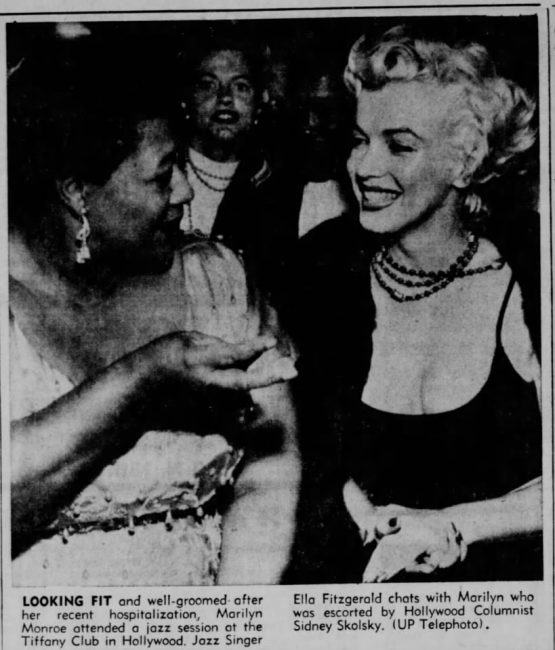
Who would have expected a dea ex machina from Hollywood to fulfil her wish? In mid-November, accompanied by the photographers who followed her everywhere, Marilyn Monroe turned up at the Tiffany Club. Photos of the two women in conversation soon appeared on AP and UPI wires, running in newspapers across the country. As the captions made clear, Monroe was in the midst of a separation from her husband, Joe DiMaggio, and was now out and about after a minor surgery. For Monroe’s fans, Ella was a prop, although a useful reminder of Monroe’s successful debut as a singer in the film musical Gentlemen Prefer Blondes. That film, in fact, had introduced Monroe to Fitzgerald’s art; as one of her coaches [Hal Schaefer] suggested, she listened to no other artist in preparation. That made her a fan.
For Fitzgerald’s fans, that encounter sparked a friendship and an intervention that led from the Tiffany Club in November to the glitzy Sunset Strip celebrity nightclub, the Mocambo, in March 1955. Monroe promised the Mocambo owner, Charlie Morrison, her presence front-row centre during Fitzgerald’s booking. It seems likely that Monroe reneged, but that mattered little once the contract had been signed. In May 1955 Down Beat described Monroe as Ella Fitzgerald’s ‘ardent’ fan.
In a 1972 article, Fitzgerald recalled not quite accurately: ‘I owe Marilyn Monroe a real debt … She personally called the owner of the Mocambo and told him she wanted me booked immediately … She told him, and it was true, due to Marilyn’s superstar status – that the press would go wild. The owner said yes, and Marilyn was there, front table, every night. The press went overboard … After that, I never had to play a small jazz club again.’
Fitzgerald added that Marilyn was ‘an unusual woman – a little ahead of her times. And she didn’t know it.’ Ella could have been talking about herself.
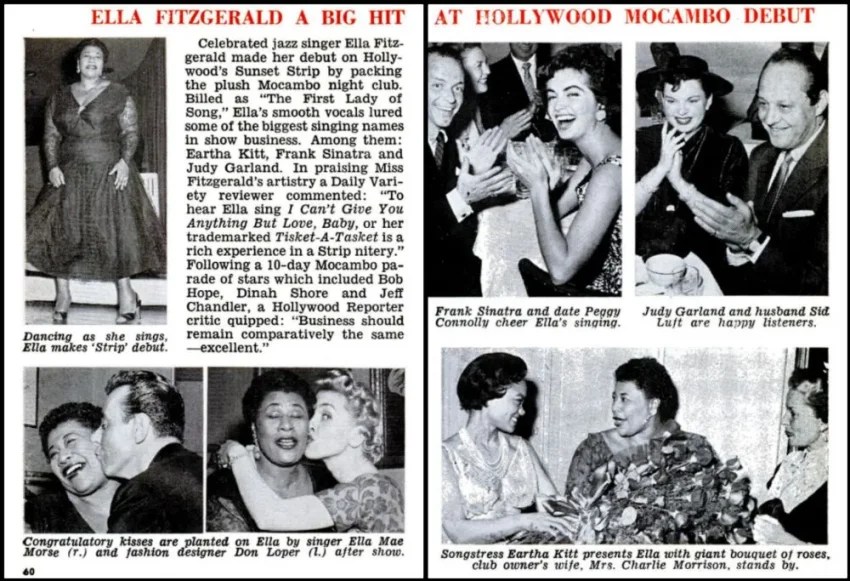
In reviews of her Mocambo appearances, the issue of jazz as an obstacle to success surfaced consistently. ‘In her first mainstream date on the Sunset Strip, Ella Fitzgerald surprises the odds makers to score a resounding success,’ wrote Billboard. ‘Ella offers a class act, not the up-tempo, driving scat she might give out with at the Blue Note or Birdland.’ Yet the ‘class act’ barely differed from her JATP setlists, although she had cultivated more ballads in her repertoire, and at the Mocambo she included her modernist version of ‘Lover, Come Back to Me,’ reprised from the Newport festival. Photos of Ella’s Mocambo engagement in Jet magazine showed her with white Hollywood celebrities Frank Sinatra and Judy Garland.”
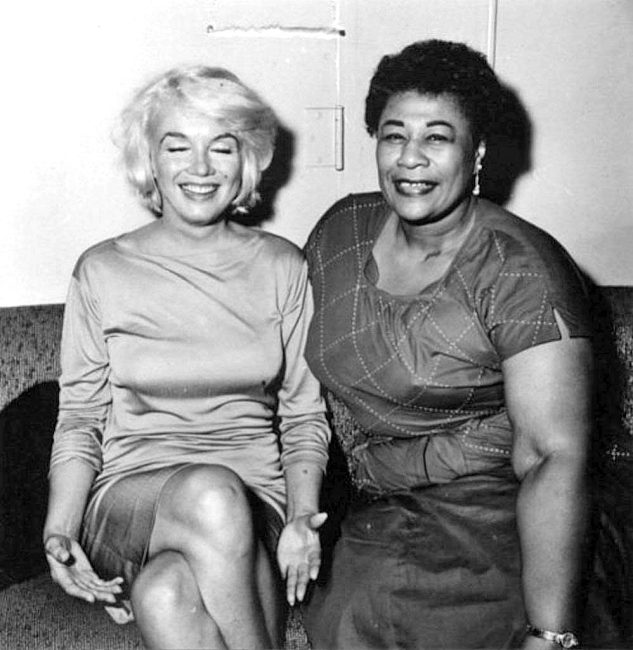
Among the sources cited by Judith Tick is April VeVea’s excellent article about Marilyn and Ella, which you can read here. Marilyn left Hollywood for New York in December 1954 and would not return until February 1956. While her promise to attend Ella’s show ‘every night’ may have helped to secure the Mocambo booking, her departure from LA – amidst a bitter legal battle with Twentieth Century-Fox – meant that she had to cancel those plans.
Neither was it the case that Charlie Morrison had been reluctant to book Ella on racial grounds, as some have assumed. In fact, the Mocambo regularly hosted black artists. It’s more likely that, as Dorothy Dandridge suggested, Ella wasn’t ‘sexy’ enough for an upscale cabaret venue; and her jazz background may also have worked against her. Ella proved the naysayers wrong, though she would still face prejudice elsewhere.
It’s unclear how much contact Marilyn and Ella had after their meeting at the Tiffany Club. However, they were photographed together once more in 1961; and both performed at the Democratic fundraising gala for President John F. Kennedy’s 45th birthday at Madison Square Garden in 1962. After Marilyn’s death, an undated Christmas card from Ella was found among her personal effects.
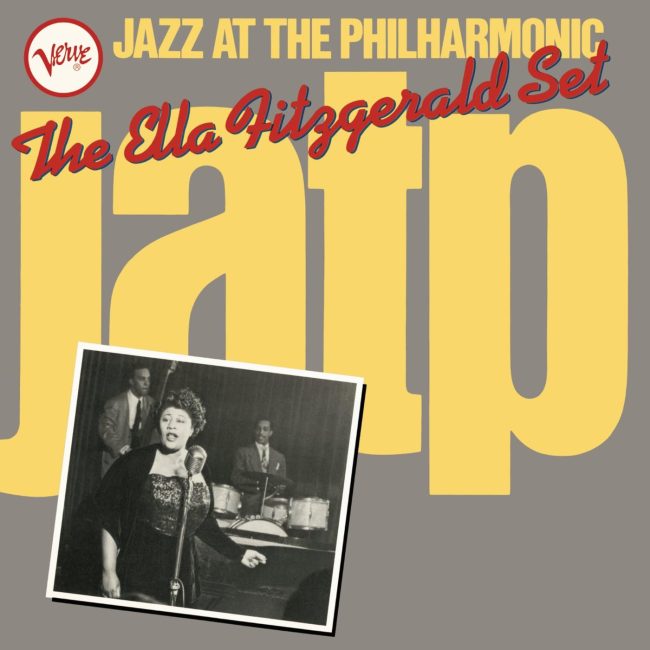
Jazz at the Philharmonic: The Ella Fitzgerald Set, available on CD, vinyl and digital formats, includes a set from 1954: ‘A Foggy Day (in London Town)’, ‘Lullaby of Birdland,’ ‘The Man That Got Away,’ ‘Hernando’s Hideaway,’ and ‘Later’ are featured, giving us a flavour of what Marilyn heard Ella sing at the Tiffany Club.
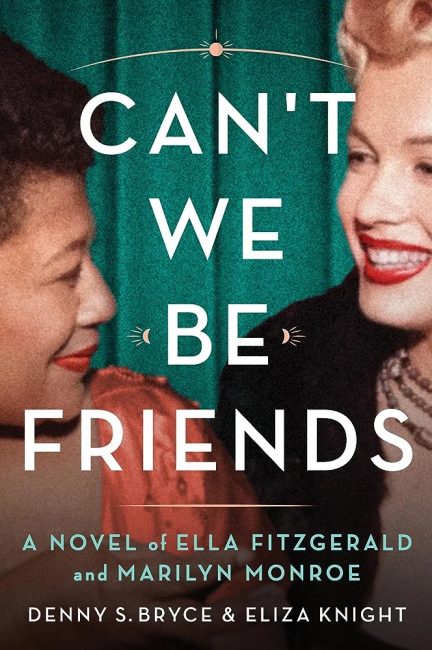
And finally, going from fact to fiction: Marilyn and Ella are the dual subjects of Why Can’t We Be Friends, a collaborative novel by Denny S. Bryce and Eliza Knight, due for release in March 2024.
 The Marilyn Report
1 Comment
Comments are closed.