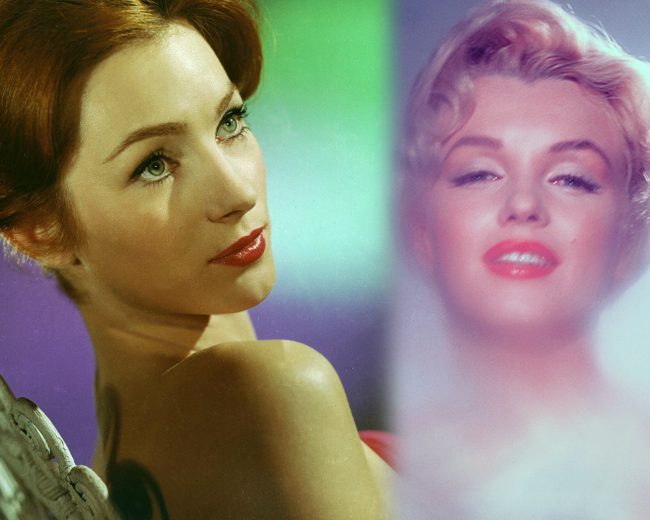
Shirley Anne Field, once described as ‘the British Marilyn Monroe’ – although not the first, or last actress to inspire the comparison – has died aged 87. Born Shirley Broomfield in London’s East End, she was placed in a children’s home in Lancashire at the onset of World War II, and would not return until 1951.
“I always had a division with my name because I remembered, before I was separated from my family, my father didn’t want – and this is his expression – ‘any bleedin’ film stars’ in his family, or ‘any bleedin’ film stars’ names,'” she told the Yorkshire Post in 2012. “But my mother, an Irish beauty from the East End, was desperate to have [that]. My oldest sister was called Joy, my youngest sister was called Sonny, or Sonja, after Sonja Henie, I guess, and I was after Shirley Temple. So he called me Anne or Annie; she called me Shirley. I’m the youngest – the third sister. Funny thing, he was sort of prejudiced against the film business early on and I ended up in it.”
She started her career as a pin-up model, appearing in magazines like Blighty and TitBits, until film director Val Lewton suggested she try acting. She was signed to an agency run by agent Bill Watts, whose star client was Joan Collins. “I was the youngest and Joan Collins was possibly the oldest,” Shirley recalled. “But we all wanted to be like her because she had a pink sports car, lived in Hollywood and earned £120 a week!” One of Shirley’s first screen appearances was a small role in Yield to the Night (1957), starring Diana Dors – perhaps the first ‘British MM’ (although Diana’s fame preceded Marilyn’s.)
“It’s a horrible experience being a teenager in the film industry: you’re exposed to all the wrong influences. It was a very predatory world, you were always at risk. I felt like a piece of meat just being picked for the way you looked and the shape you were. I felt exploited but I don’t know what else I could do. I didn’t know that I [was attractive]. I’d been invisible all my childhood until I was 15. When people used to shout out I couldn’t believe it.”
By 1959, Shirley was thoroughly disillusioned and ready to quit acting – but then she was cast as beauty queen Tina in The Entertainer, directed by Tony Richardson, and starring Laurence Olivier. The film was based on a 1957 play by John Osborne, the ‘angry young man’ whom Arthur Miller had recommended to Olivier during filming of The Prince and the Showgirl in 1956. The play revived Olivier’s career, and the film made Shirley a household name.

“I wasn’t impressed with Olivier when I met him. I’m in bed with him, filming in a caravan. And he starts talking. ‘Now who’s your favourite actor or actress, dear? I said ‘Marilyn Monroe’ and he went off into a fit. ‘Dreadful girl! Never shows up on time!’ So we get over that. Two days later he again tries, very patronising. ‘Who else do you admire?’ So I said ‘I love Vivien Leigh’ and he went into a fury. He was horrible.
I got out of his bed and said ‘I’m not staying here with you. Every time you ask me something and I answer, you’re always rude’ and I went and sulked. Tony came mincing over and said ‘What’s the matter, darling?’ and I went ‘I’m not staying in bed with him, he gets on my nerves.'”
Olivier eventually apologised, and after seeing the daily rushes, was so impressed that he invited Shirley to join his prestigious Old Vic theatre company. Still lacking confidence in her talent, she declined the offer.

In 1960 alone, Shirley appeared in three major films: the cult teen flick, Beat Girl; the controversial thriller, Peeping Tom; and Saturday Night and Sunday Morning, the kitchen sink drama which made a star of Albert Finney. But it was a lesser-known short feature, Lunch Hour (1962), that The Guardian‘s Peter Bradshaw considers her masterpiece.
“Shirley Anne Field had the kind of ingenue English-rose freshness and beauty that the British cinema loved in the 50s and 60s – it had something feline about it, a kind of innocent-fatale. Hers were the kind of looks that always introduced an almost unintentional note of innocence and poignancy into the tough dramas and kitchen-sink pictures in which she was cast; she had something of the model agency and deportment school and yet also the pin-up mag.”
Shirley went on to star with Steve McQueen in The War Lover (1962) and with Michael Caine in Alfie (1966.) In 1967, she married racing driver Charlie Crichton-Stuart, and their daughter, author Nicola Gill, was born two years later. The marriage ended in 1975.
In later years she was seen mostly on television, including a stint on the US soap opera, Santa Barbara; plus guest parts in Murder She Wrote, The Bill, and Last of the Summer Wine. She appeared on the stage, and in critically acclaimed films such as My Beautiful Laundrette (1985) and Hear My Song (1991.)
“She is so beautiful still that she stands out on the screen and breaks your heart,” said director Stephen Frears. “It is iniquitous; a tragedy that she hasn’t been used more.” Her autobiography, A Time for Love, was published in 1991.
“I didn’t have a strong sense of identity when I was growing up because I’d lost it along with my family. I hung on and the film industry literally saved me from despair because they all accepted me. I don’t think one has to be a diva and I’ve never been a bitch. I think you have to have lesser talent to be a bitch. I’m a fighter. My biggest weakness is that I always want a level playing field. It drives me mad.”

 The Marilyn Report
1 Comment
Comments are closed.