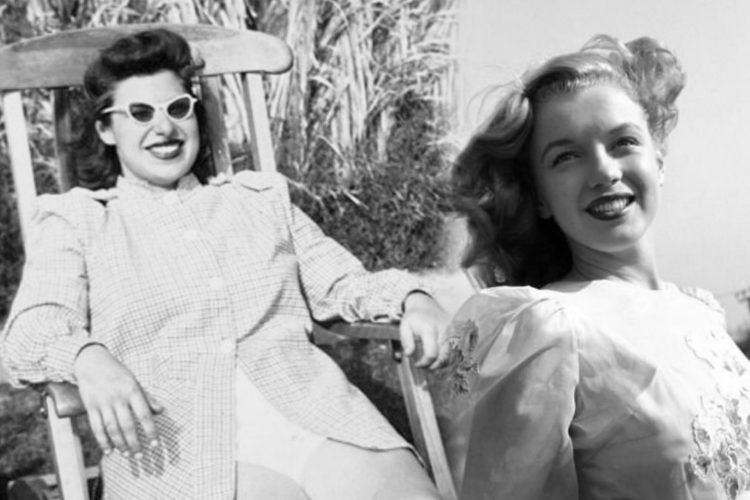
Screenwriter Norma Barzman – the oldest survivor of the Hollywood blacklist (with an intriguing connection to Marilyn) – died aged 103 in her Beverly Hills home on December 17, 2023.
Born Norma Levor in New York City, she studied at Radcliffe College in Cambridge, Massachusetts and was briefly married to mathematician Claude Shannon, known as the ‘father of information theory.’ After their divorce, Norma moved to Los Angeles and took classes at the School for Writers.
In 1942, Norma married the Canadian writer, Ben Barzman. They would raise seven children together. A year later, Norma joined the American Communist Party. “One should be proud to have been a member during those years,” she told the Los Angeles Times in 2015. “Hitler was invading the Soviet Union, so there was no reason to be anti-Russian, they were our allies.” However, after World War II ended, the House Un-American Activities Committee began investigating Hollywood figures with leftist affiliations.
The Barzmans collaborated on the story for Never Say Goodbye (1946), a romantic comedy starring Errol Flynn. Norma was also an uncredited writer for The Locket, a well-regarded film noir with Robert Mitchum among the cast.
In October 1947, comedian Groucho Marx warned the Barzmans that they were under suspicion. Norma took up the story, including her subsequent encounter with a young Marilyn Monroe, in a 2022 interview for Film Talk. At this time, Marilyn was 21 years old and had recently been dropped from her first contract at Twentieth Century-Fox. She was scraping a living through modelling, and making the rounds of auditions and Hollywood parties.
“So Ms. Barzman and her husband were out there, sitting on the lawn of their home on 1290 Sunset Plaza Drive in Beverly Hills, having a cool drink, and they were waiting for their children to come home. There was a hot Santa Ana wind blowing, and the housekeeper had taken the children to the beach, so they could get some fresh air. Suddenly, a convertible—an elderly Cadillac—with a beautiful blonde woman came up the hill and pulled up their driveway. They looked at her because they didn’t know who she was or what was happening. The woman got out of her car, and walked a couple of steps; she looked nervous and scared. Ms. Barzman asked her if she was okay. But the young woman said that she was stopped at the bottom of the hill by two sheriff’s cars; they were stopping every car that was going up and asked everyone if they were going to number 1290 because that house was under surveillance. ‘I thought I ought to warn you,’ the young woman said to the Barzmans. She was going up the hill to Judy Garland’s house for a cocktail party. Ms. Barzman remembered that she shook the young lady’s hand and said, ‘My name is Norma.’ ‘Ooh, my name is Norma too.’ Then she got back in her car and left. Ms. Barzman then wanted to call her mother and tell her about what had happened. ‘When I picked up the phone, I heard a conversation, a phone call, that I had with a friend of mine two days before. I could hear it playing back. Then I put down the phone because I realised that my phone was tapped and I knew they were watching us.’
A few years later, when in exile in Paris, her husband was reading the Herald Tribune and he spotted a familiar face: it was Norma, the blonde who had tipped them off about the surveillance. She was an aspiring actress who had played small and supporting roles. Her name was Marilyn Monroe. Ms. Barzman said, ‘So Marilyn Monroe came to warn us.’”
In 1948, Ben Barzman wrote The Boy With Green Hair, an allegory for racial prejudice. Soon afterwards, Norma left the American Communist Party and the couple fled to England, where Ben wrote Give Us This Day (1949). After their return to Hollywood, director Edward Dymytryk named the Barzmans as ‘fellow travellers’ while under investigation by HUAC in 1951.

The family relocated to Paris, where they befriended actress Simone Signoret and her husband, singer Yves Montand. Ben’s U.S. citizenship was revoked from 1954-63, but he continued to write for movies in Europe, while his contributions to American films went uncredited.
The Barzmans returned to Los Angeles in 1976. After Ben died in 1989, Norma admitted that her own screenwriting career had been stymied by the sexism of 1940s Hollywood as much as the blacklist. In later years, she published a memoir, The Red and the Blacklist, and campaigned to restore film credits to other victims of the blacklist.
 The Marilyn Report
3 Comments
Comments are closed.