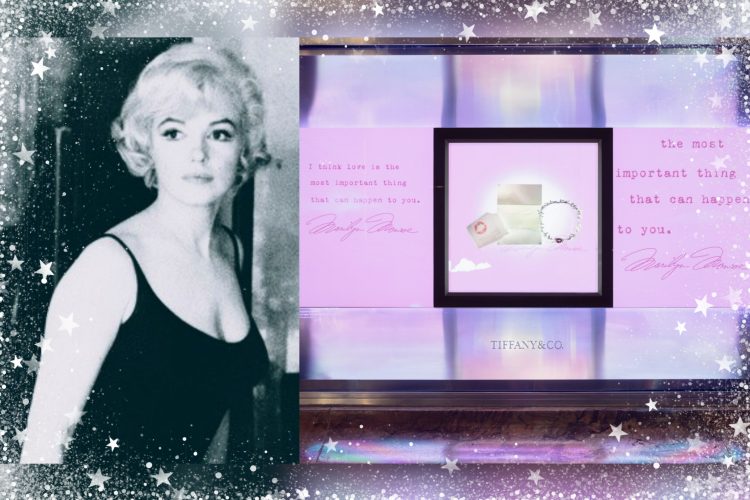
Marilyn may have sung Tiffany’s praises in Gentlemen Prefer Blondes (1953), but offscreen she preferred love to diamonds. And for this St. Valentine’s Day, a note from Marilyn – reading, ‘I think love is the most important thing that can happen to you‘ – is on display in the jeweller’s flagship Fifth Avenue store in New York, as Town & Country reports.
“Alongside Monroe’s sentiments are four other never-before-seen love letters penned by celebrities and friends of the brand … The love letters are displayed alongside a plethora of Tiffany’s jewellery because what’s Valentine’s Day without a little sparkle? The Landmark, and select stores across the country, will also feature an interactive experience from February 10 to February 14, where clients, too, can showcase their own love letters to the world.”
However, Marilyn’s note is not from a love letter – ‘sent in 1962 and sealed with a kiss’, as the article states – but a 1960 interview for the French magazine, Marie-Claire. Scott Fortner picks up the story in an Instagram reel (including Marilyn’s original audio) for his Marilyn Monroe Collection.
“I recently partnered with @tiffanyandco as part of their Valentine’s Day promotion, ‘Tiffany Love Letters.’
For this campaign, Tiffany scanned a piece of Marilyn Monroe’s personal stationery from my collection, and then added a Marilyn quote and signature. This item is now displayed in the window of their ‘Landmark Store’ in Manhattan.
The quote used by Tiffany reads, ‘I think love is the most important thing that can happen to you.’ This comes from a 1960 interview Marilyn had with Georges Belmont during filming of Let’s Make Love. The quote used for the campaign is a paraphrase of Marilyn’s actual words, which were, ‘It’s one of the most important things that ever happens to us, I think the most important thing.’ I’ve included her actual words from that interview with this video.
Marilyn’s personal stationery is light pink in colour, and measures 6”x9”. ‘MARILYN MONROE’ is embossed at the top, and also on her matching pink envelopes.
(Tiffany is also displaying what ‘might be’ Marilyn’s actual lip print from the 1962 Kennedy Birthday Gala at Madison Square Garden. It’s originally from the Robert Champion collection. We all now know the truth about his Marilyn Monroe hair from that event.)
Fun Fact: Did you know that Truman Capote originally wanted Marilyn to play the role of Holly Golightly in Breakfast at Tiffany’s? Marilyn turned down the film on the advice of her acting coach, Lee Strasberg. He thought this role would be bad for Marilyn’s public image.”
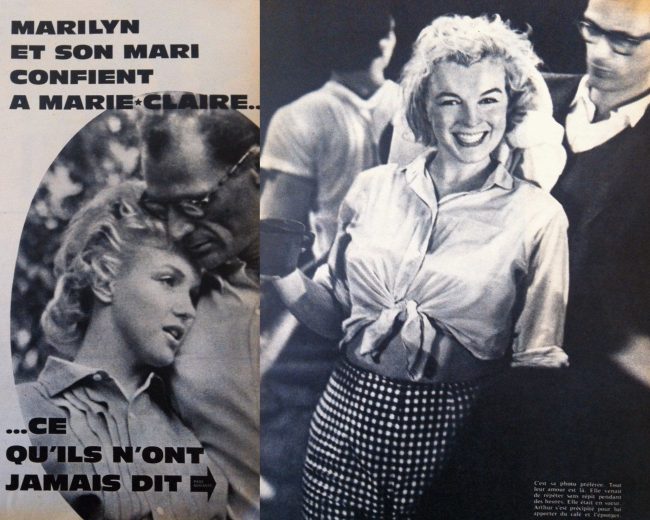
A transcript of the 1960 interview was published in Marilyn Monroe and the Camera (1989.) Following translation into French (and back again into English), here are Marilyn’s thoughts on love (and work), presented in a broader context.
“Love and work are the only things that really happen to us. Everything else doesn’t really matter. I think that one without the other isn’t so good – you need both. In the factory, though I worked so fast because it was boring, I used to take pride in doing my work really perfectly, as perfectly as I could.
And when I dreamed of love, then that was also something that had to be as perfect as possible.
When I married Joe DiMaggio in 1954, he had already retired from baseball, but he was a wonderful athlete and had a very sensitive nature in many respects. His family were immigrants and he’d had a very difficult time when he was young. So he understood something about me, and I understood something about him, and we based our marriage on this.
But just ‘something’ isn’t enough. Our marriage wasn’t very happy, and it ended
in nine months.My feelings are as important to me as my work.
Probably that’s why I’m so impetuous and exclusive.
I like people, but when it comes to friends, I only like a few. And when I love, I’m so exclusive that I really have only one idea in my mind.
Above all, I want to be treated as a human being.
When I met Arthur Miller the first time, it was on a set, and I was crying. I was playing in a picture called As Young As You Feel, and he and Elia Kazan came over to me. I was crying because a friend of mine had died. I was introduced to Arthur.
That was in 1951. Everything was pretty bleary for me at that time. Then I didn’t see him for about four years. We would correspond, and he sent me a list of books to read. I used to think that maybe he might see me in a movie – there often used to be two pictures playing at a time, and I thought I might be in the other movie and he’d see me. So I wanted to do my best.
I don’t know how to say it, but I was in love with him from the first moment.”
And finally, the Tiffany’s display also includes a letter from another screen legend, with an even closer connection to the store …
“Chief among the letters, however, is one written by Audrey Hepburn to Henry Mancini, the composer behind the score of Breakfast at Tiffany’s (most notably, the song ‘Moon River’). Mancini’s family provided the correspondence to the brand, and the display coincides with what would’ve been Mancini’s 100th birthday year.
‘A movie without music is a little bit like an aeroplane without fuel,’ Hepburn writes to Mancini. ‘However beautifully the job is done, we are still on the ground and in a world of reality. Your music has lifted us all up and sent us soaring… You are the hippest of cats, and most sensitive of composers. Lots of love, Audrey.'” – via Town & Country

 The Marilyn Report
2 Comments
Comments are closed.