
Fanfare d’amour, the 1935 film which inspired Some Like It Hot, has been released on Blu-Ray for the first time as part of French Revelations, a double bill from Flicker Alley (restored by Lobster Films), alongside Mauvaise Graine (Bad Seed), Billy Wilder’s Parisian directorial debut from 1934. (You can watch a trailer here.)
“Fanfare d’amour follows Jean Rameau (Fernand Gravey) and Pierre Dupont (Julien Carette), two out-of-work musicians in search of stable employment who eventually set their sights on the female-led Tulips orchestra when they learn of two openings in the group. Jean and Pierre disguise themselves as women to audition, ultimately landing the job and joining the group as they travel, rehearse, and perform together, facing unexpected twists and turns along the way. A direct inspiration for Billy Wilder’s 1959 American sensation, Some Like It Hot, Fanfare d’amour is a cinematic treat of romantic comedy, musical numbers, and a first-rate cast. The film was restored in 4K from the original 35mm nitrate fine grain and a vintage 35mm print.”
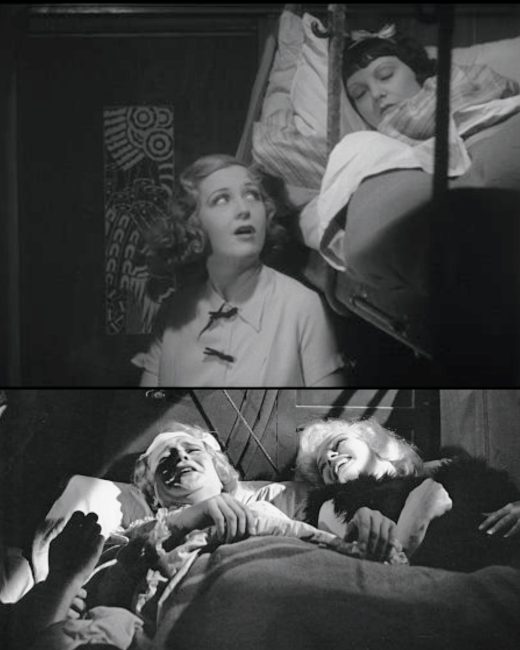
Michael Barrett has reviewed Fanfare d’amour for PopMatters…
“It’s a special treat to get a look at Richard Pottier’s cross-dressing comedy Fanfare d’amour because this film was indirectly remade in Hollywood as Billy Wilder’s Some Like It Hot. Don’t get overly excited: Pottier’s film isn’t the comic masterpiece of Wilder’s. With that in mind, we can compare and see differences in time and temperament.
Fanfare d’amour is solidly rooted in the Depression as it follows two desperate musicians, the tall and lanky Jean (Fernand Gravey) and his dumpier pal Pierre (Julien Carrette). A montage shows us how they get gigs by pretending to be qualified for whatever band is fashionable … Anyway, Jean and Pierre’s poverty and desperation are the sole reason they dress up as women to join a woman’s orchestra.
Both Pottier’s film and Wilder’s tap into the era’s genuine vogue for ‘all-girl bands’, but Wilder and his co-writer, I.A.L. Diamond, injected the brilliant additional motive of fleeing Chicago gangsters after the St. Valentine’s Day Massacre, thus adding a continual sense of danger to the sexual frisson. That’s one detail separating an amusing light throwaway (Pottier’s version) from a work of comic genius (Wilder’s film).
Both incarnations have scenes of learning how to walk like a woman. Both have scenes on a train. Both have the males in competition for a pretty star. In Fanfare d’amour, the object of desire is Gaby (Betty Stockfeld) … In fact, Wilder didn’t see the French original. He saw the German remake, Kurt Hoffman’s Fanfaren der Liebe (1951), which was even popular enough to warrant a sequel, Fanfaren der Ehe (Fanfares of Marriage, 1953). Confusing, isn’t it? That suggests another double feature in the offing for those of us who want the full history.
Robert Thoeren is primarily responsible for the story of Fanfare d’amour. Yet another refugee from German cinema, Thoeren developed the script from an idea he’d had in Germany. He also went to France and landed in Hollywood for a while. He returned to Germany after the War and worked on the 1951 remake, which he then showed to Wilder.”
 The Marilyn Report
2 Comments
Comments are closed.