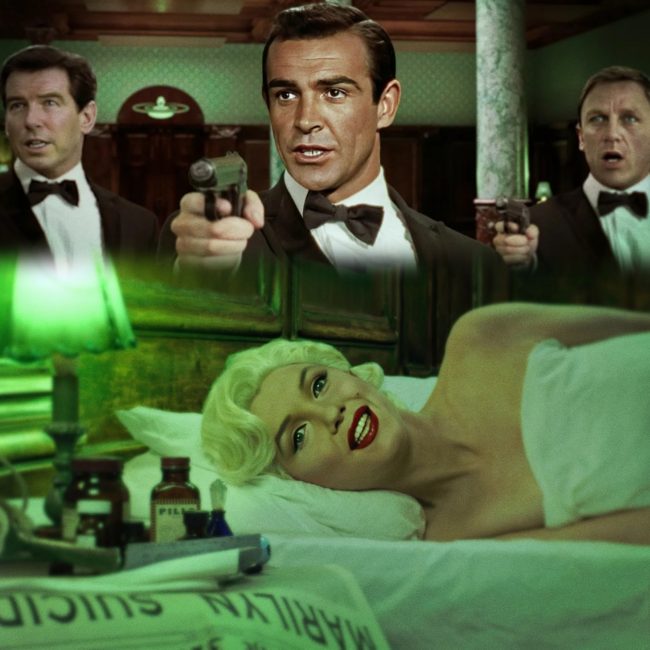
The recent surge in A.I. art and deepfake technologies is highly controversial, not least where dead celebrities like Marilyn are concerned. In a new short film, DUCK, artist Rachel Mclean tries out a more playful approach, as Artforum reports.
“A recent video piece by the artist Rachel Maclean is a blood-splattered spy thriller called DUCK, which just finished its run at the 2024 International Film Festival Rotterdam. Viewers could catch the short at a programmed screening, or as part of a special installation, themed around a postwar private members’ club. DUCK stars multiple Marilyn Monroes, as well as every iteration of James Bond—from Sean Connery to Daniel Craig. There’s also a UFO conspiracy, an explosive car crash, and a shootout scene worthy of Grand Theft Auto. As with all of Maclean’s work, the entire film has been shot on green screen, and that’s not the real Sean Connery, nor the real Monroe: in fact, the only actor is Maclean herself, playing every single part, cunningly disguised using deepfake technology.
Society is currently in a moral panic over AI. Everyone is scared of having their face grafted onto porn without their consent, and algorithms are awash with deepfake political advertisements in a year when many countries will go to the polls. In a world soaked in so much digital subterfuge, it’s no wonder Maclean’s Roger Moore points out to Maclean’s Connery: ‘It’s my reality now, and unfortunately, you’re just living in it.’
Artforum spoke to Maclean, who is based in Scotland, about her production process, the state of the British nation, and whether we should all be terrified of AI.
‘I first saw a deepfake in 2019 and was determined to figure out how to make one. I often play all the characters in my films, but transform myself in uncanny ways with costume and makeup. Using deepfake seemed like an interesting way to develop this, so swapping a physical mask for a digital one.
DUCK is a film that uses deepfake, but it’s also a film about deepfake. The title is an ironic take on the idiom “If it looks like a duck, quacks like a duck, and acts like a duck, then it is, most probably, a duck.” The protagonist is Sean Connery as Bond. I picked Bond because he is so stable, almost to a comic degree. He’s this one-dimensional character who quips his way through highly stressful situations and invariably comes out on top. Deepfake is inherently destabilising as a technology, so for me there is an iconoclasm in taking this unchanging symbol of white British masculinity and throwing him into a bewildering world of uncertainty. Marilyn seemed obvious, in that she has one of the most recognisable faces in the world. Her image has been reproduced over and over again, almost to the extent that it is completely severed from her having ever been a real person. In DUCK, I have Marilyn taking control over her image. Unlike Sean, she knows she’s a deepfake, is comfortable with her status as “pure image,” and leverages her self-awareness to manipulate him.
Deepfake lets you steal someone’s face and make them do or say whatever you want. You can steal the face of someone more powerful from you, and in so doing co-opt some of their power. Or you can take the face of someone less powerful than you, and consolidate your power over them. It’s less the technology itself than how it’s used. Unfortunately, the reality is that the vast majority of deepfakes are pornographic images of women’s faces and bodies taken without their consent. There is nothing all that new in that. Women have never been allowed total ownership of their image in a patriarchal society. In terms of the fear around untruth, the belief that images can be objectively truthful has only really been around since the dawn of photography—and even then, photography was used to fake ghosts and phantoms. I think the way we relate to images is much more complex than just as indexes of truth. Again, the fear for me is less that deepfakes can be untruthful and more how that is exploited. The right has been successful in recent years in creating the impression that nothing is true and therefore anything can be true. It’s a clever way to manipulate reality to suit you.'”
Marilyn was famously found dead in her bed, and in the image from DUCK shown above, we can see jars of pills at her side, as well as a newspaper headline announcing her suicide. However, her dazzling smile and camera-ready appearance resemble a scene from one of her movies more than an actual death scene.
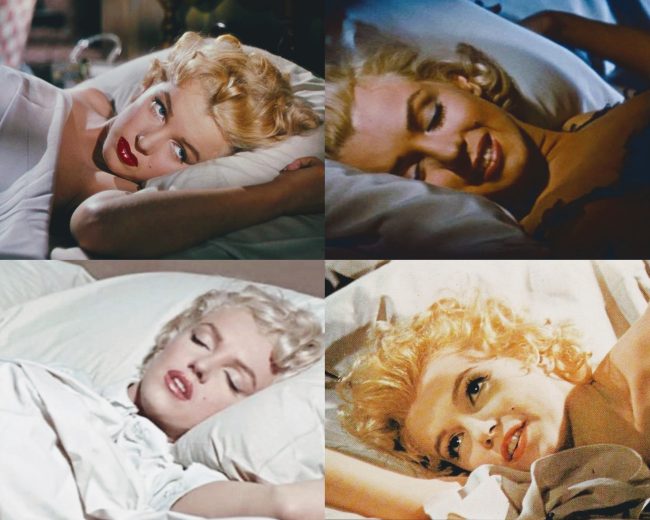
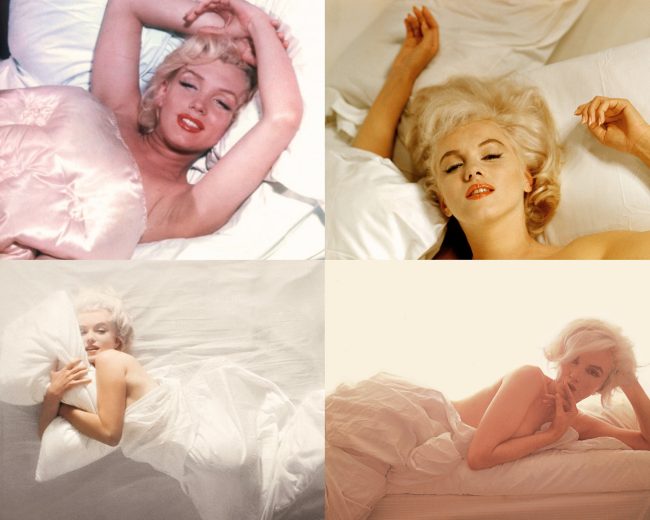
During an era of rigid censorship, Marilyn’s directors often showed her in bed (usually alone) to hint at nudity and sex – and in the more permissive arena of still photography, Marilyn pushed the concept even further. In the context of her lifelong struggle with insomnia – and, of course, the night of her death – some of these images now seem a little uncanny.
And finally, the Old Hollywood Angels YouTube channel includes a 5-minute video entitled, ‘Sleeping next to Marilyn Monroe at her New York apartment in 1956.’ The clip was created as an aid for sleep and relaxation.
 The Marilyn Report
1 Comment
Comments are closed.