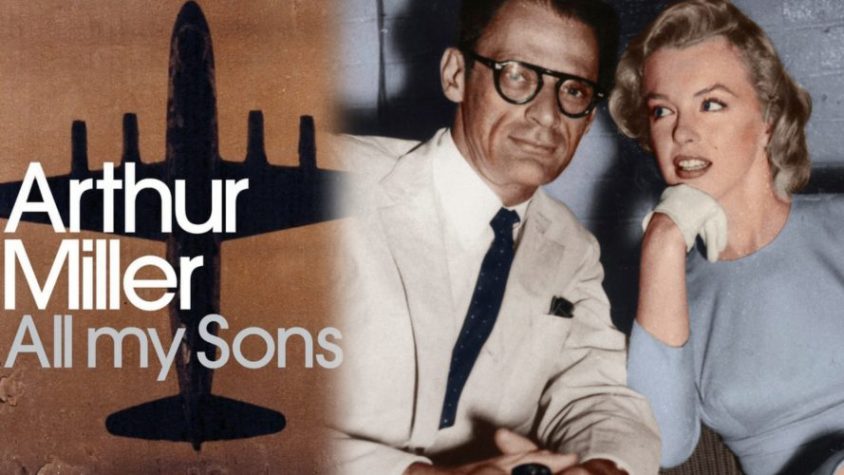
When America entered World War II in 1941, Norma Jeane Baker was a high school student in Los Angeles. Shortly after her sixteenth birthday she married Jim Dougherty, who worked at the Lockheed Martin munitions plant and later joined the Merchant Marines.
In 1944, Norma Jeane was ‘discovered’ by photographer David Conover while working at the Radioplane munitions plant, and began her modelling career which led to her first movie contract two years later.
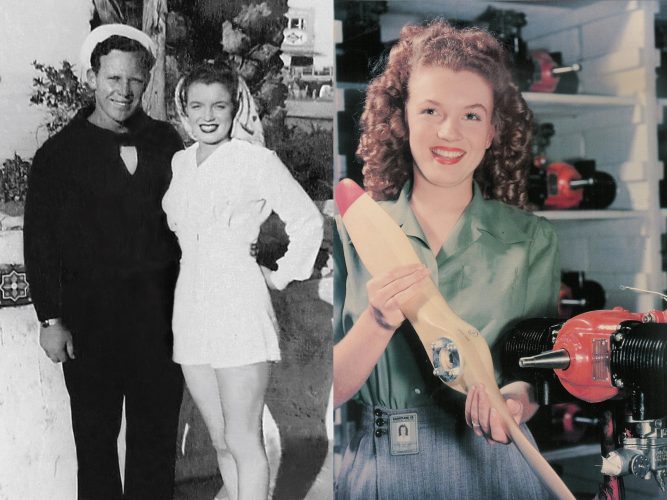
Meanwhile on the East Coast, budding playwright Arthur Miller was married with two young children. Exempted from active service due to an old kneecap injury, he worked the night-shift in a Brooklyn naval yard, and later toured army camps to research the initial draft of The Story of G.I. Joe. Arthur had left the project by the time it was produced in 1945, but the movie earned Robert Mitchum – a former co-worker to Jim Dougherty at Lockheed – his first and only Oscar nomination.
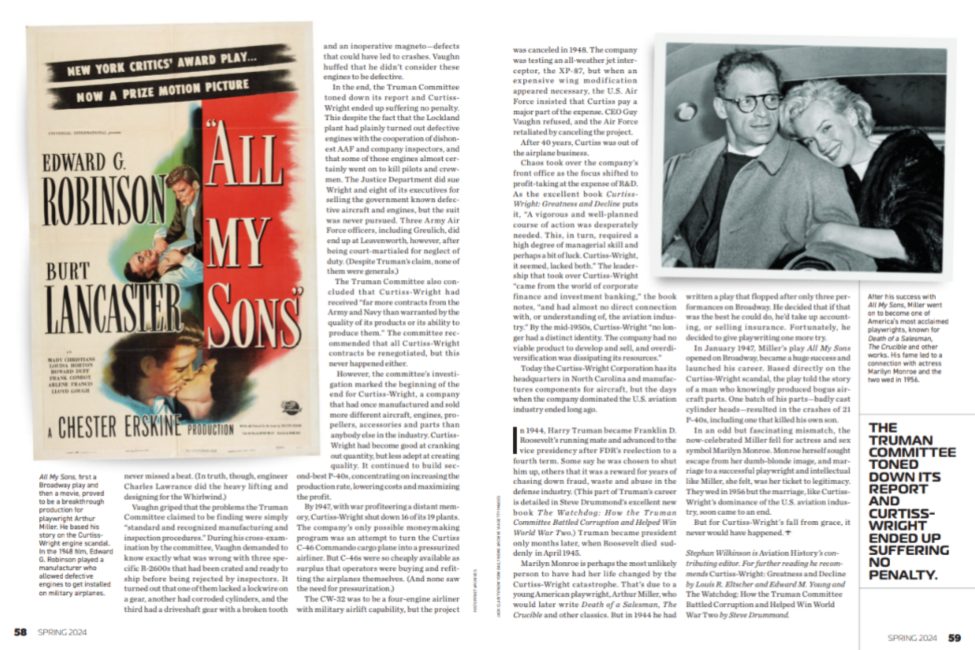
Miller would draw upon the darker side of America’s involvement in World War II for his breakthrough play, All My Sons (1947.) Directed by Elia Kazan, and starring Ed Begley, Arthur Kennedy and Karl Malden, the play was inspired by a recent scandal surrounding the Curtiss-Wright Corporation, exposed for selling defective engines to the US Army.
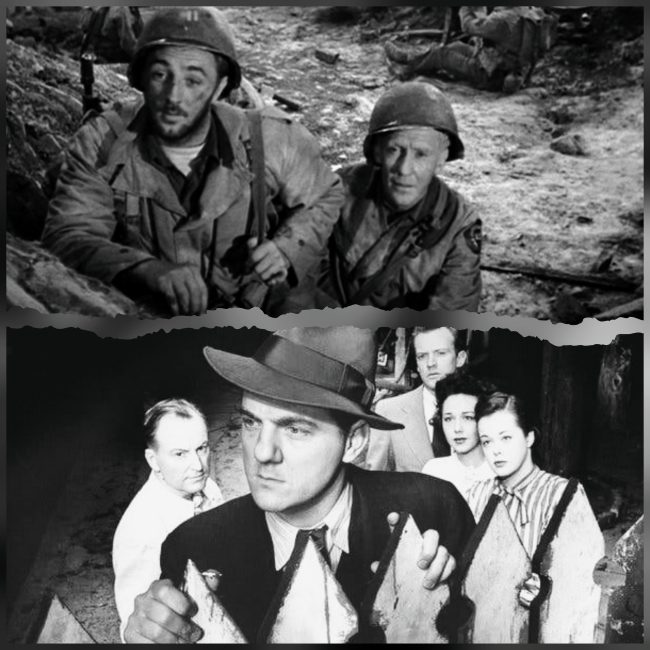
As Stephan Wilkinson writes for History Net, All My Sons – which hit the big screen in 1948, with Edward G. Robinson and Burt Lancaster taking up the lead roles – established Arthur Miller as one of America’s leading playwrights of the postwar era. His success ultimately led him to Marilyn Monroe – aka Norma Jeane Baker – as Kazan introduced them while visiting Hollywood to pitch a screenplay in 1951.
That script – The Hook, sparked by Miller’s stint at the Red Hook shipyard – was rejected by Columbia Pictures boss Harry Cohn, but Arthur would meet Marilyn again when she moved to New York in 1955.
“Trouble arrived for Curtiss-Wright in 1943 when its engines became the focus of a congressional investigation led by a senator named Harry S. Truman. The inquiry, launched back in March 1941, was formally known as the Senate Special Committee to Investigate the National Defence Program and it helped propel the obscure politician from Missouri into the vice presidency and eventually the White House. Strangely enough, it also impacted the life of actress Marilyn Monroe – but more about that later.
In the end, the Truman Committee toned down its report and Curtiss-Wright ended up suffering no penalty … The committee recommended that all Curtiss-Wright contracts be renegotiated, but this never happened either.
However, the committee’s investigation marked the beginning of the end for Curtiss-Wright, a company that had once manufactured and sold more different aircraft, engines, propellers, accessories and parts than anybody else in the industry. Curtiss-Wright had become good at cranking out quantity, but less adept at creating quality. It continued to build second-best P-40s, concentrating on increasing the production rate, lowering costs and maximizing the profit.
By 1947, with war profiteering a distant memory, Curtiss-Wright shut down 16 of its 19 plants … Today the Curtiss-Wright Corporation has its headquarters in North Carolina and manufactures components for aircraft, but the days when the company dominated the U.S. aviation industry ended long ago.
In 1944, Harry Truman became Franklin D. Roosevelt’s running mate and advanced to the vice presidency after FDR’s reelection to a fourth term. Some say he was chosen to shut him up, others that it was a reward for years of chasing down fraud, waste and abuse in the defense industry … Truman became president only months later, when Roosevelt died suddenly in April 1945.
Marilyn Monroe is perhaps the most unlikely person to have had her life changed by the Curtiss-Wright catastrophe. That’s due to a young American playwright, Arthur Miller, who would later write Death of a Salesman, The Crucible and other classics. But in 1944 he had written a play that flopped after only three performances on Broadway. He decided that if that was the best he could do, he’d take up accounting, or selling insurance. Fortunately, he decided to give playwriting one more try.
In January 1947, Miller’s play All My Sons opened on Broadway, became a huge success and launched his career. Based directly on the Curtiss-Wright scandal, the play told the story of a man who knowingly produced bogus aircraft parts. One batch of his parts—badly cast cylinder heads—resulted in the crashes of 21 P-40s, including one that killed his own son.
In an odd but fascinating mismatch, the now-celebrated Miller fell for actress and sex symbol Marilyn Monroe. Monroe herself sought escape from her dumb-blonde image, and marriage to a successful playwright and intellectual like Miller, she felt, was her ticket to legitimacy. They wed in 1956 but the marriage, like Curtiss-Wright’s dominance of the U.S. aviation industry, soon came to an end.
But for Curtiss-Wright’s fall from grace, it never would have happened.”
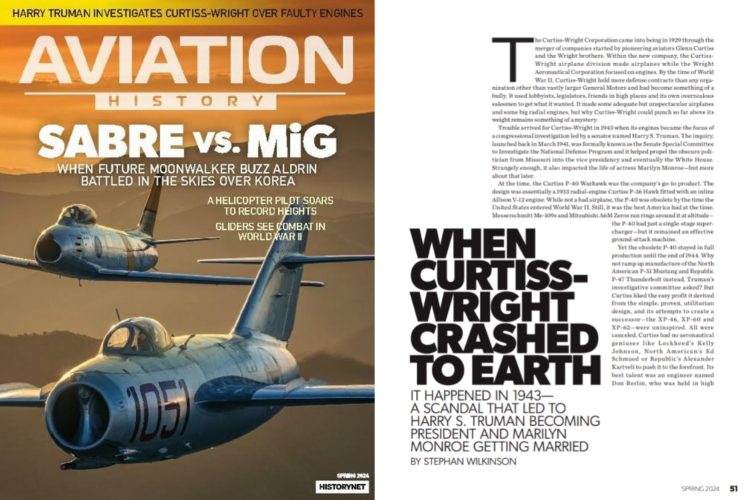
Stephan Wilkinson’s full article is also published in the Spring 2024 issue of the US magazine, Aviation History.
 The Marilyn Report
1 Comment
Comments are closed.