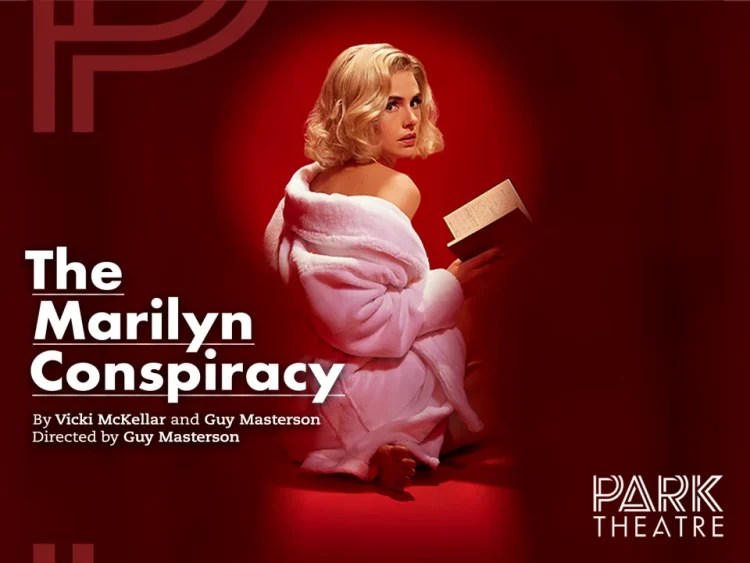
The Marilyn Conspiracy, a play exploring the many rumours about her untimely death, is now running at the Park Theatre in Finsbury Park until July 27. (It’s not the first time the North London venue has hosted a Marilyn-themed show, as the comedy Hello Norma Jeane was staged there in 2016.)
“Based on years of meticulous research, actress and writer Vicki McKellar and Olivier Award-winning director Guy Masterson’s thriller reconstructs the last four days and immediate aftermath of the death of Marilyn Monroe. In the official version of events, she was found nude in her bed holding a telephone, but before the police were called, her doctor, psychiatrist, publicist, housekeeper, and some close friends gathered to decide how to break the news. But what led to this tragic event? A tangled web of misinformation and lies unfold and the facts and myths of the case are exposed to reveal what really happened that fateful night and why. The first version of The Marilyn Conspiracy, which focused on the conspiracy elements of the story, was a hit at the Edinburgh Festival Fringe in 2018, and this updated version, which adds more around the build-up to Monroe’s death, is making its world premiere in London.”
In the show notes, co-writer Vicki McKellar lists British author Matthew Smith’s The Men Who Murdered Marilyn (1996) and Victim: The Secret Tapes of Marilyn Monroe (2003) among her sources. The latter book makes use of the discredited transcripts propagated by John Miner, a Los Angeles attorney who was peripherally involved in the 1962 investigation of Marilyn’s death.
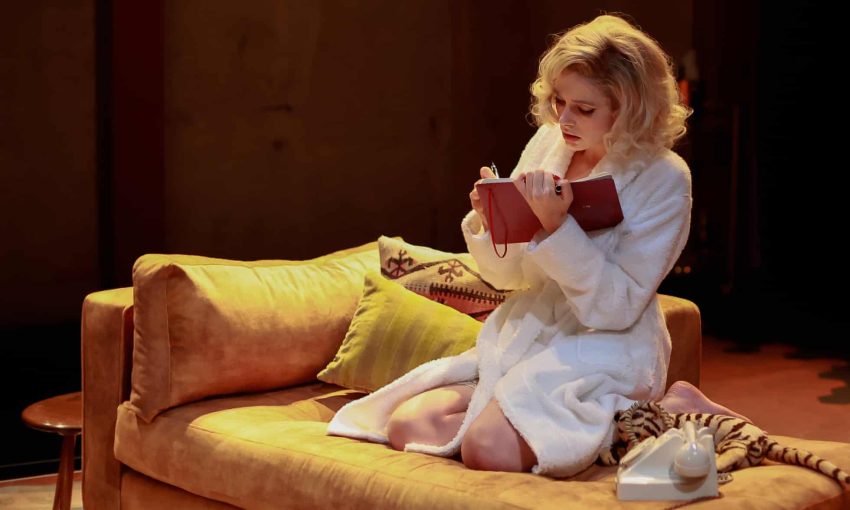
Many years later, Miner claimed to have listened to free-association tapes Marilyn allegedly made for psychiatrist Dr. Ralph Greenson. However, the tapes were never found and quite possibly never existed. Nonetheless, the Theatre and Tonic blog notes that The Marilyn Conspiracy features one of Miner’s more ludicrous claims: that Marilyn experienced her first orgasm during sex with Marlene Dietrich (of all people!)
McKellar also mentions the original Monroe conspiracy text, The Strange Death of Marilyn Monroe, a pamphlet written and published by the notorious American ultra-right propagandist Frank A. Capell in 1964, as part of a smear campaign against Robert F. Kennedy. In the same year, Capell was indicted for libel against Thomas Kuchel, a moderate Republican senator. Jack Clemmons, a police sergeant who was also the first responder when Marilyn’s death was reported, had helped to falsify a LAPD affidavit against the politician.
In his review for The Arts Desk, Aleks Sierz cites another published source for The Marilyn Conspiracy – Donald Wolfe’s The Assassination of Marilyn Monroe (1998.) Wolfe claimed that Robert Kennedy came to Marilyn’s home on the night of her death and ordered Dr. Greenson to administer a lethal injection. However, it has been established that Kennedy was not in Los Angeles on that day, and in fact spent the entire weekend with family and friends in northern California.
Speaking to the Express, co-writer and director Guy Masterson cites a 2015 news story about ‘a CIA agent who claimed to have given an enema to Marilyn.’ This was actually a viral hoax published on a now-defunct parody blog, and debunked by the fact-checking website, Snopes. Masterson also mentions other discredited allegations: that she was recounting government secrets disclosed to her in a diary; and that she was planning to hold a press conference to confess her clandestine affairs with the President and his brother. Both of these scenarios can be traced to journalist Robert Slatzer, who falsely claimed he was her husband.
Writing for The Guardian, Arifa Akbar reveals that although John F. Kennedy and his brother don’t appear in The Marilyn Conspiracy, their rumoured affairs with Marilyn are treated as fact – in reality, they only met a few times – and it’s also alleged that Bobby had been violent towards her in the past. Peter Lawford is portrayed as a ‘bullying figure,’ Akbar says, adding that Marilyn had written about being scared of him.
This is a misreading of a personal note she wrote in 1955, featured in the book, Fragments (2010.) The editors suggested she was referring to Lawford, but it was more likely Peter Leonardi, the hairdresser who tried to sue Marilyn after a falling-out during her New York years. Although she had known Lawford since her early days in Hollywood, Marilyn didn’t become close to the British actor and his wife, Patricia Kennedy (the President’s sister) until her return to Los Angeles in 1961.
Pat Lawford is also a featured character, although in reality, she was visiting family in Massachusetts on the night of Marilyn’s death. Similarly, Hildi Greenson did not accompany her husband to Marilyn’s home as in the play. Eunice Murray, the homecare assistant who discovered Marilyn’s body, appears alongside doctors Greenson and Engelberg.
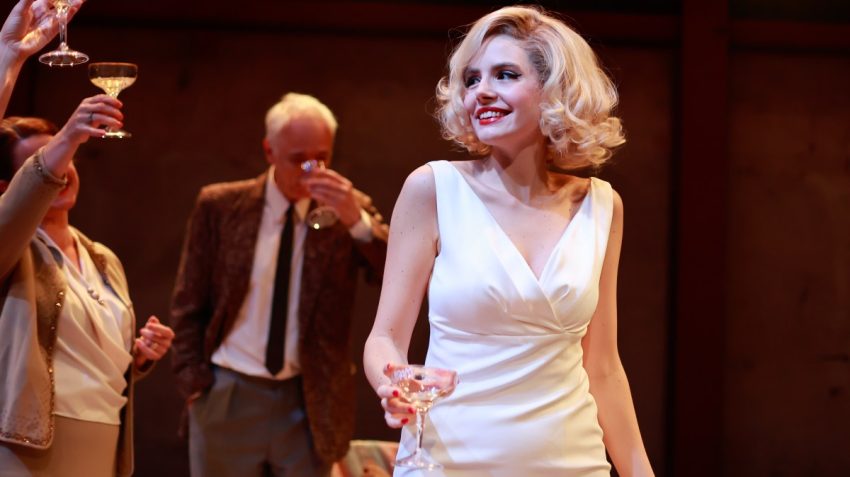
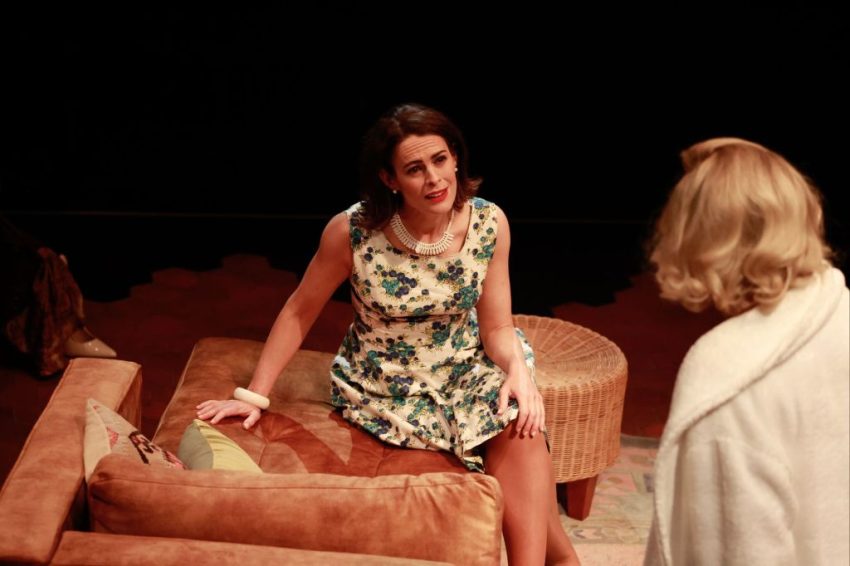
The play’s action takes place during the nocturnal hours immediately following Marilyn’s death, with flashbacks to her final days. Marilyn is played by Genevieve Gaunt, with Susie Amy cast as her publicist, Pat Newcomb (the only real-life player still with us today.) Pat is depicted as Marilyn’s ‘stalwart defender,’ which is true enough – but she was not ‘furious’ with Peter Lawford. Actually, Pat wasn’t told of Marilyn’s demise until the following morning. Soon after she hurried to Fifth Helena Drive, the press arrived. Deeply upset, she denounced them as ‘vultures.’
The Marilyn Conspiracy has opened to mostly favourable reviews, with The Times praising it as an ‘adroitly constructed thriller.’ ‘Marilyn aficionados won’t want to miss this,’ Fiona Mountford writes in the Telegraph, despite sensing ‘a whiff of tawdriness to Masterson’s production.’
Marilyn’s rumoured dalliance with the Kennedys has been wildly exaggerated – they met just a few times – and the evidence suggests she died by her own hand. She was addicted to prescribed drugs and had overdosed many times before. She had been fired by Twentieth Century-Fox and although negotiations were ongoing, the play’s reported claim that she was about to be rehired on a $2 million contract is way off the mark. At her lowest ebb the future may have seemed grim. But this is a mundane, if tragic story which cannot compete with 62 years of conjecture ignited by right-wing zealots, and sustained by a long line of showbiz hucksters.
While it may be unfair to expect drama critics to know all the facts beforehand, it’s somewhat depressing to find the hype so readily accepted. When Lorraine Nicol of Marilyn Remembered saw the play in its original form at the Edinburgh Festival in 2018, she told me that it had ‘all the bogus theories – the ambulance, Bobby Kennedy, injections, enemas etc … I could hear people laughing a lot at some of the theories talked about … maybe the audience all knew better!’
If you’d like to learn more about how this narrative became so prevalent, read my review of Donald McGovern’s excellent book, Murder Orthodoxies. And if that whets your appetite, Monroe biographer Gary Vitacco Robles has published a two-volume series on the subject, Icon: What Killed Marilyn Monroe?
And finally, here’s a selection of extracts from the more perceptive reviews of The Marilyn Conspiracy…
“The play turns into a thinly veiled exercise in airing the conspiracy theories and mysteries, characters variously sounding like suspects or detectives … Marilyn herself feels like an impersonation, breathless and volatile. She comes across as a spoilt child who plays with a stuffed toy and calls her therapist ‘shrinki’, her vulnerability not real or deep enough. Characters stew in repeated conspiracy theories, and it feels protracted.” – Arifa Akbar, The Guardian
“I found myself wondering not why and how Marilyn Monroe died, as unless Ms. Newcomb tells us this late in life we will never know, but why this play exists. For me, it has so many loose ends that fail to gather by the end. There’s a sensationalist tone which does Ms Monroe some disservice … A stage that slowly revolves throughout the evening may be playing with us and tipping a wink on what we are seeing and hearing, but I just wasn’t sure and left unfulfilled.” – Louise Penn, Lou Reviews
“The time-hopping is both a blessing and a curse. The latter, of course, because at the start of each new scene, the flip-flopping takes the audience out of whatever present moment the previous scene was in … What ultimately happens is that the show descends to the level of soap opera style shouting … If anything, it’s a mildly interesting insight into how civilised and intelligent people can be pressurised and effectively bullied into doing and saying things that aren’t entirely, if at all, true … It is, however, rather too detailed, and for a play that is itself part-imagined, I found it difficult to maintain interest.” – Chris Omaweng, London Theatre 1
“As a super fan myself, this ‘well-researched’ piece gives air to the most salacious, unfounded and frankly gruesome hypotheses thrown about by every writer with a career to build since the 1960s. Dangerously, although it has the word conspiracy in the title, it is marketed as truth. Unlike true crime’s pragmatic discussion of every possible theory, this is a theatrical approach and gives flesh to just one narrative. I question the morality of taking such a course, and along with the script, staging and acting inconsistencies, wonder why we are treated to another shock factor tale of this tragic event.” – Gabriel Wilding, Hackney Citizen
 The Marilyn Report