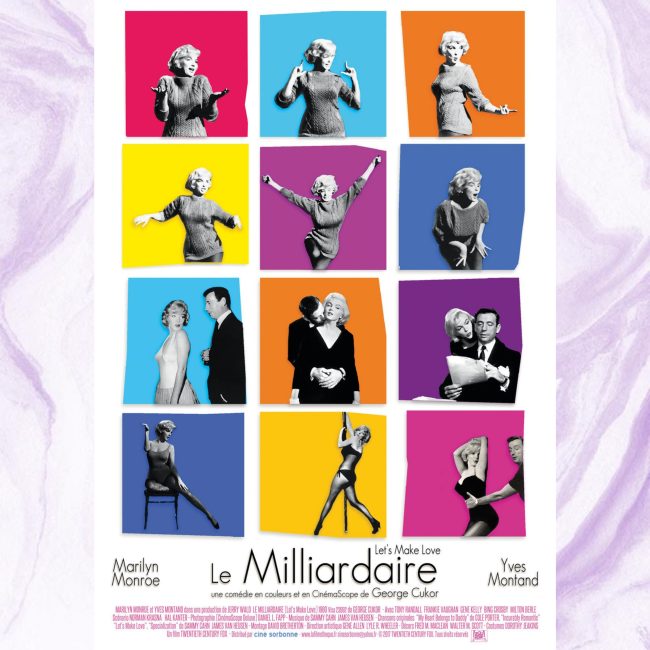
Let’s Make Love is showing at the Cinémathèque Française in Paris on Thursday, September 19 at 8:30 pm, as part of an ongoing retrospective, George Cukor: A Life of His Own. While the 1960 musical comedy may not be the director’s best work – or Marilyn’s – it retains a certain Gallic charm thanks to Yves Montand. The French title, Le Milliardaire, is a translation of the film’s original working title, The Billionaire.
“One of the giants of classic Hollywood cinema. Coming from the theatre, which he liked to invite into his films, he delivered great literary adaptations (Camille), and established himself above all as a master of matrimonial comedy (The Philadelphia Story, Adam’s Rib), and of the musical (My Fair Lady, the brilliant A Star is Born). His love of actresses, among them Katharine Hepburn and Judy Holliday, whose careers he launched, reached its peak in Rich and Famous, his moving last film.
‘My Heart Belongs to Daddy,’ Marilyn sings in Let’s Make Love. With a role made to measure the star dazzled Montand, and their love affair burst onto the screen. Cukor once again delves into the world of theatre, and playing themselves, Gene Kelly, Bing Crosby and stand-up king Milton Berle light up this vaudeville fairy tale.”
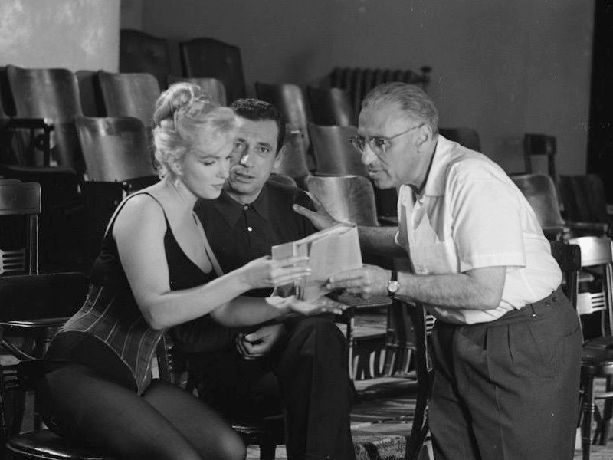
The filmmaker’s long career will be examined in George Cukor’s People: Acting For a Master Director, a forthcoming book by Joseph McBride, whose previous subjects include Billy Wilder (see here.)
“The director of classic films such as Sylvia Scarlett, The Philadelphia Story, Gaslight, Adam’s Rib, A Star Is Born, and My Fair Lady, George Cukor is widely admired but often misunderstood. Reductively stereotyped in his time as a ‘woman’s director’—a thinly veiled, disparaging code for ‘gay’—he brilliantly directed a wide range of iconic actors and actresses, including Cary Grant, Greta Garbo, Spencer Tracy, Joan Crawford, Marilyn Monroe, and Maggie Smith. As Katharine Hepburn, the star of ten Cukor films, told the director, ‘All the people in your pictures are as goddamned good as they can possibly be, and that’s your stamp.’
In this groundbreaking, lavishly illustrated critical study, Joseph McBride provides insightful and revealing essayistic portraits of Cukor’s actors in their most memorable roles. The queer filmmaker gravitated to socially adventurous, subversively rule-breaking, audacious dreamers who are often sexually transgressive and gender fluid in ways that seem strikingly modern today. McBride shows that Cukor’s seemingly self-effacing body of work is characterised by a discreet way of channelling his feelings through his actors. He expertly cajoled actors, usually gently but sometimes with bracing harshness, to delve deeply into emotional areas they tended to keep safely hidden. Cukor’s wry wit, his keen sense of psychological and social observation, his charm and irony, and his toughness and resilience kept him active for more than five decades in Hollywood. George Cukor’s People gives him the in-depth, multifaceted examination his rich achievement deserves.”
 The Marilyn Report