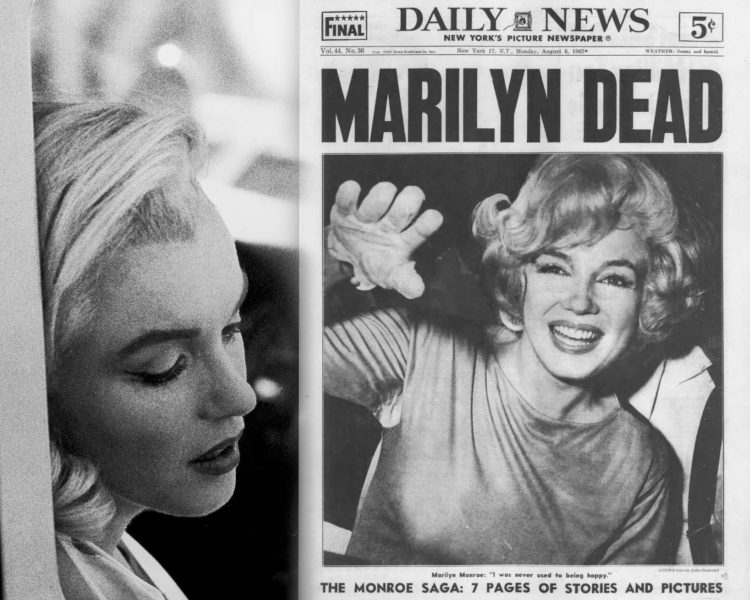
The fatal overdose of actor Matthew Perry in 2023 – leading to a string of arrests – has sparked comparisons to a similar tragedy that rocked Hollywood more than 60 years ago, as Joe Pompeo writes for The Ankler. While his thoughts on Marilyn’s death are peppered with the usual speculation, he does provide valuable insights on the reporters and photographers who covered – and exploited – the unfolding case.
“By the time Joe Hyams rolled up to the property in his black Mercedes — a hot ride once owned by Humphrey Bogart — his scoop was already a goner. Early that morning, around 5 a.m., an editor at the small news agency City News Service had gotten the tip of a lifetime, from a source in the Los Angeles coroner’s office. While Hyams and other reporters raced to Marilyn’s swanky pad, the editor, Joe Ramirez, raced over to his office to get the story out on the wire.
Hyams arrived at 12305 Fifth Helena Drive with his photographer pal Bill Woodfield, who’d been roused out of bed by Hyams at the crack of dawn. The two were no strangers to the actress who lay dead on a mattress inside her single-story home, the only one she’d ever bought for herself. Hyams, a New York Herald Tribune correspondent … had interviewed Marilyn on more than one occasion, including on the set of [Some Like It Hot.]
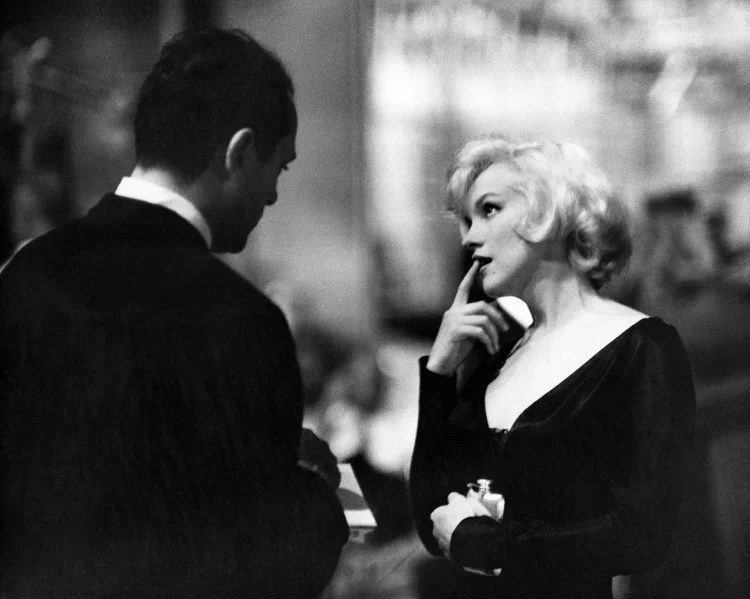
Woodfield, who would later find success as a screenwriter and producer (scoring Emmy and WGA award nominations for his work on Mission: Impossible), was one of [two] photographers who’d recently captured naked images of Marilyn in a swimming pool on the set of Something’s Got to Give, a screwball comedy that would never make it to screens.
The pair were joined by other journalists, including James Bacon, an Associated Press columnist … He strode past a cluster of pyjama-clad gawking neighbours and approached one of the officers standing guard. Lying through his teeth, Bacon said he was from the coroner’s office, and the cop gullibly waved him into the house.
It wasn’t long before photographers weaseled their way into the morgue. One of them was the renowned lensman Leigh Wiener, on assignment for Life magazine. After bribing an attendant with a bottle of whiskey, he shot five lurid rolls of film, including a chilling photo of Marilyn’s left foot poking out of a refrigeration unit, an I.D. tag dangling from her toes.
Hyams left Marilyn’s house and sat down to write his latest Hollywood dispatch for the Herald Tribune. The following morning, it would be syndicated in newspapers all over the country … ‘My last glimpse of Marilyn Monroe,’ Hyams lamented, ‘was as they wheeled her into the mortuary side entrance, into a storeroom, littered with coats, drafting tables and dust brushes. The door was then locked. The girl who struggled all her life trying to find dignity as a human being was being left alone in the dark in a shed.’ As with the discovery decades later of Perry’s body simmering in a hot tub, ‘There was no dignity in her death.’
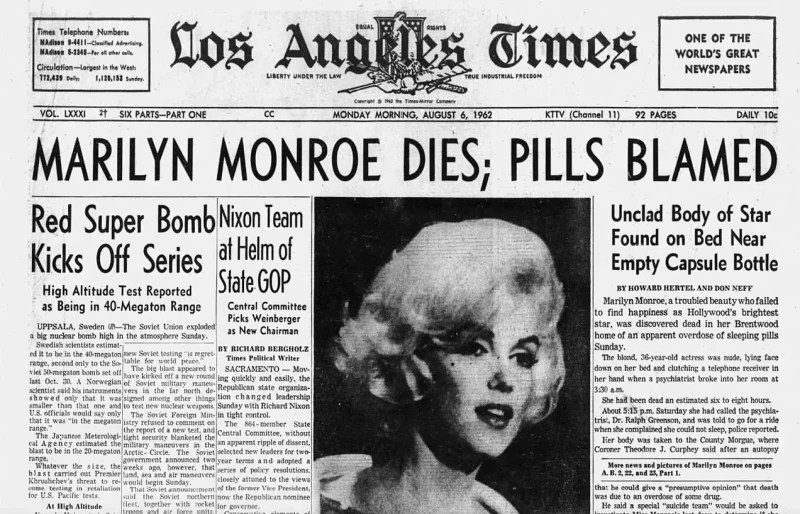
Marilyn’s overdose ricocheted around the globe on radio, television and the front pages of major newspapers. The Los Angeles Times ran one of those screaming eight-column headlines reserved for monumental news events. Condolences for Marilyn rolled off the tongues of shaken stars, from Dean Martin to Gene Kelly to Jayne Mansfield. Peter Lawford, the Rat Pack fixture — and husband of Patricia Kennedy — who would become a key figure in the coming probes into Marilyn’s Kennedy ties, said, ‘Pat and myself loved her dearly. She was a marvelous, warm human being.’
Over the next few days, the media sunk its teeth deeper into the story. ‘Marilyn Monroe’s second husband, Joe DiMaggio,’ the New York Daily News reported, ‘today stepped into the confusion created by the star’s death and a few hours later funeral arrangements were announced.’
A toxicology report concluded that Marilyn had consumed nearly twice as much barbiturate as was needed to stop the beating of her heart. But there were juicier headlines to be had.
The erstwhile Yankees star had insisted on an intimate ceremony; no press and a modest guest list consisting of two to three dozen family members, close friends and confidantes … The scene outside the chapel was less subdued. Fans and journalists were kept at bay by city police, security officers and even Pinkerton guards. Among the reporters clustered in the blistering sun was Walter Winchell, the legendary gossip columnist and inveterate celebrity scourge who’d carried DiMaggio’s water during the divorce. The doors to the chapel opened, and funeral attendees began filing across the lawn. Winchell, perhaps hoping to land an exclusive ride-along to Marilyn’s crypt, cried out, ‘Joe! Joe! It’s Walter Winchell.’ But DiMaggio just kept on walking.
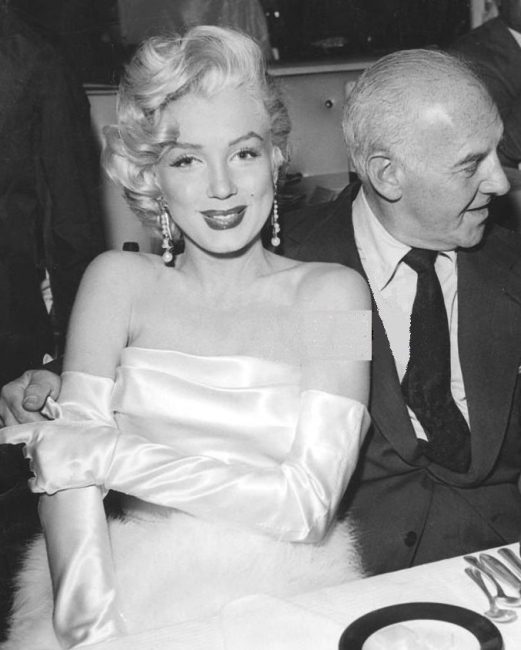
An interesting side note regarding the Walter Winchell anecdote: There are a few obscure references online to Winchell being the only reporter allowed to attend Marilyn’s funeral, supposedly because of a friendship with Joe DiMaggio. The legendary AP Hollywood correspondent Bob Thomas recalled the opposite in his remembrances of the funeral published in 1971 and 1998. I went with Thomas’ version.
Hyams, back at his desk after the funeral, transcribed those sentences for the following morning’s Herald Tribune. As he typed out this latest entry in the saga that had consumed his past four days — and would consume more to come — he thought about the clamour of Marilyn’s life in contrast with the softness of her sendoff.
‘Marilyn Monroe, the unwanted, friendless child who became the most famous glamor symbol of her time, was entombed yesterday with the quietest, most modest funeral ever given Hollywood royalty,’ Hyams wrote. ‘It was almost as though Marilyn Monroe had never been a movie star. There were no celebrities at her funeral, only the kind of folk one expects at [a] funeral to say goodbye to more ordinary people . . . Marilyn Monroe had come full cycle: From a simple and tragic childhood to a simple and tragic ending of her life.’
Hyams filed his story and got back to reporting. The mystery had only just begun.”
 The Marilyn Report