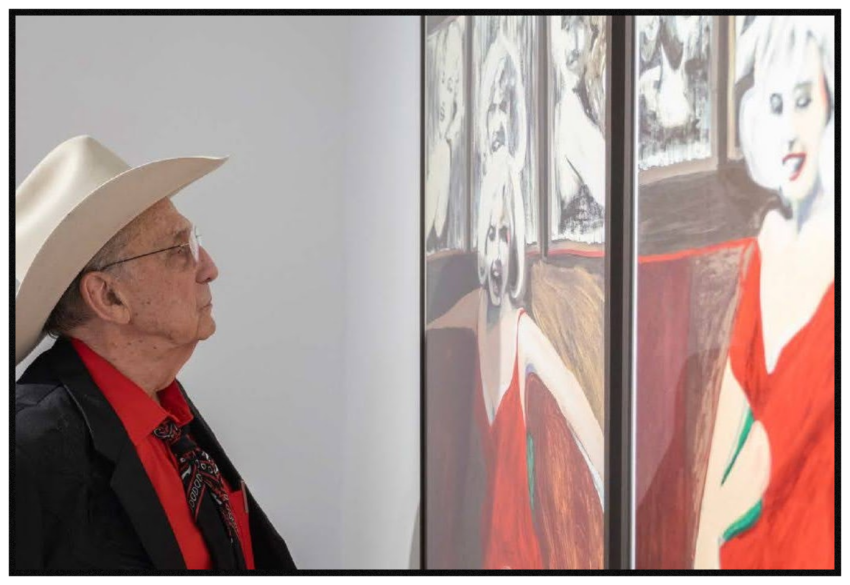
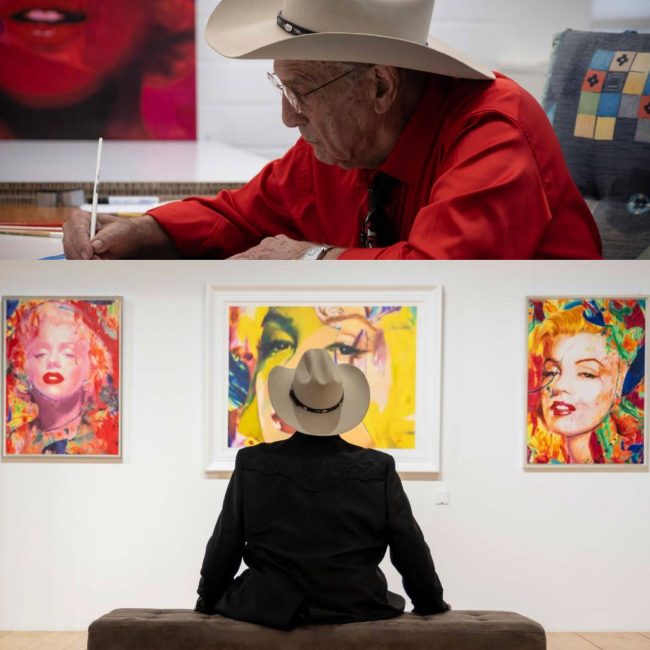
James Francis Gill, one of the first artists to make Marilyn his muse, is launching a new collection at Castle Fine Art, a chain of commercial galleries with branches throughout the UK – spearheaded by exclusive limited edition prints of his 1962 ‘Marilyn Triptych‘.
The 90-year-old Pop Art pioneer will also be presenting the original paintings during personal appearances at Castle Fine Art in Manchester (September 29), Birmingham (October 1), Exeter (October 3), and London (October 5) – more details here.
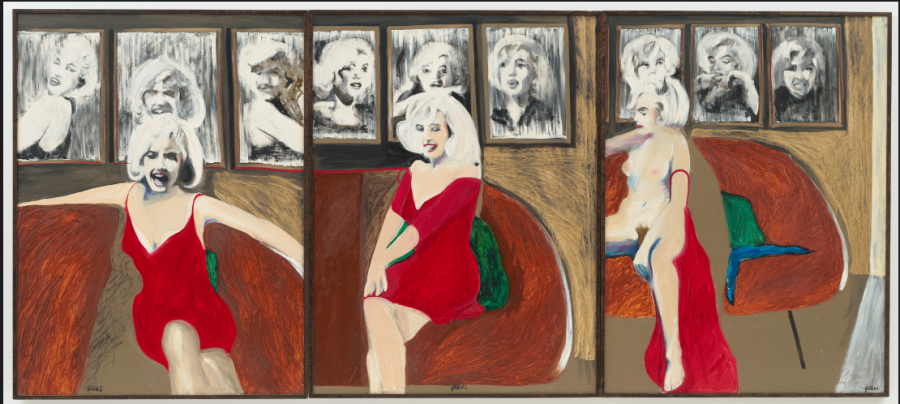
Born and raised in Texas, Gill moved to Los Angeles in 1962. Following Marilyn’s tragic death that August, the Museum of Modern Art acquired Gill’s ‘Marilyn Triptych’ in November. The three-part painting shows Marilyn with further panelled images in the background.
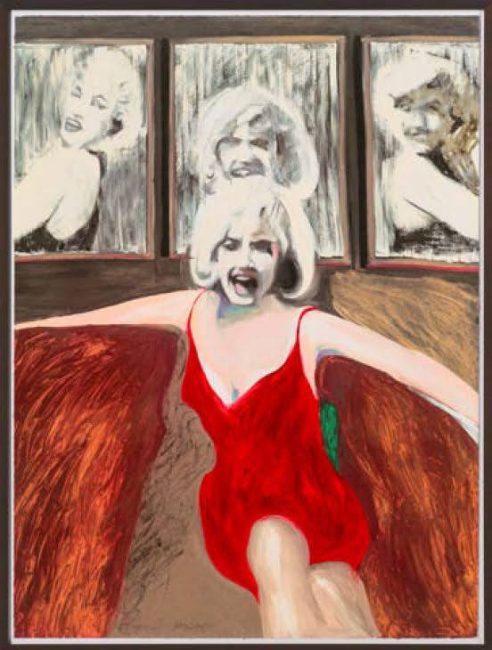
In the first painting, Marilyn is laughing – although her expression could also denote rage, or even a primal scream. Her face is drawn from an image captured by Allan Grant in the photo shoot accompanying her final interview, published in LIFE magazine on the day she died.
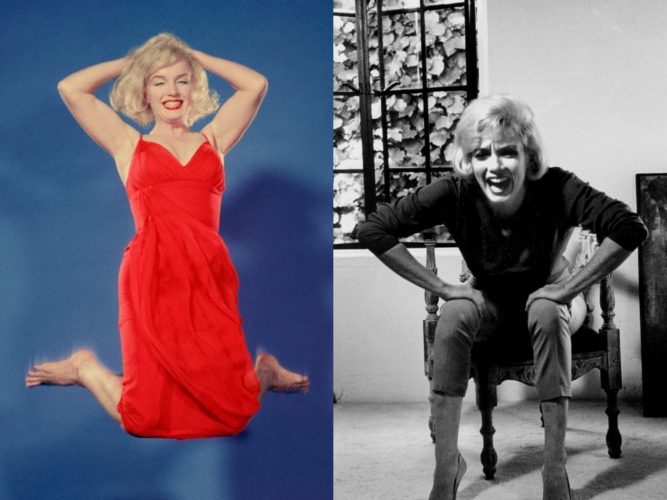
Marilyn’s red dress is similar to one she wore for the ‘Jump’ shoot with Philippe Halsman in 1959. Red is a colour which dominates all three paintings. Marilyn is sitting on the edge of a brown chair or couch, her arms circling the back of the chair and another to her left. The wood-brown seat is placed against a lighter brown wall, and the earth tones contrast with Marilyn’s pale skin and her vibrant red dress.
Directly behind her is a similar face, among two other ‘Marilyns’ more akin to her public persona – one lifted from a pin-up pose, and the other snapped during a concert in Korea. The panelled faces are shown in black and white.
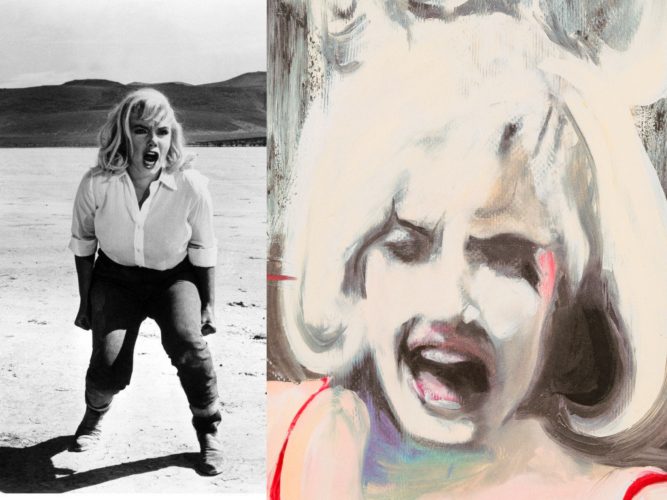
Overall, the painting recalls a dramatic speech she gave in The Misfits (1961), when she runs from the cowboys and decries their pursuit of wild horses in the Nevada desert. Marilyn’s last complete performance is also echoed in the second painting, with her main pose cropped from a cast photo.
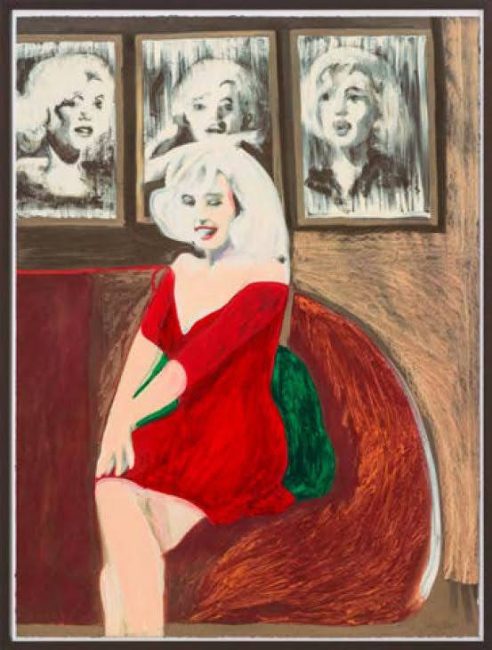
Marilyn sits cross-legged with hands folded at the knee. Her ‘cherry dress’ from The Misfits is replaced by an all-red sleeved dress, similar in style to the blue dress she wore during a public appearance at Ebbets Field in 1957. A green object – perhaps a cushion – rests behind her, the clash of red and green evoking a stop/go sign. And while Marilyn’s pose is serene, her heavy eyelids and sideways glance seem to ‘wink’ at us.
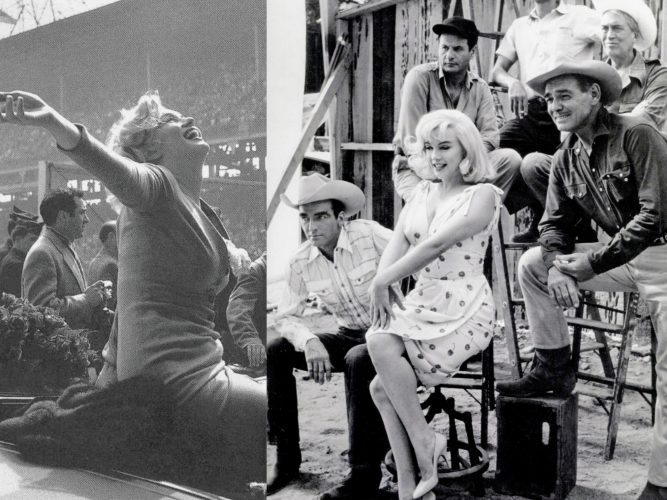
In the background are two still photos from her unfinished movie, Something’s Got to Give, plus another expressive shot from the Grant series. In all three panels, she seems bewildered – as if the full-bodied Marilyn is telling a secret to her shadow selves.
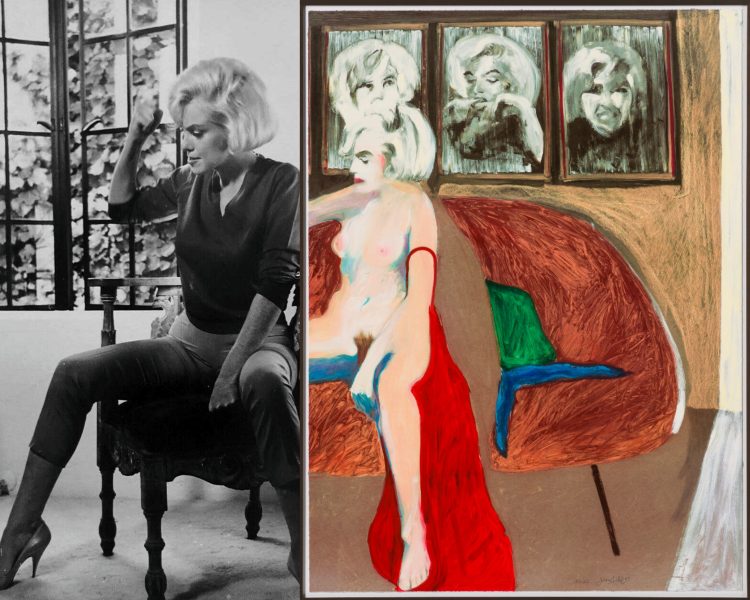
The final painting draws upon Allan Grant’s photos of Marilyn at home, in conversation with the press. But Gill strips her naked, with the red dress dangling off a shoulder by its strap. Her blonde hair shows its darker roots, and a nebulous blue object joins the green on the chair, resting between her thighs. Marilyn’s tense mood is reflected in the panels above her and the white light streaming through the doorway, as the triptych reaches its conclusion.
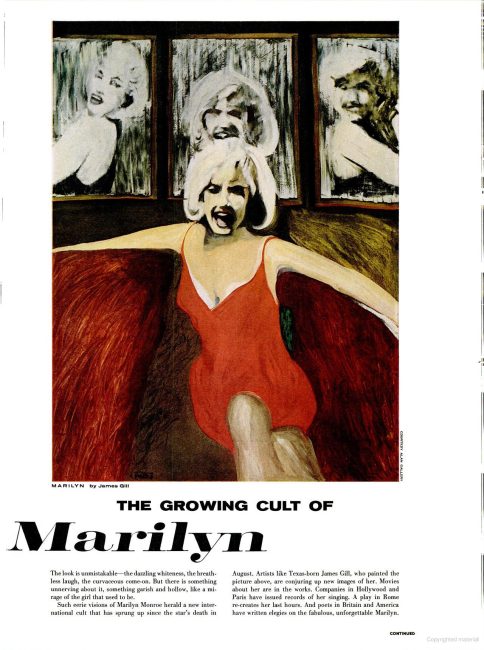
The first painting in Gill’s triptych was featured alongside works by William De Kooning, James Rosenquist, Derek Marlowe, and Pauline Boty in ‘The Growing Cult of Marilyn,’ a feature for LIFE magazine in early 1963. “The look is unmistakable – the dazzling whiteness, the breathless laugh, the curvaceous come-on,” the article read. “But there is something unnerving about it, something garish and hollow, like a mirage of the girl that used to be.”
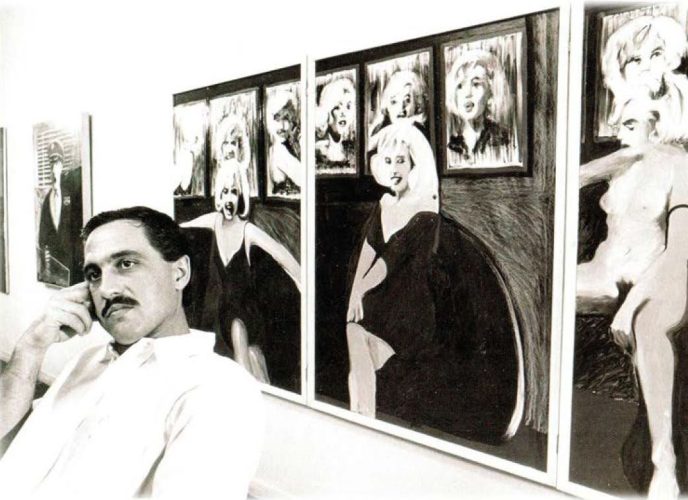
Gill’s subsequent work dealt with the political issues of the era, such as America’s involvement in the Vietnam War. In 1967, TIME magazine commissioned him to paint the Soviet dissident, Alexander Solzhenitsyn, for its cover. But at the height of his career, Gill left the art scene behind to live in the California wilderness. He returned to painting in the 1990s and has been prolific ever since, focusing mainly on nostalgia for the pop culture of his youth.
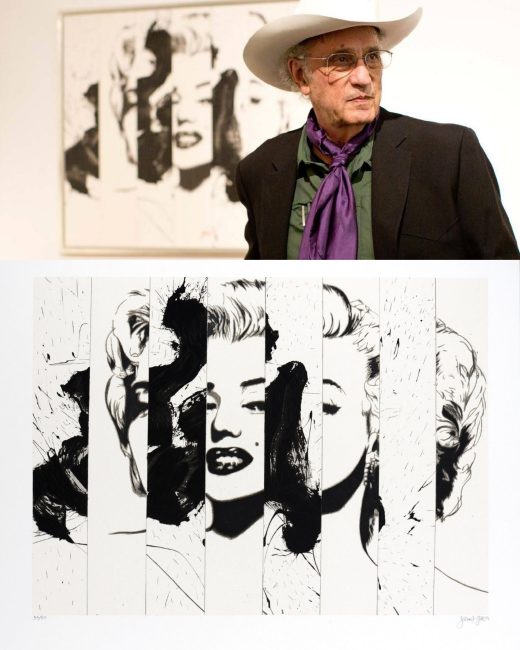
The centrepiece of Gill’s latest collection is ‘Marilyn Leaving,’ a mixed media work based on a candid 1953 photo by LIFE photographer Alfred Eisenstaedt.
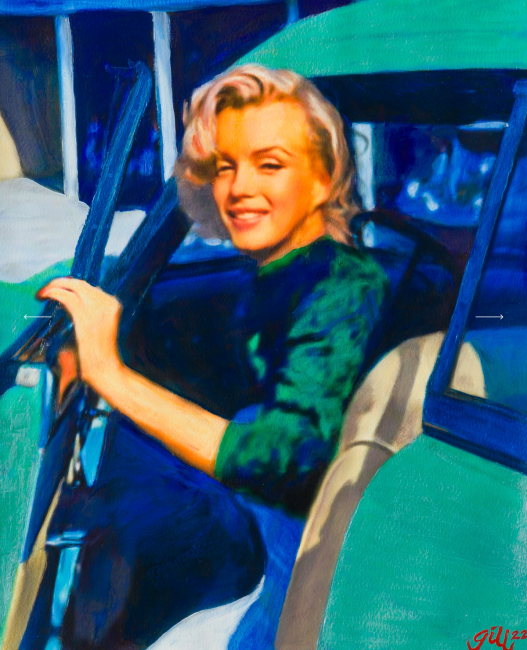
“‘Marilyn Leaving’ is central to an idea that was ahead of its time, anticipating the omnipresence of celebrity culture, image sharing and struggle to protect one’s privacy. The interior of the car is a cocoon of safety and security where Marilyn can be Norma Jeane. The moment she leaves the car, she steps into her celebrity identity. Who can see me? How do I appear? Am I being the person they want me to be?”
Thanks to Fraser
 The Marilyn Report
1 Comment
Comments are closed.