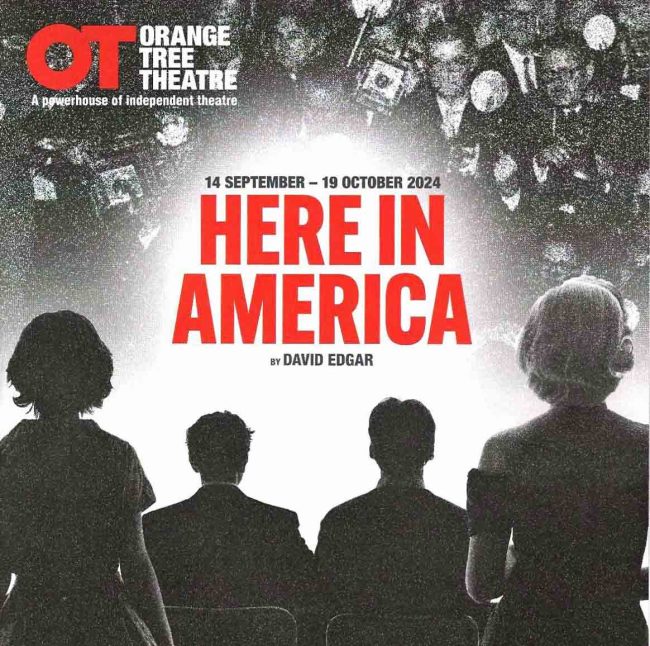
Here in America, a new play about the Red Scare – seen through the prism of Arthur Miller and Elia Kazan’s broken alliance – has just opened at the Orange Tree Theatre in Richmond-upon-Thames, in South-West London.
‘I’m saying there’s someone who could stop this madness. If you stood up, and said no.’
“On a rainswept afternoon in 1952, Hollywood and Broadway’s leading director Elia Kazan met his closest collaborator, the playwright Arthur Miller. As the anti-Communist crusade of McCarthyism blacklisted hundreds of their colleagues, Kazan and Miller faced a stark choice. Should they betray their friends, or risk never working again?
Here in America is a compelling play that imagines a confrontation between two giants of stage and screen, both passionately involved with an actress about to become the most famous movie star in the world.”
Director James Dacre previously helmed a 2015 theatrical adaptation of The Hook, Arthur Miller’s shelved screenplay which first brought him to Hollywood in 1951. And author David Edgar has more than sixty plays to his credit – the first of which, Two Kinds of Angel (1970), featured a character called Norma, a blonde actress re-enacting the life of Marilyn Monroe.
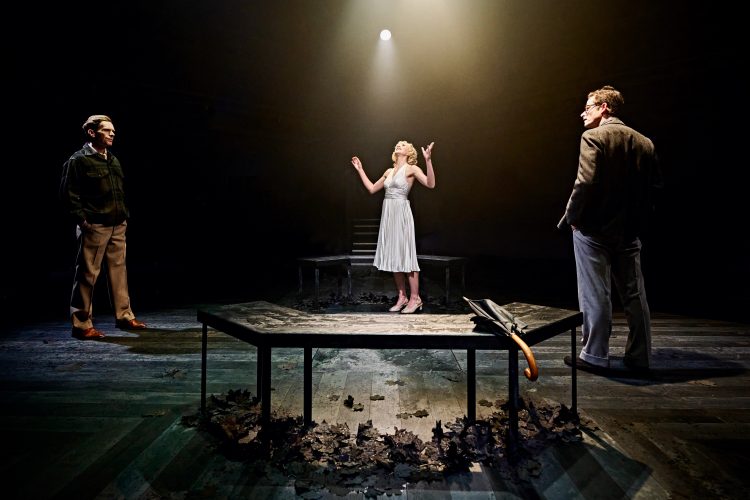
Jasmine Blackborow, who plays Marilyn – or ‘Miss Bauer,’ as she called herself when accompanying Miller and director Kazan to an explosive meeting with studio boss Harry Cohn – has appeared in the Netflix fantasy series, Shadow and Bone, and Guy Ritchie’s film, The Gentlemen. The noted Israeli actor Michael Aloni makes his UK debut as Miller, and Kazan is played by Shaun Evans (best known as the young Inspector Morse in TV’s Endeavour), with Faye Castelow as Kazan’s wife, Molly.
Here in America is not the first play to be produced on the subject of Monroe, Miller and Kazan, Jack Canfora’s Fellow Travellers was staged in the US to some acclaim back in 2018. So far, Here in America has elicited a mixed response – here’s a sample of the reviews.
“The push and pull between the four actors is captivating to watch … Marilyn Monroe, who both men were involved with, was a central figure during all of this. Miller used his engagement to Monroe as political capital when he himself was hauled in front of the House Un-American Activities Committee (HUAC) – a speech that is reenacted compellingly here … And when Art himself has moments of doubt, Blackborow’s Marilyn is there to rally him. ‘The man I want to be with is the man who tells the truth,’ she says.
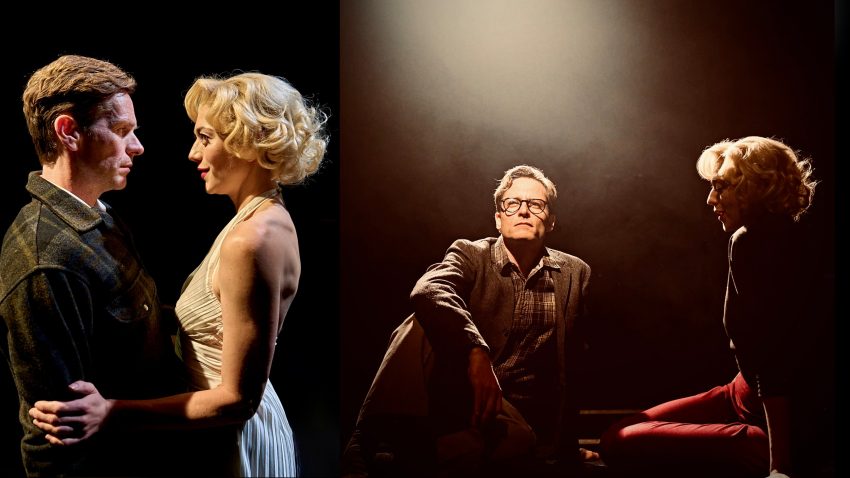
As for Marilyn, Blackborow deliberately gives us a sketch of the woman, versions of how Art and Gadg saw her at that time. Similarly to the ‘flashbacks’ in Death of a Salesman, she appears as a memory or as an imagined presence interjecting in the conversation. With Gadg – with whom she had a sexual relationship – she is more sultry, pulling him between her legs and grabbing his face. With Art, she is an exciting girlish whirlwind but also a vulnerable and bashful woman, gazing up at him with gooey-eyed admiration.”
– Kirsten Grant, The Telegraph
“What happens when two friends fall out over ideology? One of the virtues of this dense yet compelling chamber piece is that David Edgar’s script allows the audience to make up its own mind … Betrayal takes both romantic and political forms. Amid all the debates, Edgar interposes brief, dreamlike scenes with the woman who loomed large in both men’s lives. Marilyn Monroe (jokingly called ‘Miss Bauer’ here) had a dalliance with Kazan before she embarked on that ill-fated marriage with Miller. In a blonde wig Jasmine Blackborow carries off the awkward task of combining big screen allure with the fragility of a would-be autodidact. And towards the end, she briefly emerges in another guise as the actress playing the fictionalised version of Marilyn in rehearsals for Miller’s Sixties play After the Fall.”
– Clive Davis, The Times
“David Edgar brings these two giants of stage and screen together in this flawed, yet intriguing, ideas play. It is clunky in its setup, the drama’s engine taking too long to start, but there is lively and intelligent debate at its centre – when you finally get there … Edgar throws in Marilyn Monroe under the name Miss Bauer (Jasmine Blackborow), as a ghost representing the men’s consciences, complete in famed white halter-neck dress, dropping in heavy-handed mentions of her early life in foster care. Her portrayal feels cliched and discomforting. The play feels essentially like a two-hander, the women vehicles for delivering information or aiding the men’s memories … Edgar refuses to draw these men either as straightforward heroes or villains; Kazan is not fully a coward, Miller not wholly noble.”
– Arifa Akbar, The Guardian
“Marilyn Monroe is a spectral character and is played in a deliberately caricatured way by Jasmine Blackborow who later doubles up skilfully as actress Barbara Loden as we move forward in time and see a rehearsal of the 1964 Miller play After the Fall which (after a patching-up of differences) benefited from direction by Kazan … I sensed creaking sounds as the complex biographical material (particularly details of the men’s fathers and similar upbringings) was moved into place here. And much of the play struck me as broad brush. I get it that Marilyn is being merely conjured up in the abstract by other characters. But her contemporaries (and notably Miller) would often quote her smart self-deprecating humour. Does Edgar really need to have her (repeatedly) say things like ‘zip-a-dee-doo-dah!’ Dacre might have stepped in, saved Blackborow from such banalities, and given her more to work with. Saved her from the fuzzy end of the lollipop as Marilyn famously said herself in Some Like It Hot.”
– Jeremy Malies, Plays International

“Jasmine Blackborow goes full Madonna in ‘Material Girl’ as Miss Bauer, the Marilyn Monroe avatar, who appeared in both men’s lives and in both men’s beds. She is largely a ghostly presence, teasing Gadg and seducing Miller, her naive intelligence clarifying both men’s confused thinking. As usual, Marilyn gets a poor deal from male creatives, then and now, a vehicle to illuminate men’s desire and ego, rather than a person in her own right, maybe not as egregiously as in Andrew Dominik’s misguided biopic, Blonde, but surely it’s time to set her free from the pout, the push-up and the peroxide?”
– Gary Naylor, The Arts Desk
“A play about the relationship between the playwright Arthur Miller and the director Elia Kazan is an appealing prospect … Yet for all its intrinsic interest, not to mention the subtle parallels with today when what it is to be American is once more under the microscope, it stubbornly fails to spring to dramatic life. It feels like a history lesson without too much purpose behind it.
Edgar is such a good writer that some scenes still spark … But the arrival of Marilyn, under the alias of Miss Bauer (a breathy Jasmine Blackborow), to spout Actors Studio theories and semi-narrate the action is a complication too far and the tone in general veers broadly from naturalistic to stylised without ever generating a head of argumentative steam.”
– Sarah Crompton, What’s On Stage
“Marilyn Monroe appears, sometimes for a just a few moments, within a scene to add information by question or comment. It is a device that director James Dacre makes work fluidly … Jasmine Blackborow, who moves just like the real Marilyn, presents a Miss Bauer with a lively intelligence.”
– Howard Loxton, British Theatre Guide
“Here in America challenges an over-simplified narrative about Arthur Miller’s relationship with HUAC in the 1950s. Miller, Edgar suggests, cannot easily be presented as a moral hero … Instead, Edgar’s Miller may be ferociously articulate, but he is also evasive, refusing to answer questions directly, prepared ultimately to put his own feelings before moral principles … The action shuttles between two timelines – 1952, when Miller and Kazan’s friendship implodes, to ten years later when Miller invites Kazan to direct his new play … The two male characters are ably supported by Faye Castelow, a sparkling Molly, and by Jasmine Blackborow, who is simply superb as Marilyn Monroe. The play explores the way both Miller and Kazan form intense relationships with other women – sometimes with the same woman, as in the case of Monroe – and that part of the tension between them is this sexual rivalry. Here in America is a very talky play, one that lacks the elegant clarity of Miller’s own dramas, but is made watchable by the first-class cast and sharp direction.”
– Jane Darcy, The Reviews Hub
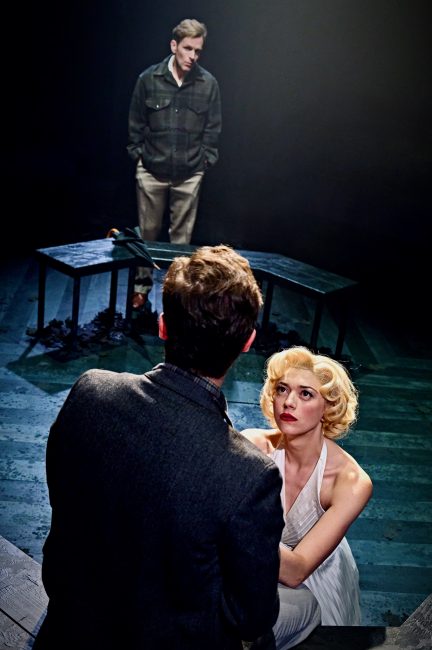
“While I was still piecing together who the central characters were, I felt slightly bombarded with new names and places, making it hard to follow the initial interactions. For instance, I understood that Miss Bauer was significant, but it wasn’t initially clear how or where she first encountered Art and Gadg … Miss Bauer, played by Jasmine Blackborow, served as the perfect conduit for Gadg and Art to reflect on their past and form their opinions in the present. I also appreciated how her character’s appearance subtly shifted, presenting her in a way that will feel increasingly familiar to the audience. Jasmine brilliantly portrayed this recognisable character, making her a welcome addition to any scene … The core of the story is strong and the writing and direction are compelling, and with some reworking, it could appeal to an even broader audience.”
Eleanor, Theatre and Tonic
“It’s always a challenge for any actress to portray Monroe as she is such an iconic and recognisable figure. Jasmine Blackborow plays her in this play (billed as ‘Miss Bauer’) and although she doesn’t quite capture her exuberance and charisma, she does portray a vulnerable person with daddy issues well … Monroe is often seen as an invisible influence and narrator to Miller’s conscience, but this doesn’t quite come off. Was Miller really obsessed for this long with a woman he only married in 1956, and is it really necessary to use a large portion of an 80-minute play to comment on her intimate involvement with both Kazan and Miller?”
– Louise Penn, Broadway World
“Jasmine Blackborow excels as the other woman, Miss Bauer … And Miss Bauer is, of course, none other than Marilyn Monroe who provided extra-marital diversion for Kazan and went on to marry Miller. From the moment Blackborow’s Monroe enters, she seems surrounded by a golden glow that shimmers from her immaculate blonde hair, almost mythical curves and translucent skin. And she is vocal with her men.
The women here, though — for all their articulacy — are devices, while their men (white and empowered) cheat casually on their wives, savour their unquestioned dominion and generally assume ascendancy. We’ve seen this all before. Nevertheless, Edgar brings us a play that is erudite, multi-faceted, philosophically stimulating and crammed with style. Not new but punching high.”
– Mary Conway, Morning Star
“In short, it’s about idealism versus pragmatism. Typically of Edgar, who’s revered for complex political plays, it is a densely argued series of discussions. Thankfully, Kazan’s first wife and Miller’s second wife bring much-needed emotional ventilation. Left to their own devices, the men’s exchanges can sound like the turgid minutes of the Committee itself … Faye Castelow as Molly makes the men cut to the chase, while Jasmine Blackborow’s Marilyn insists Miller stand by his refusal to name names (for which he got a suspended one-year prison sentence). This is certainly well-worn territory, so why now? Surely because America is once more openly at odds with itself.”
– Patrick Marmion, Daily Mail
“Miller’s genius was that he could show you why someone might make the wrong choice. That question also drives Edgar’s drama … The real target here is the paranoid political hysteria that has forced artists into impossible decisions … Jasmine Blackborow’s fragile Marilyn Monroe floats through as a spectral, imagined presence, nagging at the men’s consciences … It’s held back somewhat by the weight of exposition it has to pack in and by its cerebral nature.”
– Sarah Hemming, Financial Times
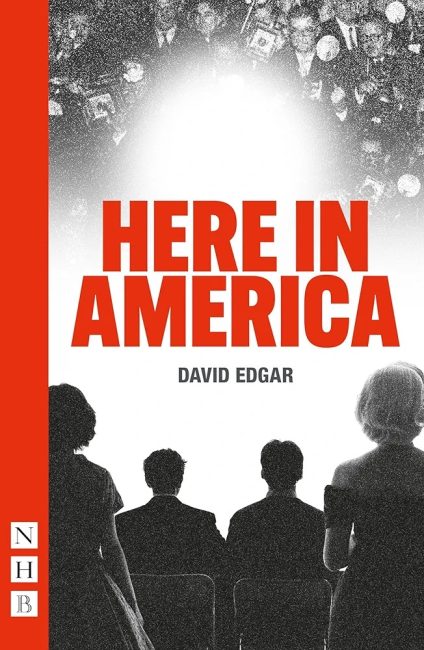
If you can’t make it to the show, David Edgar’s Here in America is also recently published – and for further reading on Marilyn’s relationships with Miller and Kazan, I can recommend Barbara Leaming’s Marilyn Monroe, Miller’s Timebends, and Kazan’s A Life.
 The Marilyn Report