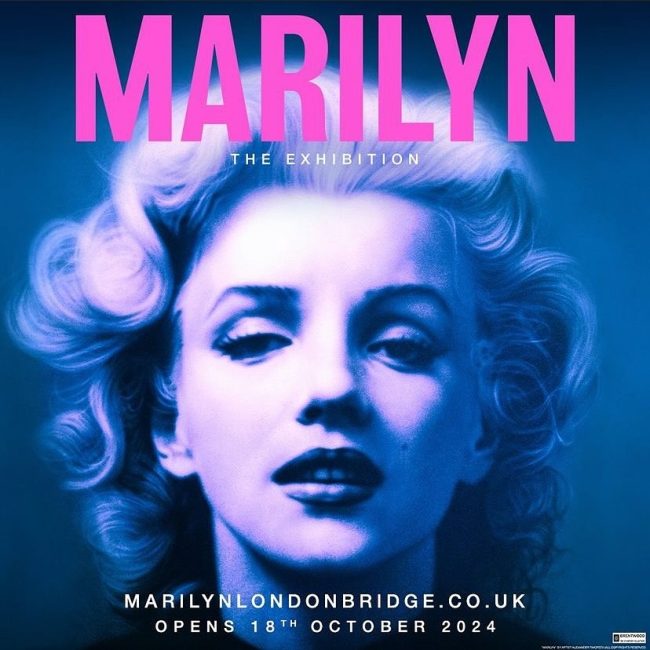
Marilyn: The Exhibition – showcasing the collection of Ted Stampfer – is currently on display at London Bridge Arches, closing on Marilyn’s 99th birthday, June 1, 2025. Although the title is new, this German fan’s ever-growing collection has been touring across Europe for more than a decade, with further stops in the US and Australia. It includes items of personal property from clothing and beauty products to household objects, plus archival documents and vintage ephemera evoking a bygone age.
Standard ticket prices currently range from around £24-£42 depending on visiting hours, or £65-£130 for a VIP package, including a 45-minute tour and ‘white glove experience’ featuring a black velvet belt owned by Marilyn, and her plaque for the ‘Sweetest Girl in Motion Pictures,’ awarded in 1953.
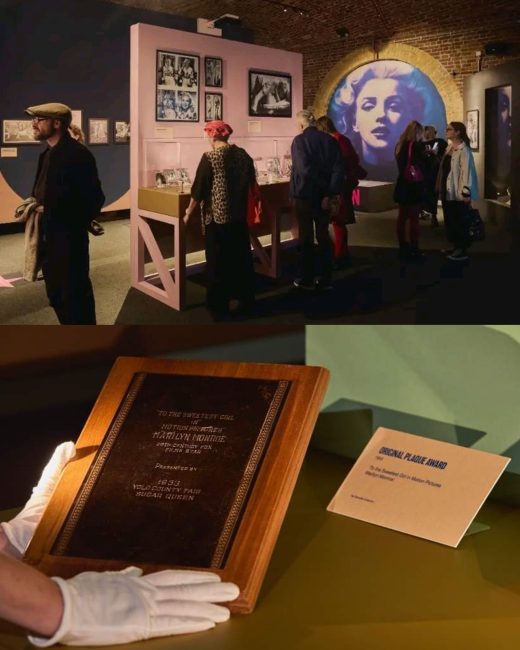
Arches managing director Elizabeth Kovaros spoke with The Mirror about how Marilyn’s possessions bring us closer to the woman behind the legend.
“Elizabeth says: ‘There are sketches and drawings from Norma Jeane early on, and then letters and postcards and correspondence back and forth with her foster sister, and all kinds of childhood documents that let us see that picture of what she was like and what a difficult childhood she had. It really was traumatic what she went through.’
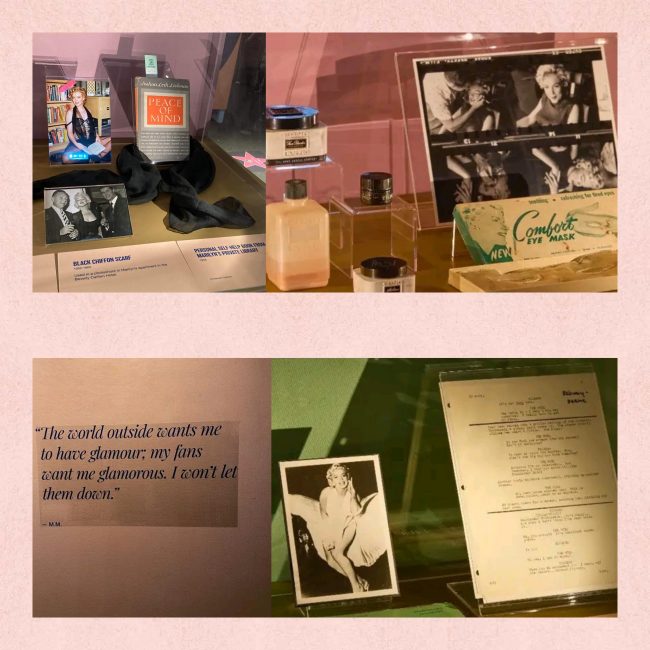
Exhibits include Marilyn’s birth certificate and her will, and even the items found on the nightstand of her LA home when she died – including pills, a black scarf and some face cream. ‘You can see the full journey of her life with lots of information about her career, with original film scripts and then things like keys to her dressing room,’ adds Elizabeth. ‘All sorts of things that give you all the detail behind what was going on.’
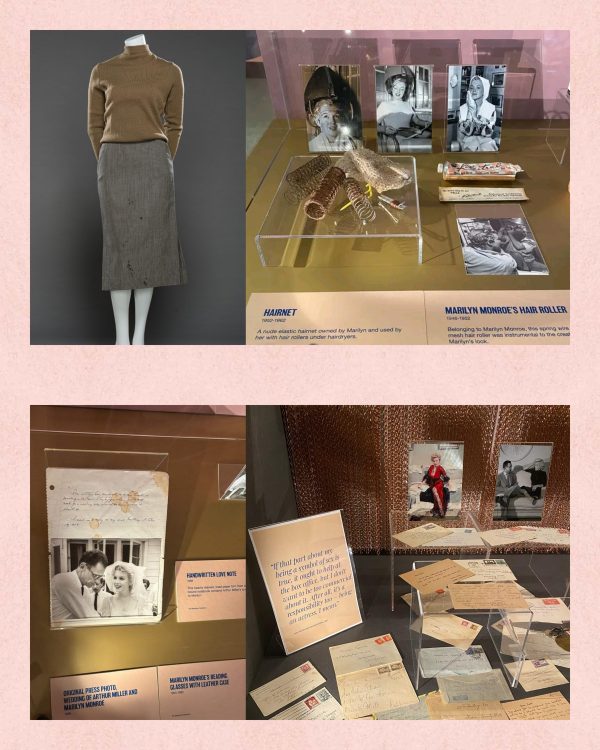
The 250 items on display belong to German collector Ted Stampfer, who has been collecting Marilyn memorabilia since his teens … One of the highlights of the exhibition is a love note from Marilyn’s third husband, the playwright Arthur Miller … Arthur’s love note, on torn paper, is filled with hope. It reads: ‘I am sitting here, dearest, and my heart is bursting with love.’
‘There are things like her hair rollers with some of her hair still stuck in them, her makeup and her skin care is there and you can see how she could sort of put together that look,’ says Elizabeth.”
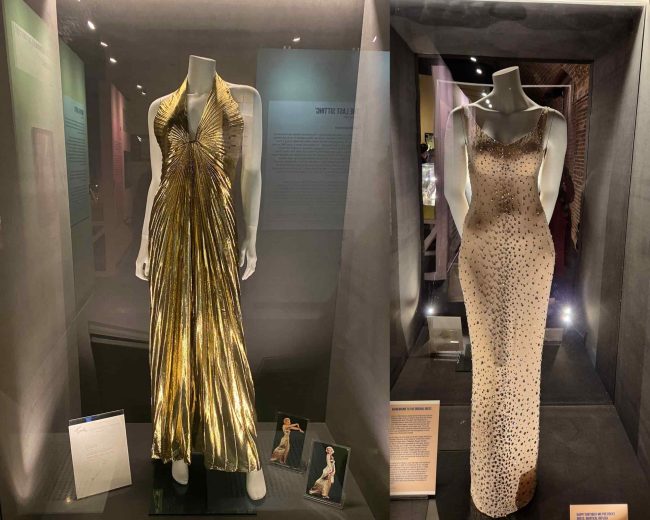
However, two of the most prominent exhibits are actually replicas – of Marilyn’s gold lamé dress and the ‘Happy Birthday Mr President’ gown. While these copies are noted, information on provenance is limited elsewhere, and a handful of items are in poor condition or otherwise questionable.
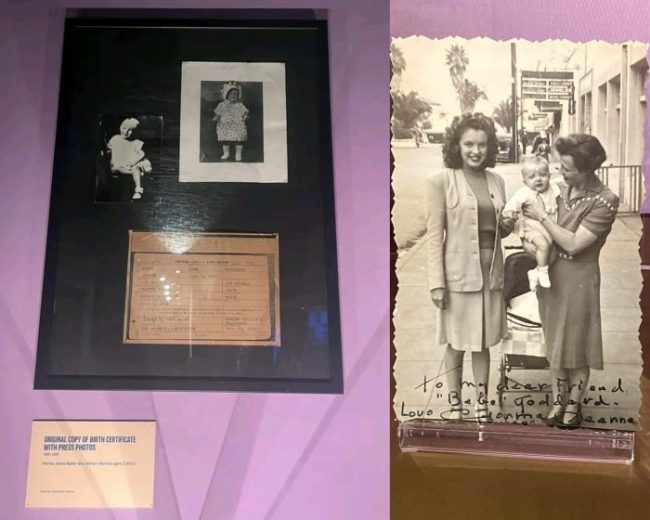
An ‘original copy’ of Marilyn’s birth certificate looks similar to a file posted on Wikipedia; and a 1940s snapshot of the teenage Norma Jeane is inscribed to Eleanor ‘Bebe’ Goddard, whom in later life often sold such items to fans. In a handwritten dedication, Marilyn’s birth name is misspelled as ‘Jeanne’ – an unlikely error, even with a careless hand.
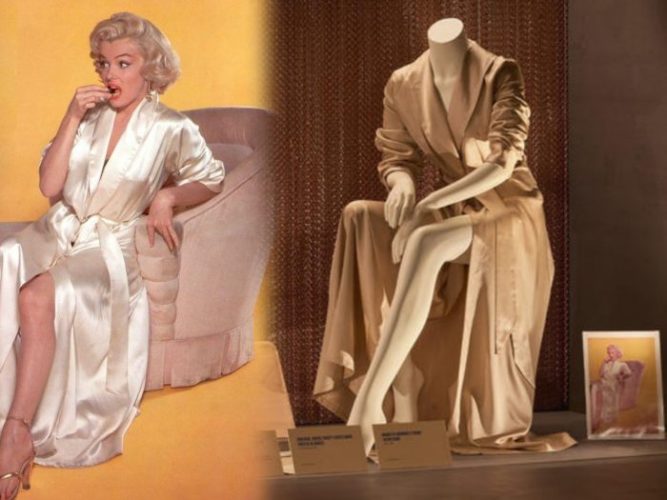
A champagne-coloured silk robe is labelled as a costume for Gentlemen Prefer Blondes (1953), also seen in a photo shoot with John Florea. However, that robe was a creamy white silk, and Marilyn previously wore it in Love Nest (1951.)
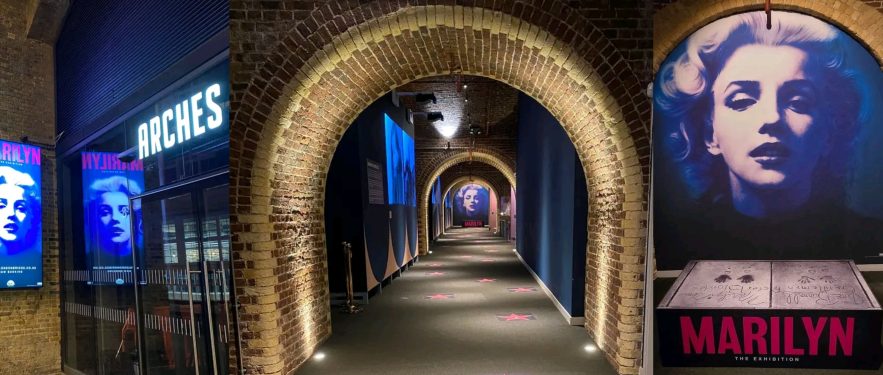
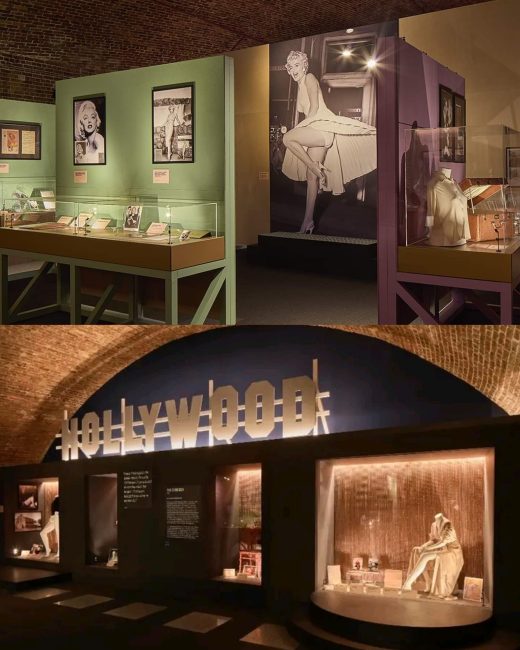
A selection of press reviews follows – and you can view over 60 fan photos from the exhibition here.
“‘She won’t be there’ was the reason Arthur Miller, Marilyn Monroe’s third husband, gave for not attending Monroe’s funeral in 1962 … Miller’s lugubrious face appears several times in Marilyn: The Exhibition, a show which, like his clever line, manages to be both entertaining and comfortless. It promises an ‘unprecedented glimpse into the private world’ of Monroe by displaying 250 of her possessions – on show in the UK for the first time – alongside film footage and contextualising texts, to tell the story of the short, restless, often miserable life of Hollywood’s brightest star.
It’s a feel-good show assembled professionally and with care: clear, chronological, well-lit and coherently labelled. The curatorial style takes its lead from the V&A’s run of successful biographical exhibitions augmented with archive material, such as Gabrielle Chanel: Fashion Manifesto.
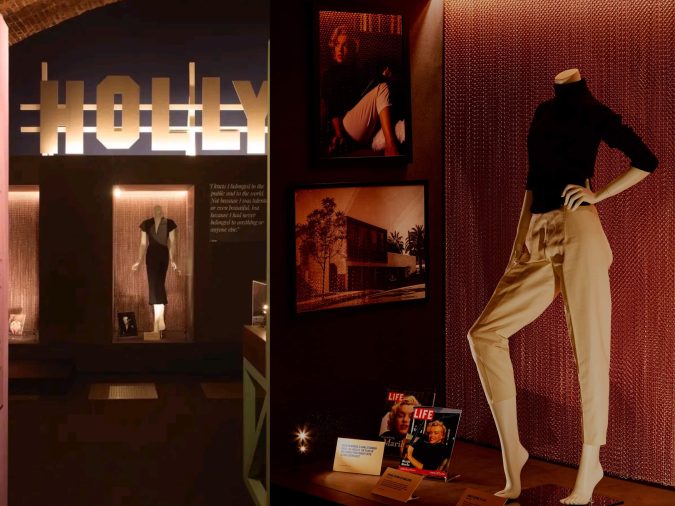
Fashion enthusiasts will find Monroe’s wardrobe fascinating … But there are moments when the show lacks curatorial judgement. Particularly desolate is a houndstooth pencil skirt by I. Magnin, which the pre-fame Monroe bought in 1946 when she was 20, the year her first marriage fell apart over her modelling ambitions, and which she wore in early photoshoots. It is disintegrating.
Other exhibits are even more inexplicable: an elastic hairnet, stained with dye; false eyelashes; a half-used tube of hair conditioner; a creepy eye mask. What they are intended to reveal about their owner is unclear – they are simply macabre relics marooned in vitrines.
But it is not all clumsy. Loud and clear is the message that Monroe was an intelligent, ambitious and brave woman who dragged herself out of awful circumstances through force of will … None of this is new information, but it is made immediate when explained in the context of her letters, diaries, clothes, and particularly her books … Monroe may not be here, but her ephemera can illuminate her interior life. She never found what she was searching for, with Miller or anyone else.”
– Helen Barrett, The Telegraph
“No one’s life and death has been picked apart, analysed and mythologised quite like Marilyn Monroe’s … In fact, the Arches is the perfect setting for this rare collection, where wandering about under the cavernous brick does feel like stepping into a secret, just-unearthed archive.
The exhibition follows the general timeline of Monroe’s life, displaying objects from each era of her life. Displays outlining her tumultuous upbringing … Her breakthrough as a wartime model … her Hollywood film years and marriages … and the ever-debated circumstances of her death.
One of the reasons Monroe’s legacy continues to enthral and mystify us is that her life itself was a tapestry of contradictions … These different sides of her personality are illuminated here, and at times objects are artfully placed together in an effort to show off her mercurial spirit … Joshua L. Liebman’s Peace of Mind, which she read for self-development, is placed next to a pair of her false eyelashes and a picture of her kneeling by a set of bookshelves wearing a sheer black lace negligée.
An audio guide provides more extended commentary and has some moving audio from Monroe impersonator Suzie Kennedy – but it will cost you an extra £4. And a lot of the objects on display are underwhelming. A dull cabinet of whisks, measuring spoons and other miscellaneous kitchenware … A battered chair from the 1956 film Bus Stop … a promising video display looking at the emancipation of women in the 1920s that Monroe was born into is left frustratingly unexplored.
But there are some moments of magic. A haunting collection of her cosmetics gives a peek into the reality of what it takes to look like a famous sex symbol. While the most moving items are Monroe’s simple, everyday clothes … It’s a reminder that beneath the ostentatious blonde locks and fur coats, was a woman who sweated and loved and cried and endured the pain of heartbreak and loss just like the rest of us.”
– Alex Sims, Time Out
“The upside of idolising dead people is that you can go through their things. It’s not creepy – you’re an amateur historian, reconstructing the material culture of a lost age … There has never been anything like this before in Britain; it provides the kind of thrill that international fans can’t get from reading online auction listings or taking Hollywood pilgrimages on Google Street View.
If you’ve ever wanted to be a fly on the wall in her marriage to Joe DiMaggio, you can get up-close-and-personal with his shaving kit and signed baseball and her monogrammed suitcase from their honeymoon to Japan … There are even steps up to the display cases carrying her real clothes, so you can stand on equal footing with a risen Marilyn …
The curators understand all the morbidities of Hollywood fandom; they get, instinctively, that fans want proximity to Monroe’s last moments. She died of a barbiturate overdose in the bedroom of her newly bought Mediterranean-style home in Brentwood, California. We’re shown detailed floor plans and a copy of the plaque from outside the front door … A prescription for the fatal medication, Phenergan, sits under glass in a spread of items from Monroe’s bedside table. True crime fanatics and Hollywood escapists might have more than a few things in common.
The London Marilyn exhibition realises it has created an exciting opportunity for sensationalism, and attempts to cover its own tracks with a tenuous feminist narrative. Monroe becomes an ‘idol for many women who fight for gender equality’ and ‘a pioneer of the emancipation movement’ – both slightly trumped-up statements prompted by her wearing trousers and founding a short-lived production company …
One needs no new political justification to worship at the Hollywood altar. Life in the industry was tough for all female stars. Collectors of memorabilia understand better than anyone that this entails valuable narrative interest in and of itself – they spend millions to get physical verification of grooming rituals and predatory contracts … Rather than rewrite their stories, it might be more appropriate to think of Marilyn et al as Homeric heroines, controlled from above by a vengeful pantheon and pelted with tragic parallels.”
– Ella Dorn, New Statesman
 The Marilyn Report