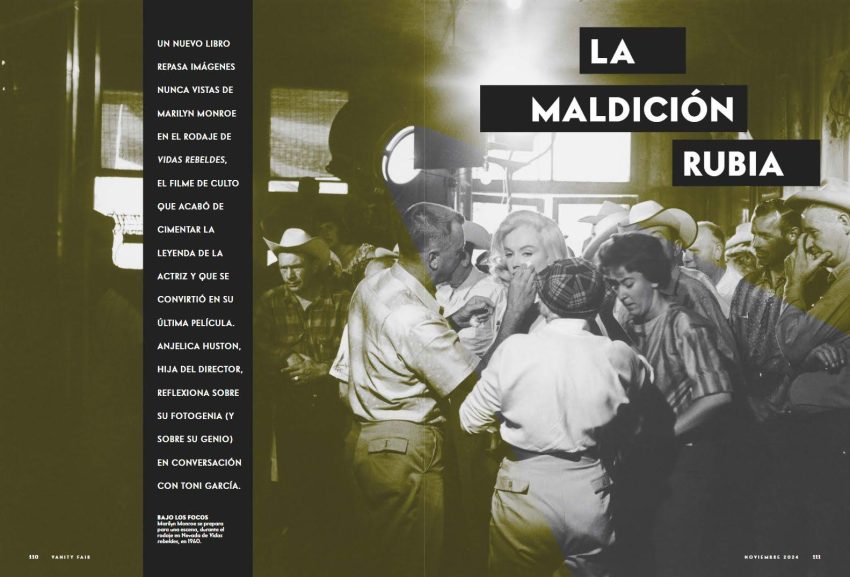
The November issue of Vanity Fair España (with Keira Knightley on the cover) includes an eight-page feature on ‘la maldición rubia’ – or blonde curse – of The Misfits, with Toni Garcia reviewing the recently reissued Marilyn monograph by Eve Arnold.
“In the history of cinema there are a handful of works that cinephiles consider ‘cursed’ … The most famous of all is The Misfits (released in Spain as Vidas Rebeldes), the last film by Marilyn Monroe … The filming in the Nevada desert, the conditions in which it took place, the fate of its leading trio and the film’s own story have made it one of those titles that film fans consider extraordinary and that time has taken care of revaluing, as usually happens with great works of art.
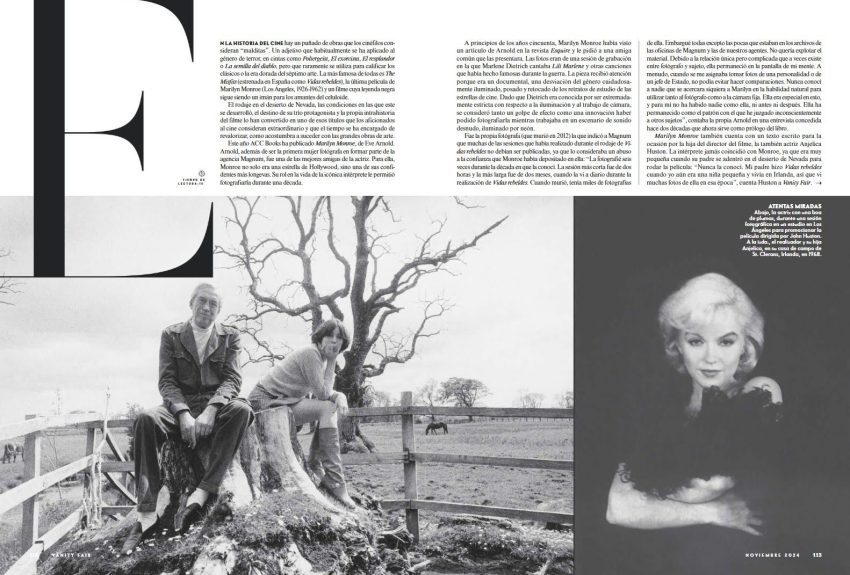
In the early 1950s, Marilyn Monroe had seen an article by Arnold in Esquire magazine and asked a mutual friend to introduce them … It was the photographer herself (who died in 2012) who indicated to Magnum that many of the sessions she had done during the filming of The Misfits should not be published, as she considered it an abuse of the trust Monroe had placed in her: ‘I photographed her six times during the decade I knew her. The shortest session was two hours and the longest was two months, when I saw her daily during the making of The Misfits. When she died, I had thousands of photographs of her. I seized all except the few that were in the files of the Magnum offices and those of our agents. I did not want to exploit the material,’ Arnold herself said in an interview given two decades ago that now serves as the prologue to the book.
Marilyn Monroe also has a text written for the occasion by the daughter of the film’s director, actress Anjelica Huston. The actress never met Monroe, as she was very young when her father went into the Nevada desert to film the movie: ‘I never met her. My father made The Misfits when I was still a little girl and I lived in Ireland, so I saw a lot of photos of her at that time,’ Huston tells Vanity Fair. ‘I think Marilyn represents the strongest but also the most vulnerable part of the American woman. She remains an extraordinary mystery. No one is sure if she was smart or dumb, if she was a woman for men or a woman for women. Obviously, she was an icon.’
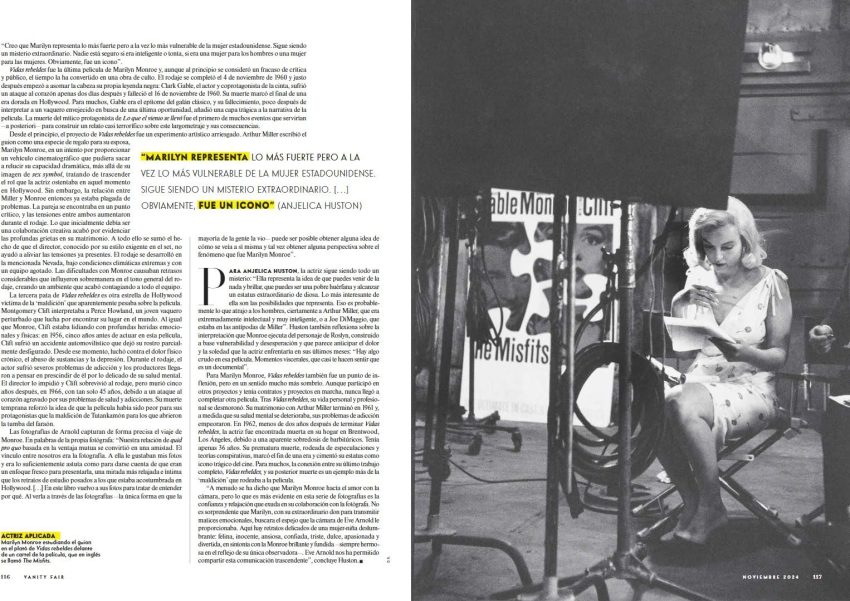
The Misfits was Marilyn Monroe’s final film, and although it was initially considered a critical and commercial failure, time has turned it into a cult classic. Filming was completed on November 4, 1960, and shortly afterward, its own black legend began to rear its head: Clark Gable, the actor and co-star of the film, suffered a heart attack just two days later and died on November 16, 1960. His death marked the end of a golden age in Hollywood.
From the beginning, The Misfits project was a risky artistic experiment. Arthur Miller wrote the script as a kind of gift to his wife, Marilyn Monroe … What was initially intended to be a creative collaboration ended up exposing the deep cracks in their marriage. Added to this was the fact that the director [John Huston], known for his demanding style on the set, did nothing to ease the already present tensions.
The third leg of The Misfits is another Hollywood star who fell victim to the ‘curse’ that apparently weighed on the film. Montgomery Clift played Perce Howland, a disturbed young cowboy struggling to find his place in the world. Like Monroe, Clift was dealing with deep emotional and physical wounds … Clift survived filming, but died five years later, in 1966, at just 45 years old, due to a heart attack aggravated by his health problems and addictions.
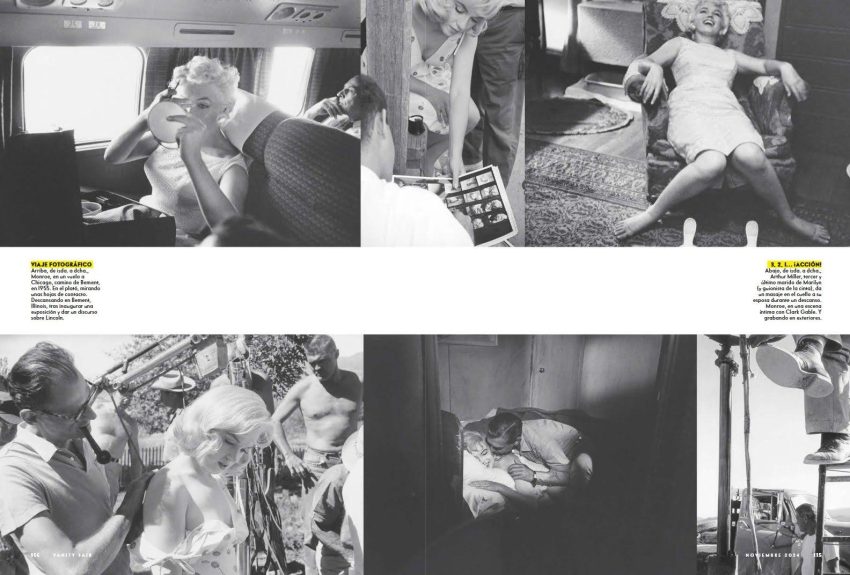
Arnold’s photographs accurately capture Monroe’s journey. In the photographer’s own words: ‘Our quid pro quo relationship based on mutual advantage developed into a friendship. The bond between us was photography. She liked my photos and was astute enough to realize that they were a fresh approach to presenting her, a more relaxed and intimate look than the posed studio portraits she was used to in Hollywood … In this book I return to her photos to try to understand why.’
For Anjelica Huston, the actress remains a mystery: ‘She represents the idea that you can come from nothing and shine, that you can be a poor orphan and achieve extraordinary goddess status. The most interesting thing about her is the possibilities she represents. That’s probably what attracted men, certainly Arthur Miller, who was extremely intellectual and very intelligent, or Joe DiMaggio, who was the antithesis of Miller.’ Huston also reflects on Monroe’s interpretation of the character of Roslyn, built on vulnerability and desperation and which seems to anticipate the pain and loneliness that the actress would face in her final months: ‘There’s something raw about that film. Visceral moments, that almost make you feel like it’s a documentary.’
‘It has often been said that Marilyn Monroe made love to the camera, but what is most evident in this series of photographs is the confidence and ease she exudes in her collaboration with the photographer. It is not surprising that Marilyn, with her extraordinary gift for conveying emotional nuance, sought out the mirror that Eve Arnold’s camera provided,’ concludes Huston.”
 The Marilyn Report