
As a new Eve Arnold exhibition opens in Germany – see here – Marilyn graces the cover of Arts & Collections International‘s latest issue. Inside, ‘The Spell of Marilyn’ – a 5-page feature on Eve’s reissued monograph, Marilyn Monroe – includes an interview with her grandson and archivist, Michael Arnold.
“What were your experiences of working with Eve in her London home office?
I worked as her assistant in her home office for a year before going to University. This is when I really got to know her body of work and the amazing people, events and places she captured.
How did your relationship with Eve develop over the years?
Eve was always someone special to me, even as a child. But it wasn’t until I moved to London when I was 12 that I started to spend more time with her and get to know her. She would take me out to the cinema, or an exhibition and we would sit around her kitchen table afterwards and talk for hours … After her death I felt I needed to play a part in keeping her legacy alive.
How did her attitudes to her work and particularly to that with Marilyn change with time?
I think previously Eve was much more interested in photojournalism and reportage. But the more she got to know Monroe, the more she was fascinated by her and captured by her spell. ‘Let’s make a Marilyn’ Monroe would say. Eve described her as being very smart and astute. She knew what she wanted and how to become the star she had always dreamed of.
What was it about Eve’s approach to photography that helped her to capture the more personal side of Marilyn?
Eve always treated everyone with respect and was compassionate and curious. She wanted to get to know her subjects and what made them tick. This genuine interest allowed people to let their guard down. They trusted her. This was very much the case with Monroe. By the time Eve arrived on the set of The Misfits in 1960 Monroe was struggling … Initially Eve was only meant to stay for two weeks. But Monroe asked her to stay on until the end of the filming.
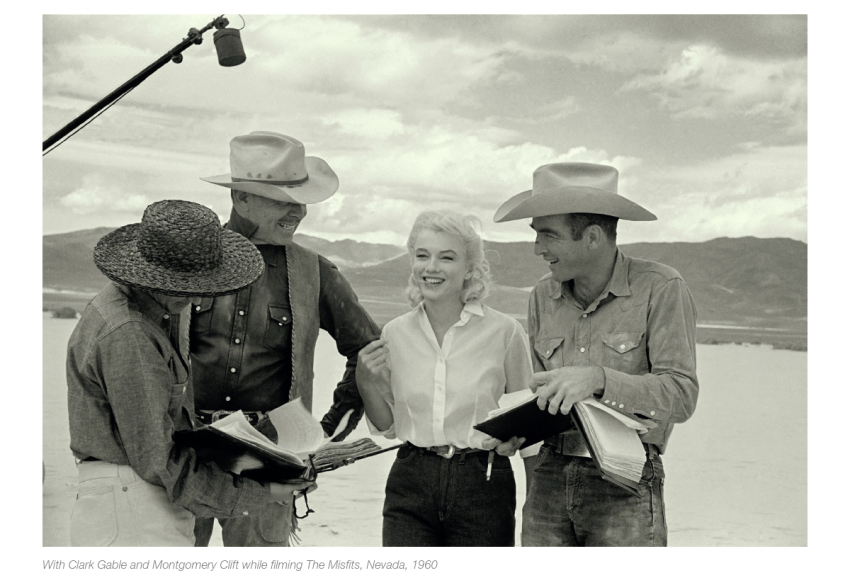
Eve was able to get close to Monroe and capture Monroe in a more personal light because she had taken the time to get to know her over the years they had worked together. A good example of this is the famous image of Monroe in the desert with the boom mic hanging over. Monroe can be seen nervously going over her lines for an important scene. She was acting alongside her childhood hero Clark Gable who was an extremely accomplished actor. The lines of dialogue were constantly being changed and he would rattle off the new lines as if nothing had changed.
Monroe felt under pressure to do the same and in this photo, we see some of this fragility beneath the seemingly confident exterior. Eve was very privileged to be able to see and document a more multifaceted Monroe than many of her photographer colleagues.
It’s been suggested that one of Eve’s virtues was her avoidance of judgement in her photographic work, do you agree?
Yes, I do agree. Eve was very keen to ‘show, not tell’. Through her work she wanted to ‘show you something you otherwise wouldn’t have seen’. But she believed it was her job not to tell you what to think about the subject. She wanted to present as honest a picture as possible, free from judgement. This is also what allowed her to get close to her subjects.
What were Danny Pope’s contributions to the new edition of Monroe?
Danny Pope remastered all the images for the book to bring out new depth and vibrancy that was sometimes lacking in the original book. Danny was Eve’s dark room colour printer during the 1980s and 90s. He learned from her exactly how Eve wanted her photos to look. He is also one of the very few printers who successfully transferred their expertise from the dark room into the digital realm.”
FYI: According to the Arts & Collections International website, a print edition of the magazine is also available – so if you’re interested, contact them here.
 The Marilyn Report
1 Comment
Comments are closed.