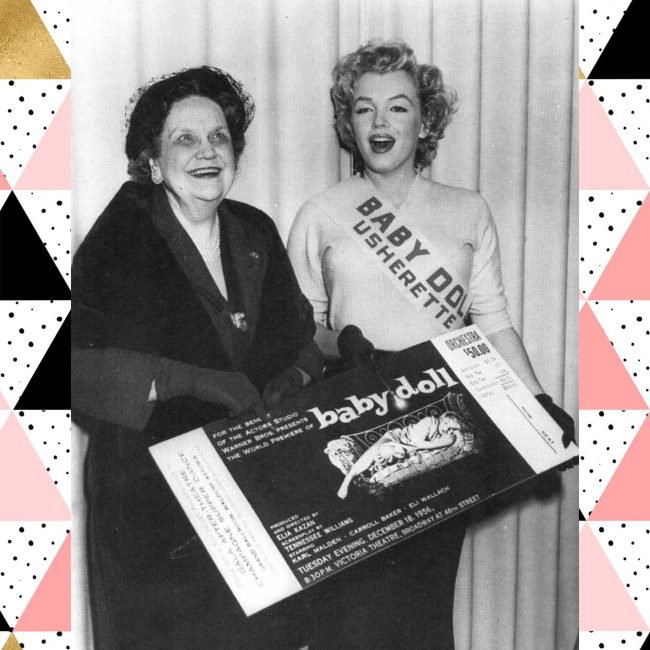
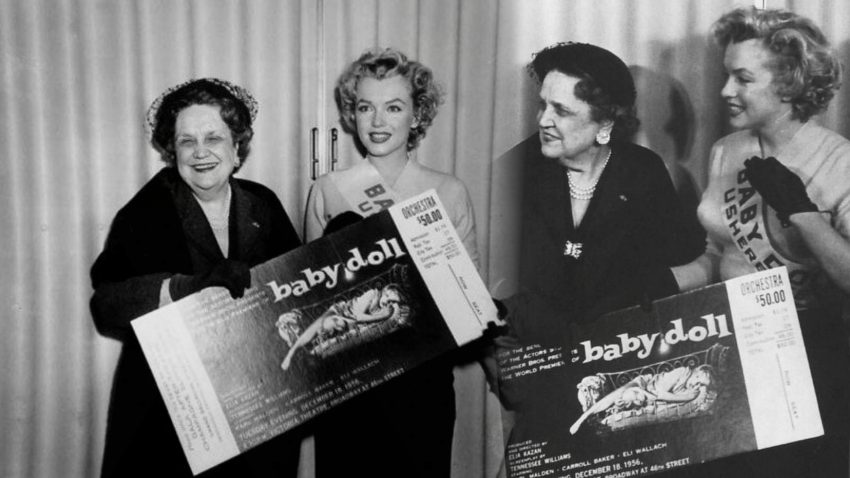
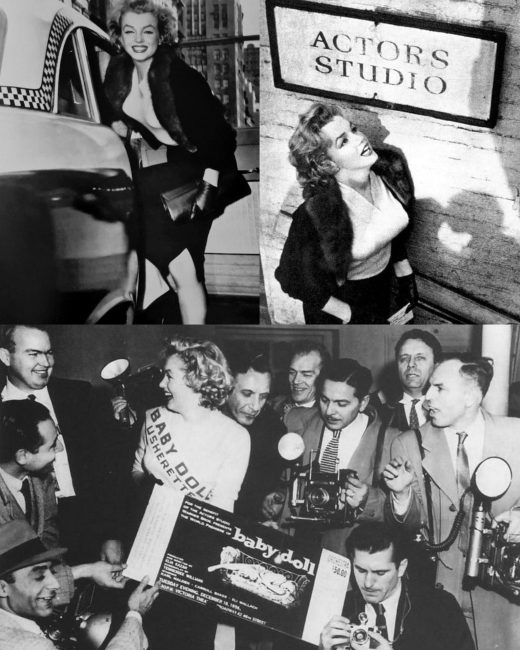
On December 4, 1956, Marilyn held a photo call for the New York press, wearing an usherette’s sash and holding a giant ticket for the upcoming premiere of Baby Doll. Her special guest that day was Perle Mesta, as noted in The Woman Who Knew Everyone, Meryl Gordon’s new biography of the wealthy widow turned US ambassador to Luxembourg, and celebrated hostess of parties for Washington’s political elite.
“Promoting a benefit for the Actors Studio, she posed for photographs with Marilyn Monroe (‘She’s a sweet little thing, charming and so pretty,’ Perle told a reporter) … She had become the woman who knew everyone. She had wined and dined and posed for photographs with an astonishing number of famous people, from Marilyn Monroe to Chiang Kai-shek to every American president dating back to Woodrow Wilson.”
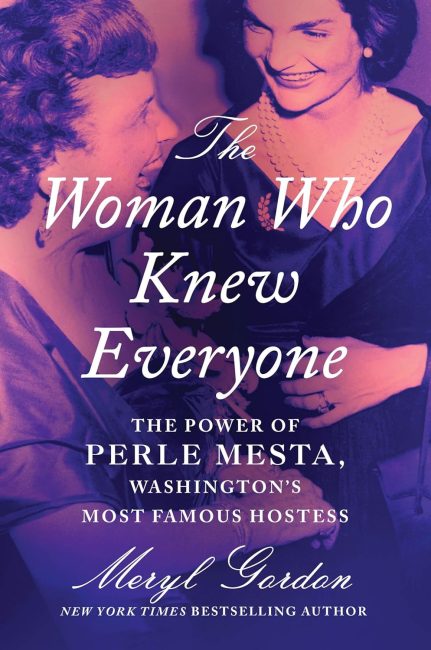
The book’s cover photo shows Perle Mesta with Jacqueline Kennedy in August 1956, when the future First Lady attended one of her legendary parties in Washington. Perle was an old friend of family matriarch Rose Kennedy.
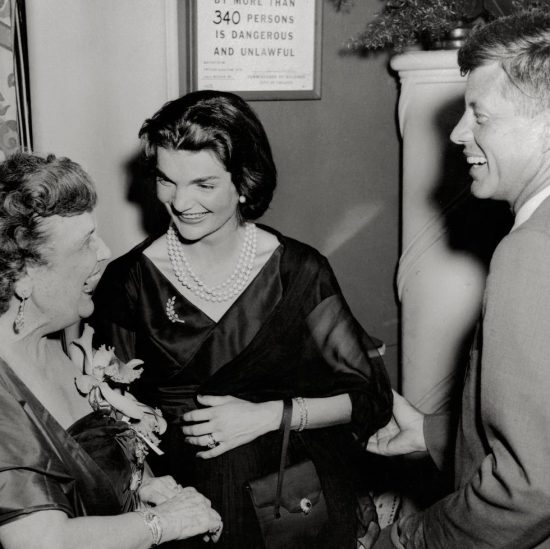
However, when Jackie’s husband, John F. Kennedy, won the Democratic nomination over Lyndon B. Johnson for the 1960 presidential election, Perle backed Republican candidate Richard Nixon instead – bringing her own political influence to an abrupt end.
In her heyday, Mesta had inspired Irving Berlin’s Broadway musical, Call Me Madam. In 1953, Marilyn attended the Los Angeles premiere of the movie adaptation, starring Ethel Merman as ‘the hostess with the mostest’.
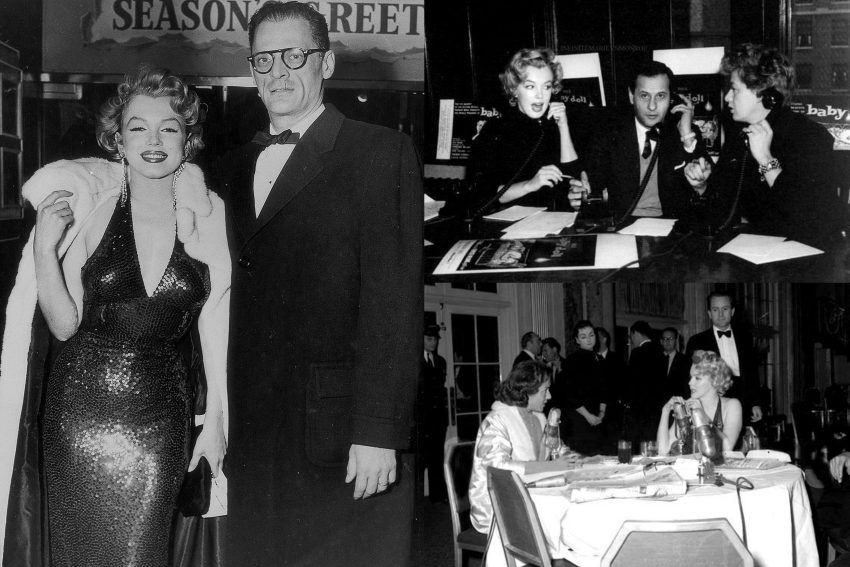
In addition to her publicity shots with Perle, Marilyn joined a ticket sales drive with actors Eli Wallach and Shelley Winters. On December 18, 1956, she attended the Baby Doll premiere with husband Arthur Miller, followed by an after-party (and a rare radio interview) at the Waldorf-Astoria Hotel.
Marilyn had helped out with earlier Actors Studio events, including the premieres for East of Eden and The Rose Tattoo in 1955. She was also considered for the lead in Baby Doll, until director Elia Kazan chose Carroll Baker instead. While the provocative heroine was certainly within Marilyn’s dramatic range, at thirty she had rather ‘aged out’ of the role.
Clearly she held no grudge, but given Arthur’s prior rift with Kazan – who had ‘named names’ to the House Un-American Activities Committee – it was surely an interesting evening!
 The Marilyn Report