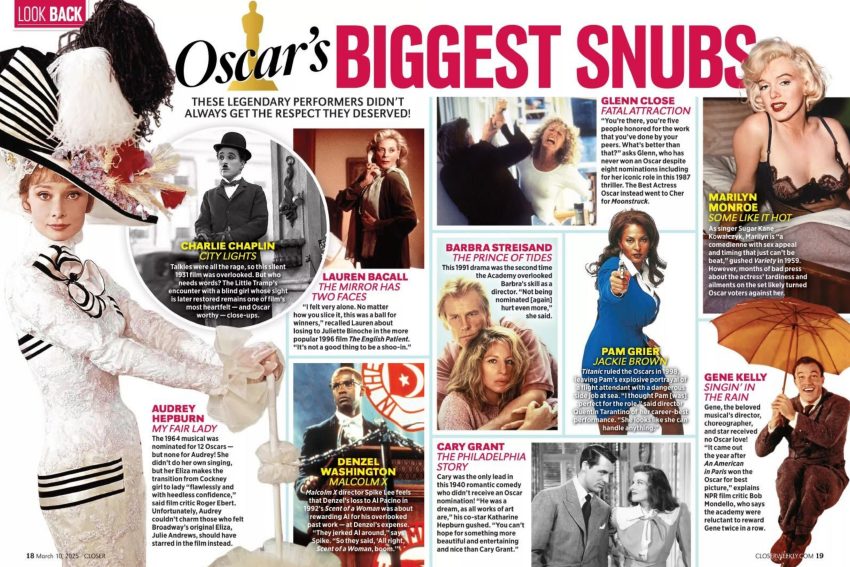
With this year’s Academy Awards set for Sunday, Closer Weekly (USA) looks back on the stars who missed out in its latest issue (dated March 10, with Esther Williams on the cover.) Focusing on Marilyn’s role in Some Like It Hot, the magazine suggests her erratic behaviour on the set may have cost her an Oscar nomination.

While this may be a valid point, I think Marilyn having less screen-time than her co-stars was also a factor, as Jack Lemmon did earn a Best Actor nomination – losing to Charlton Heston for Ben-Hur, one of eleven awards the biblical epic scored in 1960. Furthermore, the Academy tends to reward dramatic roles, with Doris Day that year’s only Best Actress nominee in a comedy for Pillow Talk – and she also lost out, with Simone Signoret taking home the Oscar for Room at the Top.

And elsewhere, one of Elliott Erwitt’s cast photos for The Misfits – with himself in the frame – is featured in ‘The Big Picture,’ a regular double-page spread. The death of Clark Gable cast a pall over The Misfits, which received no Oscar nominations in 1962. Had Marilyn been nominated as Best Actress, she would have faced stiff competition from Audrey Hepburn (Breakfast at Tiffany’s), Piper Laurie (The Hustler), Natalie Wood (Splendour in the Grass), and the ultimate winner, Sophia Loren for Two Women.
And finally, a timely reminder that many other Hollywood legends – including Marilyn’s erstwhile co-stars Cary Grant and Lauren Bacall – never won an Academy Award…
UPDATE:
Over on her Shadows and Satin blog, Karen Burroughs Hannsberry names Marilyn among other golden age stars overlooked by the Academy – alongside leading men Joseph Cotten and Dean Martin, and the original blonde bombshell, Jean Harlow.
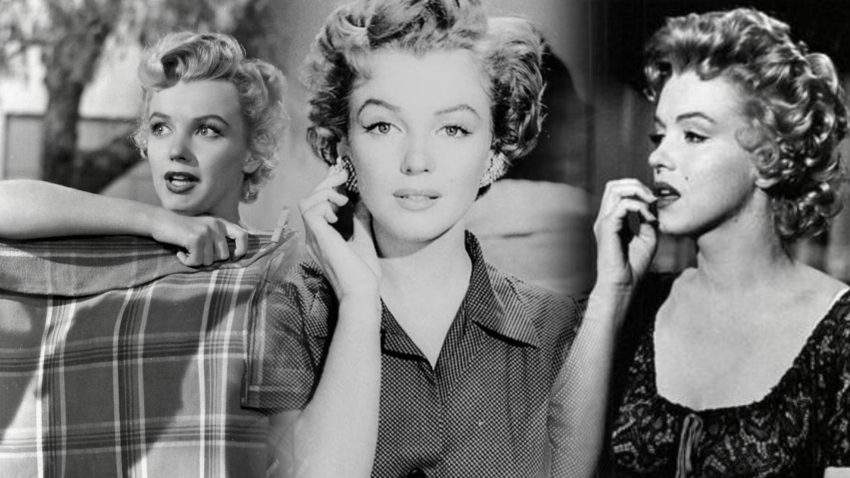
“When most people reflect on Marilyn Monroe, I’d venture to say their first thought is not her acting ability – but I think that’s a mistake. While her acting talents may have been overshadowed by her sheer dazzle, I think she could have been Oscar-nominated for a number of her films, but especially Don’t Bother to Knock (1952), where, in one of her few completely dramatic roles, she played a mentally ill young woman; Clash by Night (1952), in a supporting role as a fish cannery worker who was at once feisty, independent, and sweet; Bus Stop (1956), where she was funny and heartbreaking as a semi-talented café singer with aspirations of Hollywood stardom.”
 The Marilyn Report