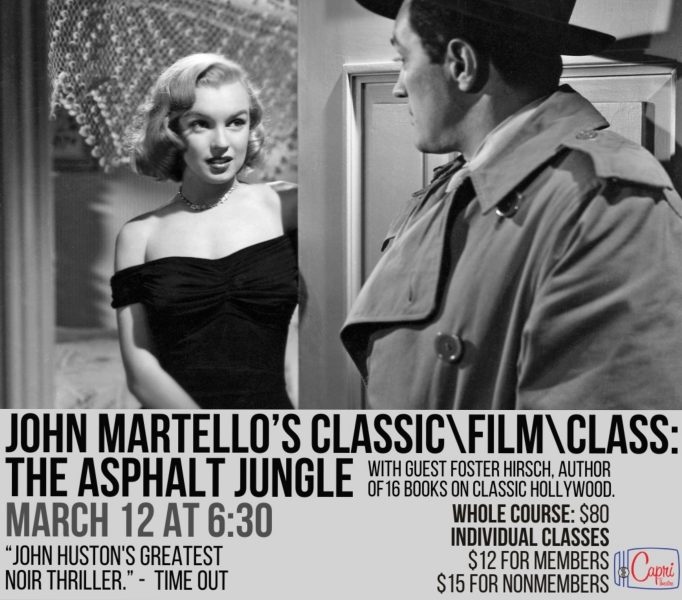
The Asphalt Jungle – which turns 75 this spring – is showing at the historic Capri Theatre in Montgomery, Alabama on Wednesday, March 12, at 6:30 pm, as part of John Martello’s Classic\Film\Class series.
“John Huston’s gritty noir classic marked a turning point in the history of MGM and became a template for many of the heist films that would follow including Jules Dassin’s RIFIFI, Stanley Kubrick’s THE KILLING and Quentin Tarantino’s RESERVOIR DOGS. The story takes place in an unnamed city in the Midwest. Criminal mastermind Erwin ‘Doc’ Rieden (Sam Jaffe) is released from prison and has a meeting with ‘Uncle’ Lon Emmerich (Louis Calhern), a crooked lawyer who is intrigued by Doc’s plan to steal jewellery worth over one million dollars – in 1950 dollars – and is even more intrigued by his ‘niece’ Marilyn Monroe (in her breakout role).”
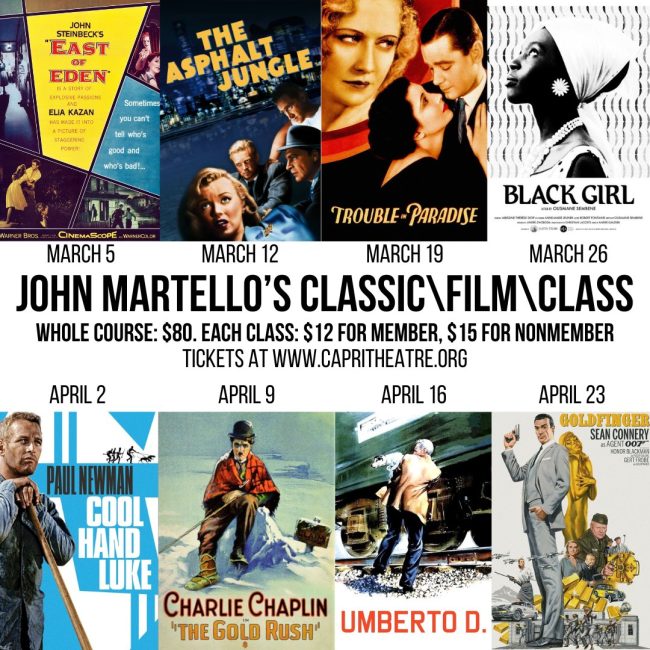
The show will be followed by a streamed discussion with Foster Hirsch, whose 2023 book, Hollywood and the Movies of the Fifties, details how The Asphalt Jungle marked a departure from outgoing studio head Louis B. Mayer’s manicured fare – and how his replacement at MGM, Dore Schary, let Marilyn slip through his hands.
“Mayer also disagreed with Schary about two major projects that were endorsed but not personally produced by the newcomer. When the Schary-sponsored Asphalt Jungle, a film noir drenched in despair, opened to acclaim in June 1950, Mayer was apoplectic. To close associates he railed against the heist thriller as ‘full of nasty, ugly people doing nasty, ugly things. I won’t walk across the room to see a thing like that.’ Horrified, Mayer regarded the film as a personal affront, a refutation of the airbrushed, idealised Americana he had always promoted. Taking place in an inner-city world of shabby rooms, The Asphalt Jungle looks nothing like a traditional MGM product. John Huston‘s taut direction and screenplay (co-written by Ben Maddow), the grainy black-and-white cinematography by Harold Rosson, and the work of the ensemble cast reveal not a trace of the ‘more stars than there are in heaven’ house style.
With his enthusiastic support of The Asphalt Jungle, Schary right from the start of his MGM tenure was continuing to sponsor the kind of dark thrillers he had supervised at RKO … Mayer did not approve of any of them and was vocal in pointing out that all the gloom-ridden Schary-sponsored movies about crime and racism, about husbands plotting to kill their wives and law-abiding citizens resorting to crime, were box-office duds. Even The Asphalt Jungle, the most acclaimed of the noir-stained MGM ensemble, posted only a modest profit. Nonetheless, as Scott Eyman, Mayer’s unsympathetic-to-Schary biographer, admitted, ‘Schary was clearly nudging the studio into the postwar world.’
Schary bashers point to his failure to sign Marilyn Monroe to an MGM contract after her striking supporting performance in The Asphalt Jungle. ‘I was guilty of an egregious error,’ Schary later admitted. ‘I did not recognise Marilyn Monroe’s star potential, particularly since we seemed to have a plethora of glamorous women stars. Darryl Zanuck signed Miss Monroe, she became an extraordinary figure in movie history, and for years I blushed with embarrassment each time her name was mentioned.'”
 The Marilyn Report