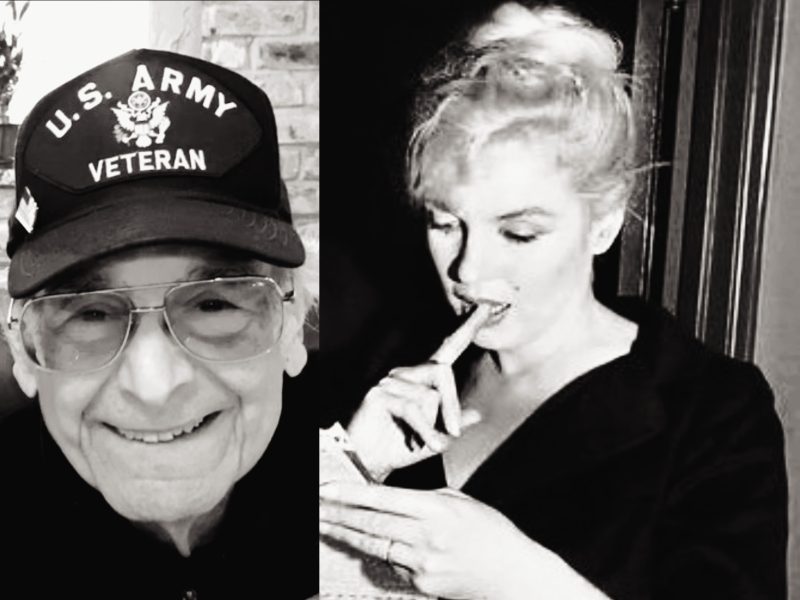
Modesto ‘Bob’ Medina, archivist at the New York Times news ‘morgue’ and photo library for over 40 years, died aged 95 on March 20, 2025, NJ.com reports. “My dad was Google before there was Google,” his son Carlos said.
One of Bob’s favourite anecdotes was an encounter with Marilyn when she visited the New York Times building, which was situated on West 43rd Street until 2007, when the newspaper moved to Eighth Avenue.
“Medina said the brushes with celebrities are what his dad liked talking about the most in his later years. A shout-out from Ed Sullivan on TV – ‘special thanks to Bob Medina and The New York Times‘ – has long been part of the family lore.
Of course, nothing topped the meeting with Monroe, the world’s biggest star, when she came to the paper with Miller, the famed playwright seeking information for his latest work.
While outsiders from the newsroom tried to sneak a peek at the icon, Medina said his father enjoyed a one-on-one conversation with a star he described as glamorous and down to Earth.
According to Medina, his dad gave Monroe a personal tour of the morgue, including unpublished photos of her and others.
‘Even then, they would take hundreds of photos of people but only use a few,’ Medina explained. ‘Remember, there wasn’t any “online” back then. So, they only could be found in places like the morgue at the Times. My dad was able to show Marilyn Monroe pictures the paper didn’t use – and willingly gave her a few she liked.'”
It’s unclear what project Arthur Miller was working on at the time. It could have been The Misfits, which he filmed with Marilyn in 1960; or the big-screen adaptation of A View From the Bridge, released in 1962.
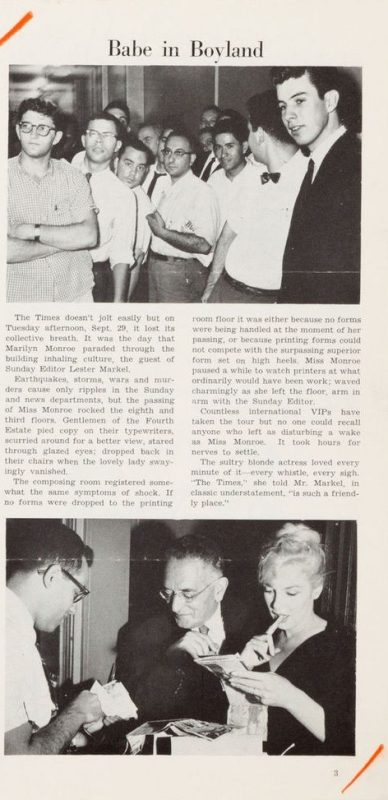
Among a collection of Marilyn’s correspondence sold at Heritage Auctions in 2013 is a rare 1959 staff pamphlet, Times Talk, with an item headlined ‘Babe in Boyland’ describing her visit.
“The Times doesn’t jolt easily but on Tuesday afternoon, Sept. 29, it lost its collective breath. It was the day that Marilyn Monroe paraded through the building inhaling culture, the guest of Sunday Editor Lester Markel.
Earthquakes, storms, wars and murders cause only ripples in the Sunday and news departments, but the passing of Miss Monroe rocked the eighth and third floors. Gentlemen of the Fourth Estate pied copy on their typewriters, scurried around for a better view, stared. through glazed eyes; dropped back in their chairs when the lovely lady swayingly vanished.
The composing room registered some-what the same symptoms of shock. If no forms were dropped to the printing room floor it was either because no forms were being handled at the moment of her passing, or because printing forms could not compete with the surpassing superior form set on high heels, Miss Monroe paused a while to watch printers at what ordinarily would have been work; waved charmingly as she left the floor, arm in arm with the Sunday Editor.
Countless international VIPs have taken the tour but no one could recall anyone who left as disturbing a wake as Miss Monroe. It took hours for nerves to settle,
The sultry blonde actress loved every minute of it every whistle, every sigh. ‘The Times,’ she told Mr. Markel, in classic understatement, ‘is such a friend-ly place.'”
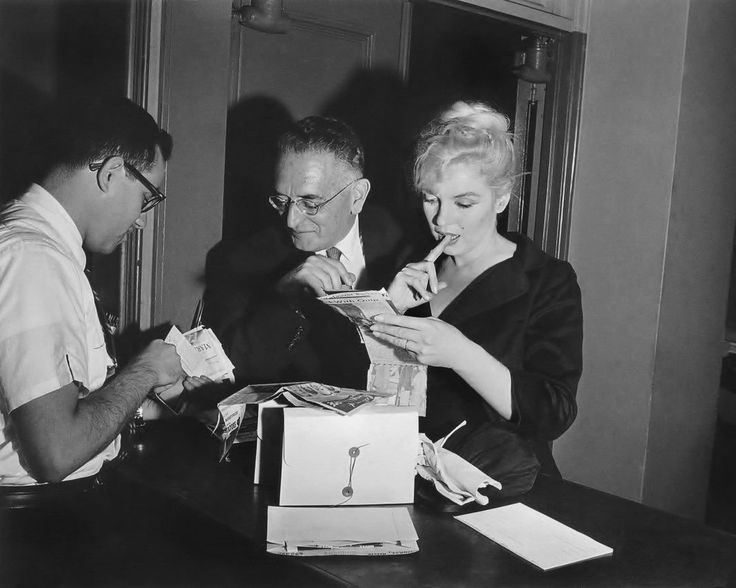
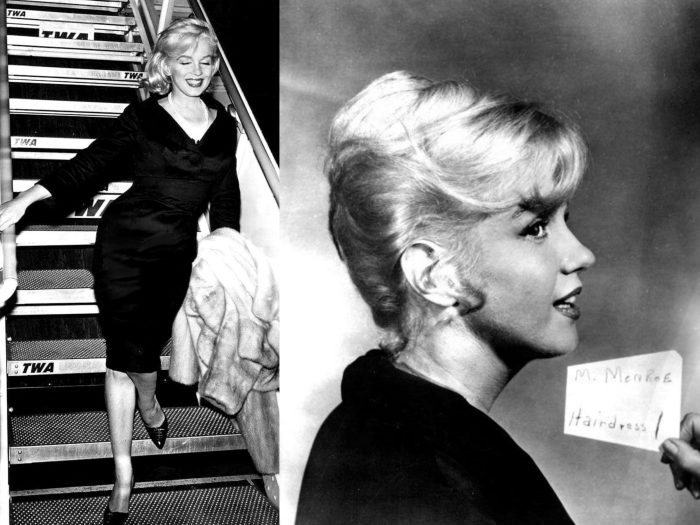
Could one of the adoring male faces in the accompanying photos be Bob Medina’s? Lester Markel is shown next to Marilyn here, with another man behind the desk. Marilyn’s hair is worn in a chignon, similar to how it would appear in test shots for Let’s Make Love (1960), and in The Misfits; while her outfit resembles the black suit she had worn at Idlewild Airport when boarding a flight to Los Angeles for Soviet premier Nikita Khrushchev’s visit to Twentieth Century-Fox on September 19.
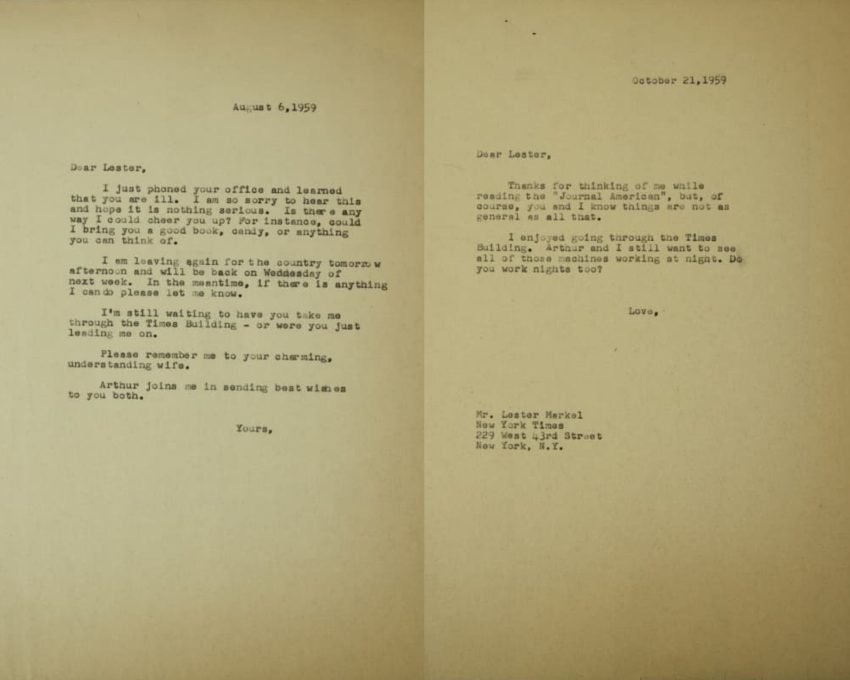
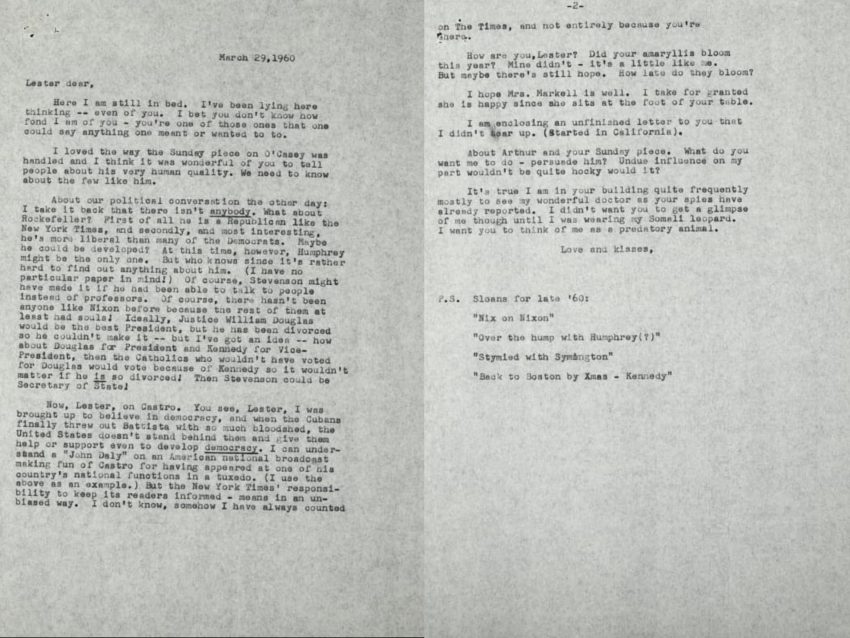
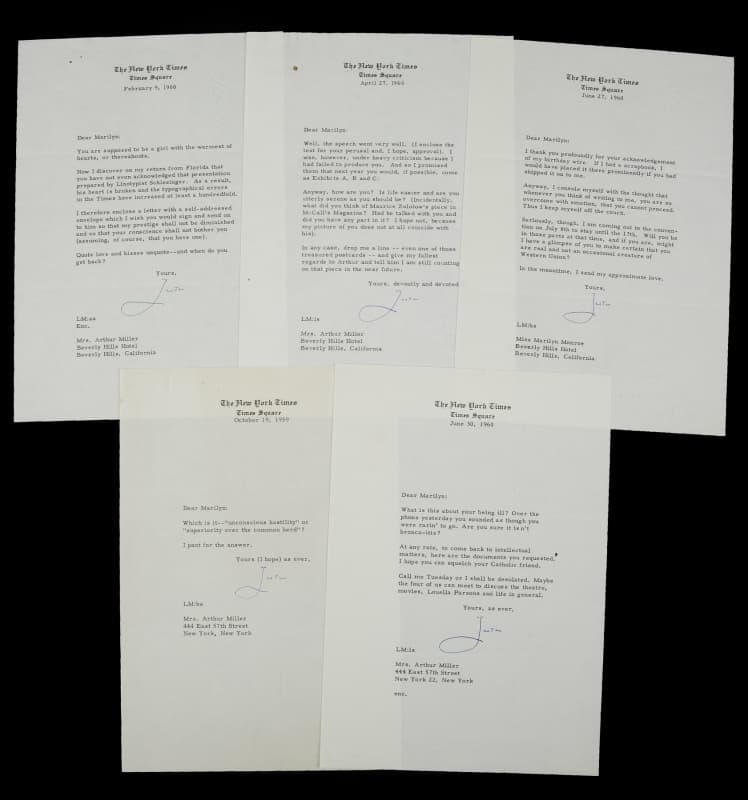
And finally, Marilyn’s friendship with Lester Markel preceded her Times visit, as seen in correspondence sold at Julien’s Auctions in 2016. (Interestingly, an offhand remark from Marilyn suggests she wasn’t initially as enamoured of JFK as the gossip-mongers would have us believe …)
“A series of letters including five unsigned file copies of Marilyn Monroe’s letters to Pulitzer Prize-winning journalist Lester Markel together with five typed, signed letters from Markel on New York Times letterhead. The two had a friendship and an interesting series of communications dated between August 6, 1959, and June 30, 1960, including the now famous letter in which Monroe demonstrates her humour and comprehensive understanding of the politics of their time. On the subject of Fidel Castro, Monroe writes, ‘Now, Lester, on Castro. You see, Lester, I was brought up to believe in democracy, and when the Cubans finally threw out Battista [sic] with so much bloodshed, the United States doesn’t stand behind them and give them help or support even to develop democracy.’ She also discusses possible presidential candidates and offers slogans for their campaigns in the post script: ‘Nix on Nixon’ and ‘Back to Boston by Xmas – Kennedy.’ Two of the five pages of Monroe’s file copies contain three drafts of the same letter that is left unfinished.”
 The Marilyn Report
1 Comment
Comments are closed.