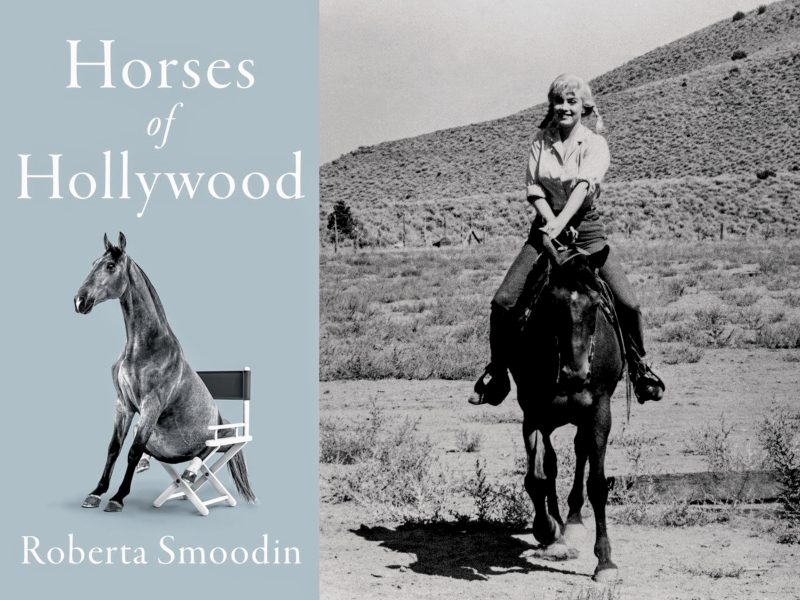
The Misfits remains one of Marilyn’s more controversial films 64 years after its release, not least because of its graphic depiction of the mistreatment of wild horses. In a new book, Horses of Hollywood, Roberta Smoodin argues that without horses, American cinema as we know it might never have existed.
“In Horses of Hollywood, Roberta Smoodin gives equine film stars the credit and recognition they have long deserved. Smoodin goes behind the scenes to feature the trainers, actors, and directors who brought some of our favorite horses into the spotlight. From silent movie horses like Gallant Bess, to John Wayne and his four-legged sidekicks, to the origins of the ‘horse girl’ trope in National Velvet, to equine actors in Ridley Scott films, Horses of Hollywood ensures that no self-proclaimed horse whisperers detract from the real stars of the show. Smoodin—who was for many years a horse breeder and caretaker—explains what went right and amiss in films featuring horses, including factual discrepancies and unrealistic depictions of human-equine relationships.”
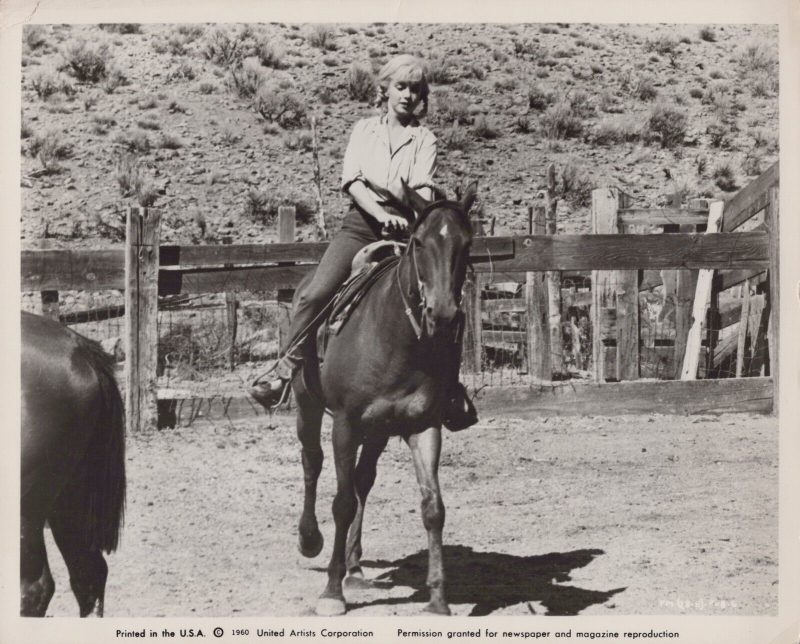
In a chapter entitled ‘Heartstrings,’ Smoodin compares The Misfits with another non-traditional Western, No Country for Old Men (2007.)
“We horse lovers have a love/hate relationship with films that use horses to make us cry. We can watch violence being done by humans to humans in any Quentin Tarantino or Martin Scorsese film without getting weepy, but kill a horse and the floodgates open. This phenomenon may say something important and even sinister about the horse lover’s soul – we may be miscreants when it comes to humans. But our hearts are pure when it comes to horses.
The Misfits (1961) is a film you either hate to love or love to hate. Wild horses are rounded up for profit and slaughter; although they struggle mightily against the men who would capture them, they lose their battle for their continued wild existence, their souls, their integrity. The thematic irony is that the men doing the rounding up are men deeply invested in their off-the-grid, free existence, part of a dying breed: cowboys … What makes the film more tragic are Clark Gable’s death, which occurred less than two weeks after filming was completed; Marilyn Monroe’s premature and mysterious demise; and the premature passing of Montgomery Clift in 1966, the result of alcoholism and drug addiction.
The film is about real, human death, horse death, and the death of cultures of freedom, and it has a sepulchral quality that informs every frame, not to mention its purple pedigree: it was written by Arthur Miller (then married to Marilyn Monroe) and directed by John Huston. David Niven fully believes, as is detailed in one of his memoirs, that The Misfits killed Gable, the true professional on set, having to put up with Monroe’s and Clift’s epic lateness and lack of preparedness. Bored by the endless waiting, Gable insisted on doing many of his own stunts with the wild horses in the extreme desert heat, and this took its toll on his already fragile heart…
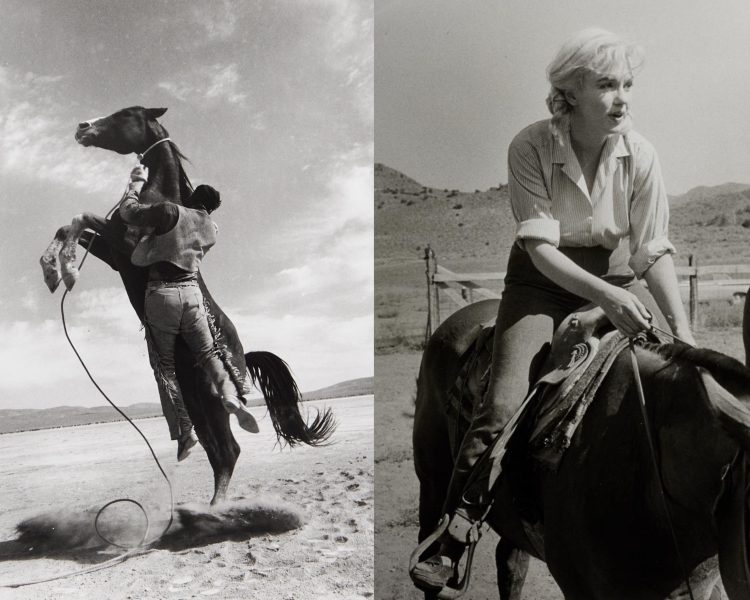
But the horses in The Misfits aren’t merely symbols. The stallion who leads the small band of wild mustang mares struggles mightily with Gable, Clift and Eli Wallach, refusing to be tamed until the three men wear him down … When Clift, suddenly comprehending Monroe’s empathy with these beautiful, wild creatures, cuts his rope to set him free, the stallion engages in yet another clash with Gable, a kind of macho bout for alpha male. Gable is dragged by the stallion, who then rears and paws at him, seemingly about to kill him, but Gable subdues him, pets him, and then sets him free. Gable’s character, Gay Langland, has had an epiphany like that of Clift’s character, Perce Howland, and he frees all the horses. Do they now realise that the animals they struggle with are the equine versions of themselves?
Miller based Monroe’s character, Roslyn Tabor, on Monroe’s actual life, specifically her sorry childhood in foster homes and orphanages. If Monroe off the soundstage was half as empathic and compassionate as this character, she was indeed a rare individual. She feels for these damaged men, Gay’s dog Tom Dooley, and especially for the horses and their ugly fate, though she is also a sexual object desired by all of the male characters. At thirty-four, Monroe’s face appears puffy and, in some shots, lined, and her waistline has thickened. But like the wild horses, she has ineffable, untameable qualities which are unmistakable. Her soon-to-be ex-husband Miller wrote this film as a love letter to her, her sweetness and her impossibility in the real world. So she too is twinned with the wild horses, not long for this ugly world.
Gable too appears weather-beaten and past his prime, though he gives an amazing performance as Gay, and Clift, who had suffered a nearly fatal car accident in 1957, has a face with no memory of his fine, good looks before that accident, not unlike the wild horses, who are thin and rugged … In these three stars, the casting is brilliant, though profoundly troubling. Nearly everything about this film is disconcerting. This is a tragic and romantic film […] in which neither cowboys nor horses can truly fit into the modern world nor can men and women truly connect or fit together to find real happiness. Thelma Ritter, as Monroe’s friend, says, ‘Cowboys are the last real men left in the world,’ but like the wild horses, they are a dying breed and are now misfits.”
In 2011, The Misfits was featured in ‘Honouring the Horse‘, an exhibition at the University of Nevada in Reno; and some of the region’s last remaining ‘misfit horses‘ won a judicial reprieve in 2015.
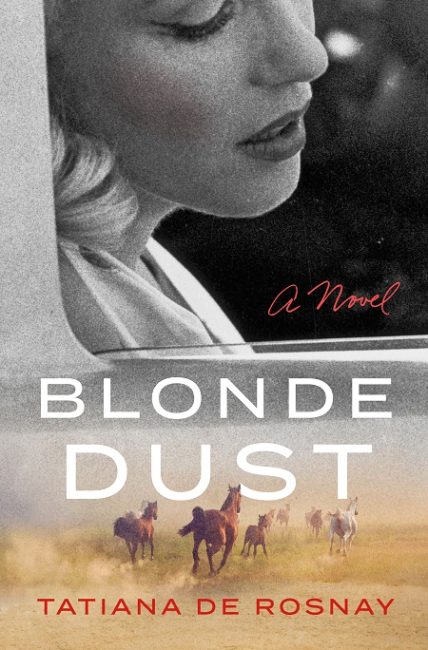
And on a related note, Blonde Dust – Tatiana de Rosnay’s novel set during filming of The Misfits – will be released in the US on June 3. It was first published in France in 2024 (see here.)
“Pauline, a young chambermaid who works at the legendary Mapes Hotel in Reno, Nevada, is asked to step in for a colleague and clean Suite 614. Although she was told the rooms were empty, a dazed, sleepy woman appears before her. This is Mrs. Miller, aka Marilyn Monroe, whose stay in Reno coincides with the breakdown of her marriage to Arthur Miller and the filming of what was to be her last film, The Misfits.
Set in the American West in 1960 where the mustang horses run wild, an unexpected friendship unfolds between the most famous movie star in the world and a young cleaning woman whose life will be changed forever through the course of a few weeks. A testament to the enduring power of female friendship and a reimagining of a side of Marilyn Monroe that has never been seen before.”
‘A lovely portrait of female friendship, loss, and the unexpected ways in which a life can change. Haunting.’— Kristin Hannah, author of The Women
‘A Hollywood tale with heart’—Adriana Trigiani
 The Marilyn Report