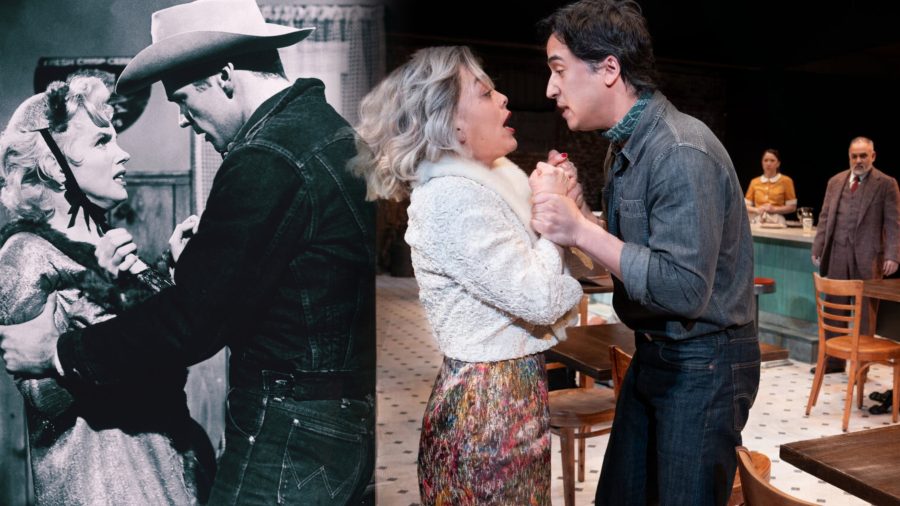
Bus Stop was a success onstage before it hit the big screen, but William Inge’s play has been revived only once on Broadway. His original vision – set entirely in Grace’s Diner, and featuring additional characters and an expanded storyline for the young waitress Elma – remains quite popular in provincial and non-profit theatre.
Bus Stop has now returned to New York with a professional off-Broadway production by the Classic Stage Company in association with the National Asian American Theatre Company (NAATCO), running through June 8 at the Lynn F. Angelson Theatre on East 13th Street in Manhattan’s Union Square neighbourhood.
“William Inge’s Bus Stop opened in March, 1955 and was a Tony nominee for that year’s best play, as were Harold Clurman for best director and Elaine Stritch [as Grace] for best supporting actress. Now it’s revived by Classic Stage Company, NAATCO, and Transport Group in a production directed by Jack Cummings III that, were Inge introducing it now, would undoubtedly retain a strong Tony chance.
As always with the three-act piece, the action unfolds at 1am and continues until 5am in a street corner restaurant—Grace’s Diner—30 miles west of Kansas City … Diner owner Grace Hoylard (Cindy Cheung) and assistant Elma Duckworth (Delphi Borich) must cater to delayed passengers Cherie (Midori Francis), a chanteuse of questionable past; Bo Decker (Michael Hsu Rosen), a Montana rancher stalking Cherie … How even cleverer of Inge to provide his own Romeo and Juliet in Bo and Cherie. Granted, audience members are ahead of him on the eventual reconciliation, but probably that’s where Inge wants them to be, sufficiently satisfied to see how he works things out. Has Inge’s reputation faded unfairly since his death? This revival burnishes it.
Cummings has the oh-so-right cast at his incisive disposal. If choosing a first among equals had to be done, Francis’ fluttery Cherie would have to be it; but no, Rosen’s combustible Bo would have to be it … and so on through all eight ensemble members.
A final significant comment: Cummings sticks scrupulously to the Bus Stop text. But with one exception … The change greatly affects the ending—and, more directly, who is left onstage as [the] lights fade.”
– David Finkle, New York Stage Review

“The diner’s owner Grace and a waitress, the high school student Elma, are used to parades of customers, but maybe not for such extended stays … the most striking of the newcomers is Cherie, a nightclub singer who has been whisked away by Bo, a smitten young cowboy who plans to take her to his Montana ranch, whether she likes it or not.
The story line is rattling to a contemporary audience. But the beauty, humanity and complexity of Inge’s writing is that he makes us understand what drives Bo and, even more important, who Cherie is and why she stays with Bo.
Both naïve and wise to the ways of the world, she has been ‘goin’ with guys’ since she was 14 – ‘down in the Ozarks, we don’t waste much time,’ she says. Delivering the show’s standout performance, Francis illuminates how Cherie realises that she may have met someone who not only cares about her, but also doesn’t mind what she had to do to survive. A performance of ‘That Old Black Magic,’ backed by Bo’s friend, Virgil (Moses Villarama), on guitar, hits the right balance of awkwardness and sincerity: This Cherie is not wanting for pity or de-serving of laughter. (Unfortunately, Rosen is not as assured as Bo, making the relation-ship more imbalanced than it should be.)
Inge’s main subjects are usually said to be loneliness and the search for connection. Bus Stop has something else: Its examination of masculinity is particularly perceptive about the way it can instill feelings of inadequacy and shame, but also a quiet confidence. This production might not hit all the play’s grace notes, but I’m still glad it pulled over for a while.”
– Elizabeth Vincentelli, New York Times
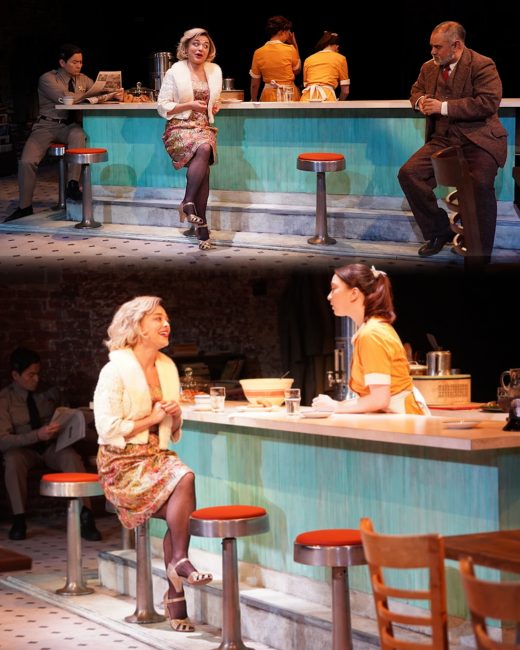
“The most prominent dramatic arc revolves around Cherie’s attempts to escape the clutches of Bo, who is forcing her to marry him even though she doesn’t love him. But other interpersonal dramas grace this claustrophobic canvas … And though Virgil acts as a father figure to the younger, brasher Bo, there are hints throughout of a much deeper affection he has for him.
Perhaps it’s obligatory to note this production’s all-Asian American cast, suggesting the possibility of viewing this play from a fresh cultural perspective. That never quite materialises in the production, but when the performances are as well-calibrated as most of these are, that hardly matters.
Francis may not perfectly maintain her Southern accent, but she nails Cherie’s innocent side underlying the world-weary exterior. So does Rosen, finding a core of touching naïveté to a character whose behaviour many would find inexcusably macho.”
– Kenji Fujishima, Theatre Mania
“Cherie, uneducated, down on her luck and with a long history of brief affairs behind her is of two minds about making Bo her beau. He is physically abusive and inexperienced when it comes to relationships, but she suspects that underneath Bo’s gruff facade lies a tender soul, so she just might be willing to roll the dice with him if he stops throwing punches. Francis unearths Cherie’s heart of gold, making her a likeable waif whose bad choices come with good reasons. But Rosen’s performance is more problematic. Bo is meant to be mean and threatening on the outside, soft and naive underneath. And while the softness eventually comes through, he seems frantic rather than mean, nervous instead of threatening; more neurotic New Yorker than beefy cowpoke.”
– Stanford Friedman, The Front Row Centre

“If Inge’s language avoids vulgarity, he doesn’t hide his core subject: the myriad agonies that come with love and sex. Let us refer to the aforementioned labels and map them. Impetuous young cowboy Bo lost his virginity to nightclub singer Cherie, subsequently forced her on a bus and has been harassing her for more physical affection … Cherie, suitcase stashed behind the counter, prays the bus will leave soon—without her aboard … In a role that Marilyn Monroe hoped would prove her acting bona fides, Francis sports blonde highlights and adopts a Southern drawl to charming effect. Cherie is neither victim nor innocent, and the gifted Francis finds the right proportion of kittenish alarm to hellcat fury … Rosen’s recently deflowered cowpoke is a baby-man with a temper, and for the first half Rosen seems more like a rodeo fop than a real fella. But his Bo grows on you, acquiring layers of pain and emotional intelligence before your eyes.”
– David Cote, New York Observer
“It’s a lonely time in the world right now. An unoriginal observation, though with no less truth in it, is that our age of mass telecommunication technology has only accentuated our collective solitude … So the impulse to revive William Inge’s Bus Stop, now at Classic Stage Company, makes sense. Inge’s middle-of-nowhere Kansas purgatory is a potentially useful arena in a time capsule to work through these ideas, with the cast of locals and drifters untangling their various psychosexual hangups at a desolate diner. But there’s none of that urgency in this production directed by Jack Cummings III, with much of the cast skimming the surface of Inge’s words.
With few exceptions … Cindy Cheung’s assured five-and-dime owner Grace (an all-too-small role for such a pro), the soft and sensitive Midori Francis as kidnapped singer Cherie — these characters talk about their loneliness and their inability to form or sustain personal connection but rarely inhabit it.
Cummings and cast also miscalibrate the humour and darkness, in that there’s not enough of either … As Bo pesters Cherie, the attempt at making this faux macho man pity-worthy falls flat because the gestures (he veers on violence throughout) feel stilted. The hunger and desperation from the cast feel put-on and absent of the cratering sadness that drives the play.”
– Kyle Turner, New York Theatre Guide
 The Marilyn Report