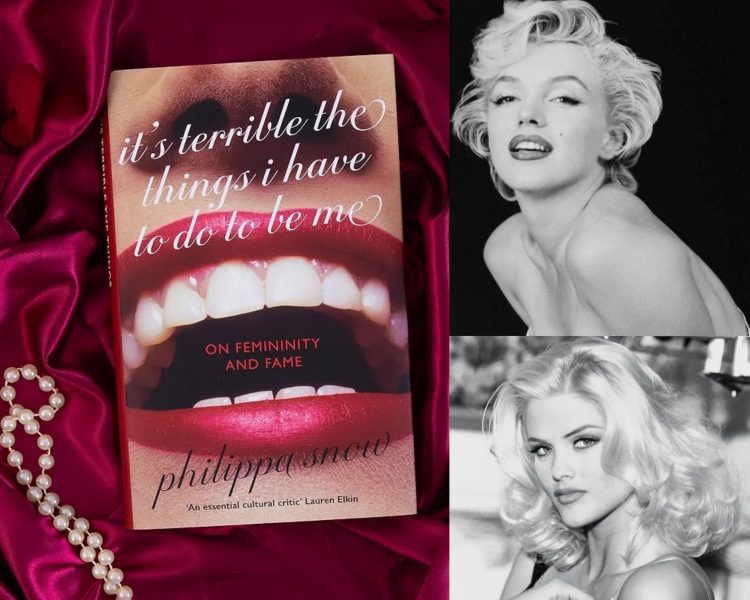
It’s Terrible the Things I Have to Do to Be Me is a new essay collection from Philippa Snow, exploring themes of femininity and fame. In this extract from the first chapter – first published in The White Review in 2021 – Snow looks at the parallel fates of Marilyn and Anna Nicole Smith, the ’90s model who remade herself in Monroe’s image.
“Here was a woman who had modelled her life so closely on Marilyn Monroe’s that doing so eventually helped drive her to her death – the blonde waves and the fake breasts; the pill addictions and the airheaded pronouncements about men and sex and diamonds; the years spent tumbling down the rabbit-hole in search of somebody with cash willing to play at being Daddy; the Playboy cover and centrefold, and the unwise sexual exhibitionism, and the occasional moments of bleak honesty that nodded at some formative abuse – and yet still she achieved twice the thing that Monroe never did: for four days, from 7 September 2006 to 10 September 2006, Anna Nicole Smith was a mother to two children. As it had for Monroe, who confessed in her last year that she had wanted children ‘more than anything’, motherhood held as much significance for Smith as big-time fame did, her desire to be the world’s hottest chick only commensurate with her certainty that she should procreate. ‘I’m either going to be a very good, very famous movie star and model,’ Smith told Entertainment Weekly at the height of her success, in 1994, ‘or I’m going to have a bunch of kids. I would miss having a career, but I’ve done my acting, and I’ve done my modelling. I’ve done everything I wanted to do.’ She did not become a great actor, even if for a short time she was one of the biggest models on earth. She did not make it to 40, even though she outlived Monroe by 3 sad, medicated years, dying at the Hard Rock Hotel in Florida at just 39 years old, in 2007.
One thing she did make was herself. Vickie Lynn Hogan, born 28 November 1967, was a flat-chested brunette. At five, she announced her intention to become a supermodel; shortly after, she revised her statement and suggested that, in fact, the thing she really wanted to be was the reincarnation of Marilyn Monroe. (Not an impersonator, note, or an entirely different starlet who took Monroe as her inspiration: the same woman, occupying the same body, not to mention the same obviously troubled mental space.) A deadening, potentially damaging childhood and adolescence followed, culminating in her growing up too fast … Later in life, she often claimed that she might be Monroe’s long-lost daughter, despite Monroe having died in 1962, five years before her birth. In literal terms, it was quite obviously a lie; symbolically, it could not have been more astute. Monroe’s baby-voiced appeal and her unreal, Coke bottle curves were hardly the most significant bond between the two sex symbols. Like Monroe, Smith was the daughter of an absent Daddy, the product of an unhappy home, and the alleged victim of sexual, emotional and physical abuse.
Later in life, she often claimed that she might be Monroe’s long-lost daughter, despite Monroe having died in 1962, five years before her birth. In literal terms, it was quite obviously a lie; symbolically, it could not have been more astute. Monroe’s baby-voiced appeal and her unreal, Coke bottle curves were hardly the most significant bond between the two sex symbols. Like Monroe, Smith was the daughter of an absent Daddy, the product of an unhappy home, and the alleged victim of sexual, emotional and physical abuse.
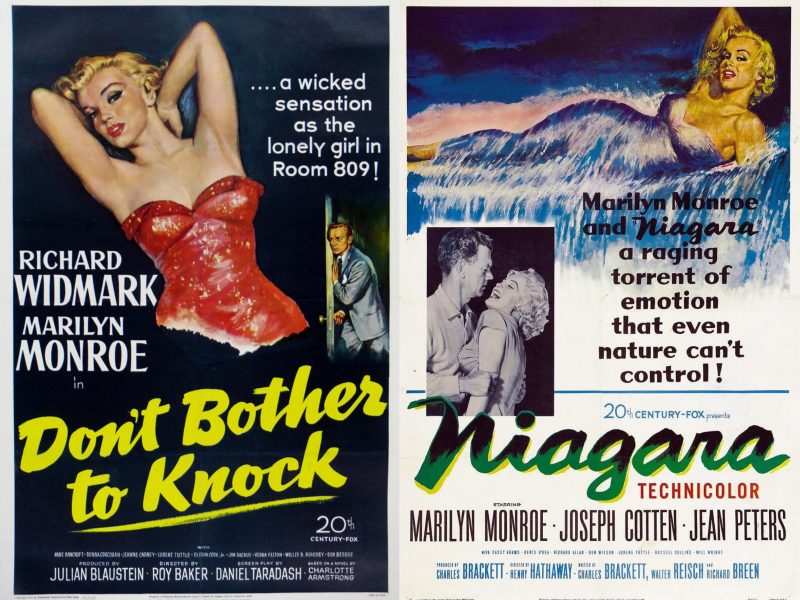
‘From the moment Anna Nicole got famous,’ one reporter wrote in Texas Monthly, ‘she told the world that her role model was Marilyn Monroe. It was a shrewd move, as it linked her image with one of the greatest American icons of all time, and it had a neat logic: one platinum-haired sex symbol taking after another, one poor, deprived child latching onto the success of another.’ In the 1990s, she ended up renting 12305 Fifth Helena Drive, where Monroe died. ‘I’d love to play a psychotic woman, like Marilyn Monroe in Don’t Bother to Knock,’ Smith told The Morning Call in 1994. ‘She was so good in it, and I just know I could play it. I can just see [it in] her eyes. I know I could get into it.’ She carried VHS tapes of Monroe movies with her at all times in her purse, as if to do so might attract some of her glamour. If Hugh Hefner had not already bought the burial plot next to Monroe’s grave, Smith often said she would have purchased it herself.
In 1993, Smith briefly signed on for an unrealised, unnecessary remake of the Monroe-starring noir Niagara, whose screenplay ‘[played] up the sexual undercurrents that, because of the times, were [subtler] in the original’, according to Variety. In the 1953 film, released in the same year Hefner published Monroe’s naked photographs in Playboy, a young couple on their honeymoon at the titular landmark meet another married pair named Rose and George, who are both volatile and wild. Rose is having an affair, and because she is played by Marilyn Monroe, the movie paints her as the physical embodiment of Eros, as untamable and dangerous as the Falls.
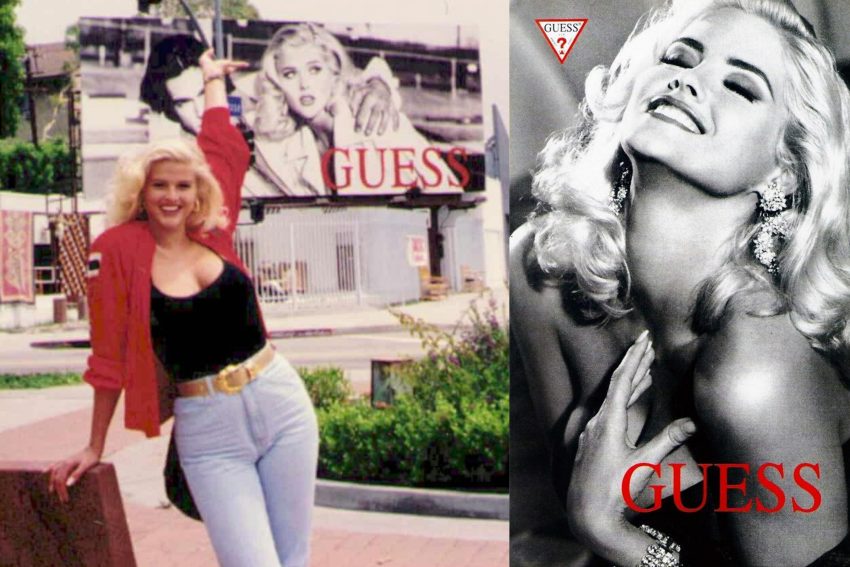
‘I can just relate to [Monroe],’ Smith said, in an interview that addressed her speculative casting in the project – adding, as if she had not really taken corporeal form until her transformation into America’s newest, blondest sweetheart, ‘especially after I got my body.’ Because it was 1993, what she meant when she said ‘my body’ was the body that had made her the new Guess? girl, i.e. one of Amazonian improbability. She would have many bodies over the ensuing decade: very fat and very thin, a desired body and a joke body, a drug addict’s body and a junk food addict’s body and the body of a girl who owed it all to the diet drug she once advertised by purring ‘Trimspa, baby!’
Like Monroe, she operated on a continuum between child and mother, one moment expressing her desire to have further babies, and the next naïve and scared. Both women seemed to want a child because of the unspoken implication that to do so meant being loved and loving limitlessly. Whether or not it occurred to Smith that this was one way in which she had managed to outdo her goddess-idol, it would not be possible to say. What it is possible to say is that for three days in 2006 – in spite of everything else that had happened that year, and the year before that, and the year before that – she got everything she had really wanted – more than the fame or the money or the implants or the mansion – two times over.
Because both women are equally as famous for their early, tragic deaths as for their lives, the public has the dubious honour of being able to compare images of them not only on the red carpet or on photographic shoots, but in the morgue. What is eeriest is the fact that side-by-side, Smith’s post-mortem photograph appears to be a recreation of Monroe’s – the dirty, swept-back platinum hair in profile, the colourless lips and thin black brows … Monroe’s death has long been talked about by conspiracy theorists as a possible murder, usually pinning it on the involvement of the FBI after her long-rumoured affair with John F. Kennedy. More likely, if more mundane, was that she took 40 barbiturates on purpose in order to escape an existence that felt murderous.
Anna Nicole Smith’s autopsy suggested she had died as a result of ingesting a mix of medications – chloral hydrate, diphenhydramine, clonazepam, diazepam, nordiazepam, temazepam, oxazepam, lorazepam, atropine, acetaminophen, topiramate and ciprofloxacin – in amounts that were not large enough to kill her in and of themselves, suggesting that the overdose had been an accident … There was a certain parity with Monroe here, too, even if Smith had not meant to commit suicide: a longing to escape, or to withdraw from, a world in which the desire and attention of the public had begun to feel like violence. ‘Covering a cluster of small scars on her right leg and ankle was an icon medley [tattoo],’ the Broward County medical examiner observes in his summary of identifying features: ‘Christ’s head, Our Lady of Guadalupe, the Holy Bible, the naked torso of a woman, the smiling face of Marilyn Monroe, a heart, shooting flames, and a cross.’ ‘Vickie Lynn Marshall was a 39-year-old white female who died of acute combined drug intoxication,’ the autopsy concluded … Minus her liveliness, her sex appeal, she had returned to being Vickie Lynn, a fact that might be an indignity if it did not mean that ‘Anna Nicole Smith’ managed in some way to escape death.”
 The Marilyn Report