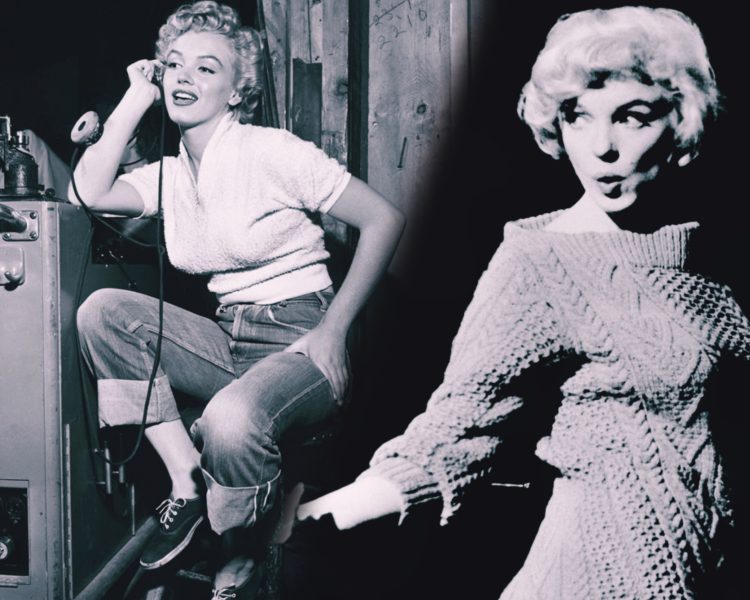
When Marilyn’s onscreen style is mentioned, it’s usually her most elaborate costumes that come to mind. But she also sported everyday fashion in some movies, as noted in the latest issue of Australian Women’s Weekly Icons (#30, with Audrey Hepburn on the cover.)
It’s often said that Marilyn pioneered denim for women in Hollywood, which is rather an exaggeration as other actresses were already wearing jeans in Westerns. Nonetheless, she wore them routinely in her younger days, though in later years she preferred capris.
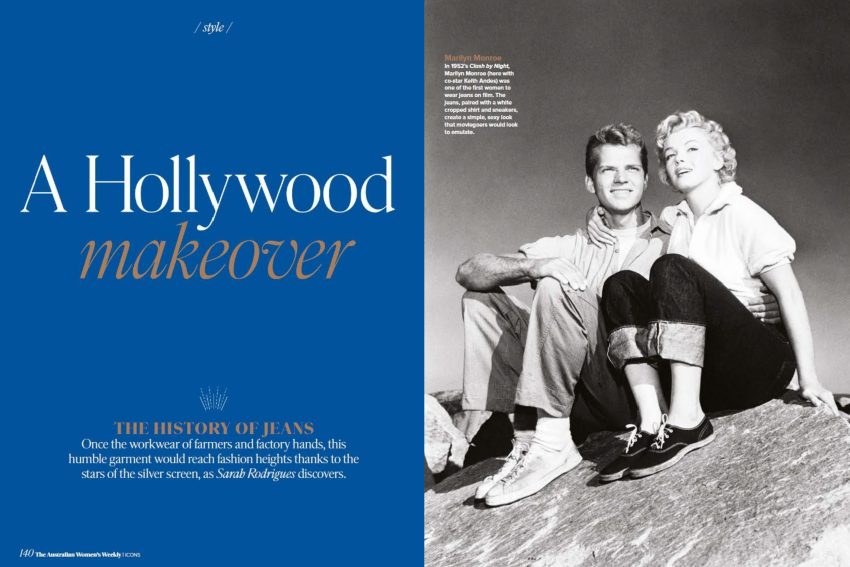
“But it was after World War II that jeans really came into their own as the ultimate style statement. Post-war affluence and the emergence of a distinct youth culture created a new social group: Teenagers, as they were cleverly called by advertisers, were young people questioning norms and seeking to distance themselves from the culture and conventionality of their parents.
Cue a new breed of Hollywood star – a brooding, disaffected one. James Dean in Rebel without a Cause is an obvious example, but there was also Marlon Brando in The Wild One (1953) … Girls wanted to save them; guys wanted to be them. And with that, jeans had officially become the most covetable item in a young person’s wardrobe.
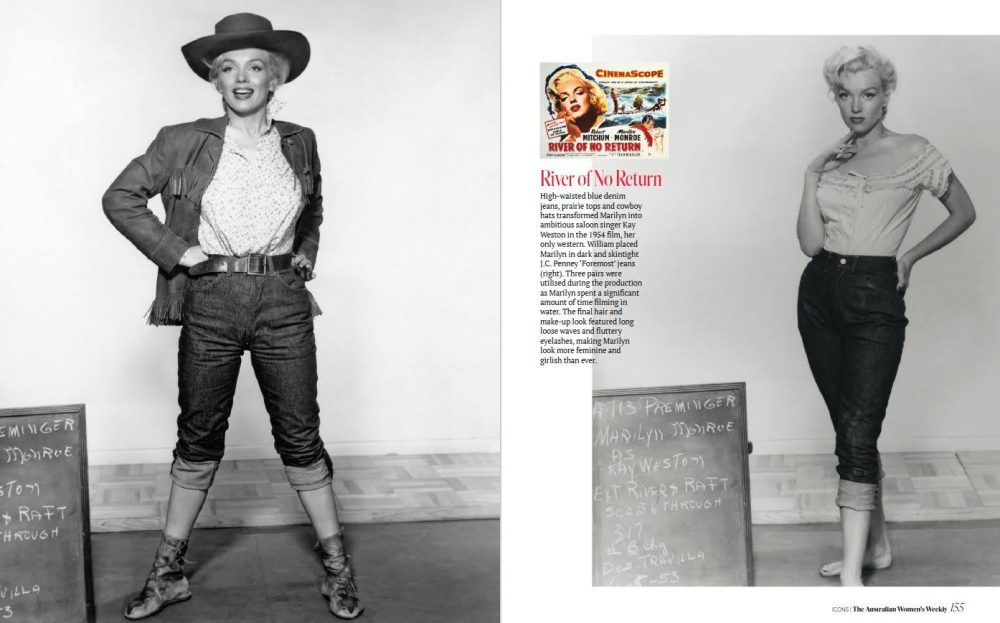
And this included girls, thanks to Marilyn Monroe, who’d first worn rolled up jeans with sneakers and a simple short-sleeved, open-necked shirt in 1952’s Clash By Night. Boxy in shape, it wasn’t long before jeans were being cut specifically to hug and flatter the female form, as Marilyn’s character, Kay Weston, demonstrated in 1954’s River of No Return. The look was undeniably sexier, with an off-shoulder lacy milkmaid top paired with figure-hugging jeans, low-heeled boots and those platinum curls.
While Marilyn Monroe may have been seen as a dangerous temptress, jeans were now also being worn by other stars, whose appeal was less sexually loaded: Grace Kelly in 1954’s Rear Window, for example, and Audrey Hepburn in 1961’s Breakfast at Tiffany’s.”
– Sarah Rodrigues
And of course, the J.C. Penney jeans sported by Marilyn in River of No Return were resold at Julien’s Auctions for $52,000 in March 2025, one of three pairs originally purchased by American designer Tommy Hilfiger for $42,550 at Christie’s in 1999.
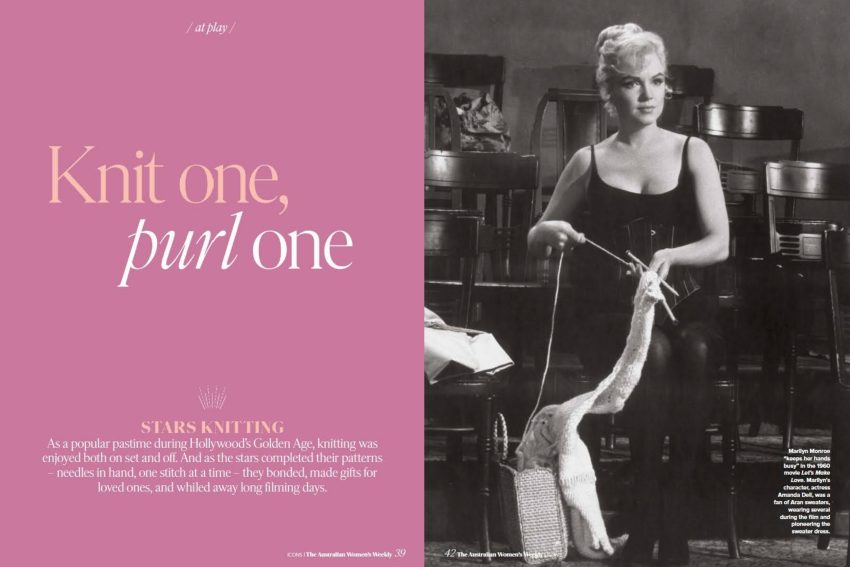
Elsewhere in this month’s Icons, Marilyn appears more tangentially in a feature about stars who knit, with a still photo from Let’s Make Love (1960), as her showgirl character Amanda Dell knits on a break from dance rehearsals. She famously wore an Irish cable-knit sweater in the film’s opening number, ‘My Heart Belongs to Daddy ‘ – only to whip it off by the end, revealing a diaphanous black unitard beneath.
Knitting wasn’t among Marilyn’s offscreen hobbies, a fact bemoaned by Gentlemen Prefer Blondes author Anita Loos in a 1967 magazine article, later republished in the anthology, Fate Keeps On Happening.
“The most common complaint of any film actress is that acting occupies a very small portion of a day’s work. The majority of time is spent in waiting: waiting for huge, clumsy lights to be arranged, for cameras to be adjusted, for make-up to be freshened, for costumes to be changed, for endless technical details. Nothing ages a girl so much as boredom. It dulls the eyes, brings on wrinkles, and deadens the spirit.
But both Joan [Crawford] and Paulette [Goddard] looked years younger than their age. Could this partly be due to the fact that during long periods of boredom on studio stages, Paulette did acres of needlepoint and that Joan, during World War II, knitted enough socks to outfit a regiment? (One can only wish that poor little Marilyn Monroe, instead of getting hooked on sleeping pills, had become addicted to needlework or sought tranquility in a pair of knitting needles.)”
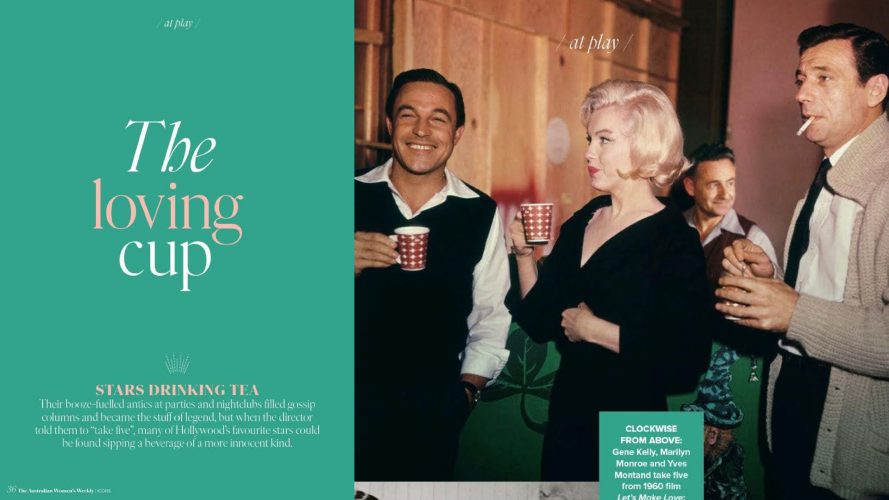
Even if handicraft didn’t take her fancy, Marilyn found other ways to relax on the Let’s Make Love set – such as sipping tea (or coffee) with co-stars Gene Kelly and Yves Montand, as noted in a previous issue of Australian Women’s Weekly Icons, from 2023.
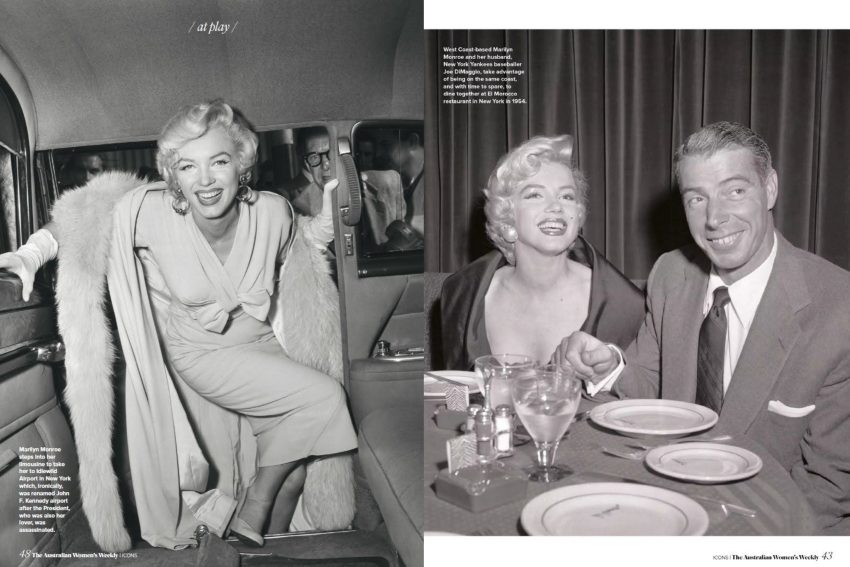
Other past entries in the magazine’s ‘At Play’ series include a feature on jet-setting stars – with Marilyn pictured on arrival at Idlewild Airport in 1954. And a recent article on the legendary El Morocco nightclub shows a photo of Marilyn dining there with husband Joe DiMaggio during the same New York trip.

And finally, Hollywood costumer Travilla’s dazzling designs for Marilyn – including the hats and blouses he added to glam up those J.C. Penney jeans – were given a twelve-page spread by Australian Women’s Weekly Icons in 2024 (#25, with Audrey on the cover again …)
 The Marilyn Report