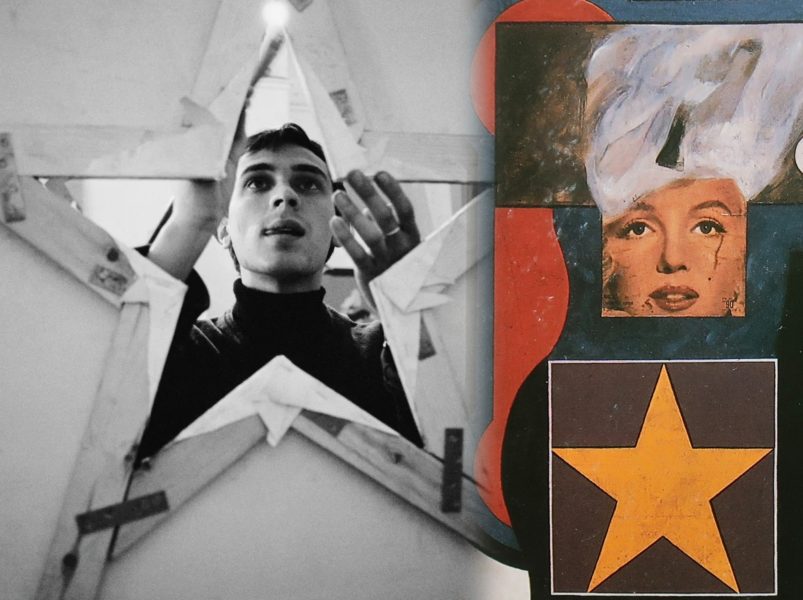
Peter Phillips – one of the first British artists to depict Marilyn in his work – died aged 86 on June 23, 2025.
He was born in Bournville, near Birmingham, in 1939. His father was a carpenter, and his mother worked at Cadbury’s chocolate factory. He enrolled at the Royal College of Art in London in 1959. “A small group of us started to use popular images for our pictures, which was frowned upon at the time,” he recalled. “We never called it ‘Pop Art’; we were just trying to express who we were.”

A photo of Marilyn shot by Richard Avedon to promote Some Like It Hot – which made the cover of France’s Marie Claire magazine in September 1959 – would inspire one of Phillips’ breakthrough works, now in the permanent collection of the Gulbenkian Centre of Modern Art in Lisbon, Portugal.
“For Men Only – Starring MM and BB (1961), one of Peter Phillips’ early works, created while he was still a student at the Royal College, demonstrates Phillips’ familiarity with technical design and the graphic arts, as well as with the conceptual power of collage. On a wooden panel of monumental proportions meet media icons and cultural emblems, disparate and strikingly contradictory. In a manner parallel to that of Peter Blake’s, Phillips adroitly incorporates into a single framework the photographic representations of the age’s stereotypical sex symbols, movie stars Brigitte Bardot and Marilyn Monroe, snapshots from performances of a famous stripper of the time and traditional symbols. The image of the hare is borrowed from a Victorian game and it bears the words ‘she’s a doll’ followed by the stripper’s name.”
– Margarita Kataga

Completed before Marilyn’s death, For Men Only also precedes Andy Warhol’s Marilyn Triptych by a year. In March 1962, Phillips appeared in a BBC television documentary, Pop Goes the Easel, alongside Peter Blake, Derek Boshier, and Pauline Boty. The only woman associated with British pop art at the time, Boty would produce three paintings of Marilyn that year.
“Phillips is filmed as the cool dude with no voice-over; his use of mass culture is established visually. Flicking through pulp fiction and pin-up magazines, he maintains his aloof ‘detachment’ by tossing them to a reclining girl who reads them avidly; similarly, wandering into a different room, he watches another girl play a pinball table …”
– Sue Tate, Pauline Boty: Pop Artist and Woman
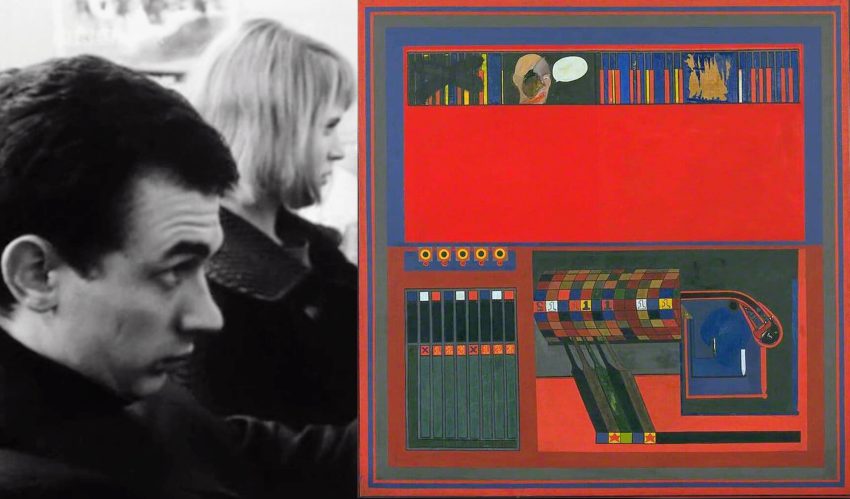
The other artists featured in Pop Goes the Easel also studied alongside Phillips at the RCA.
“Peter Phillips was, in a sense, the outlier: the youngest of the group, attracted to the rough energy of engines, pinball games and shooting galleries, trained from the age of 13 in such craft skills as technical draughtmanship, silversmithing and heraldry. Yet at the College, Phillips produced fully realised works of lapidary Pop: inspired to a degree by board-game formats, his paintings were organised compositions that integrated abstraction and figuration, and with their cool glamour – and great size – resembled their American cousins.”
– Marc Kristal, Pauline Boty: Pop Art’s Sole Sister
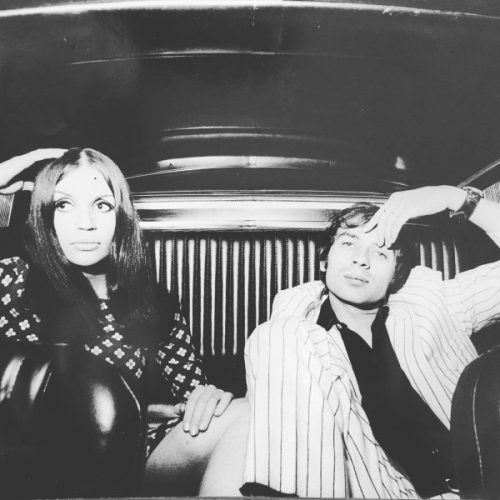
Phillips moved to New York in 1964, returning to Europe two years later. After marrying Claude Marion Xylander, a model and fashion designer, in 1970, Phillips lived in Switzerland, the Seychelles, Spain and Costa Rica.

“Fittingly, his work eventually transitioned from the thin air of high art back to the popular culture from which it emerged. His 1972 painting ‘Art-O-Matic Loop Di Loop’ — a teenage boy’s fantasy come to life, with its Plymouth Duster muscle car, scantily clad temptress and automotive parts, all floating as if in a dream — became the cover image for Heartbeat City, the multiplatinum-selling 1984 album by The Cars. The Strokes used a portion of his 1961 painting ‘War/Game,’ with its pistols and playing cards, for their 2003 album, Room on Fire … Mr. Phillips’s approach evolved over the years: He turned to a sleek, airbrushed style that further blurred the line between high art and commercial art, and at times veered into photorealism, as with his sensuous ‘Mosaikbild’ paintings from the mid-1970s. In the ’80s, his work became more conceptual, featuring fantastical shapes and figures.”
– Alex Williams, New York Times

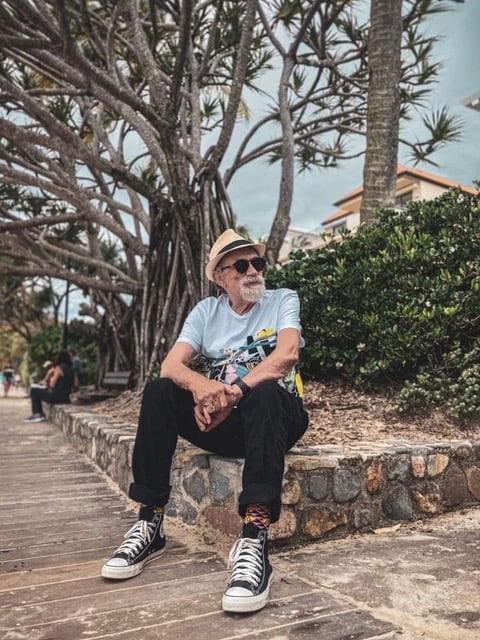
After his wife died, Phillips moved to Australia in 2015 to live with his daughter, Zoe Phillips-Price. “I definitely don’t favour the early work,” he said in a 2019 interview with the Sydney Morning Herald. “I am excited about some of the newest pieces, possibly because it is what interests me most at the moment.”
As for Pop Art, he felt that it had become a meaningless term: “For me, there are really only two forms of art — good and bad.”
 The Marilyn Report