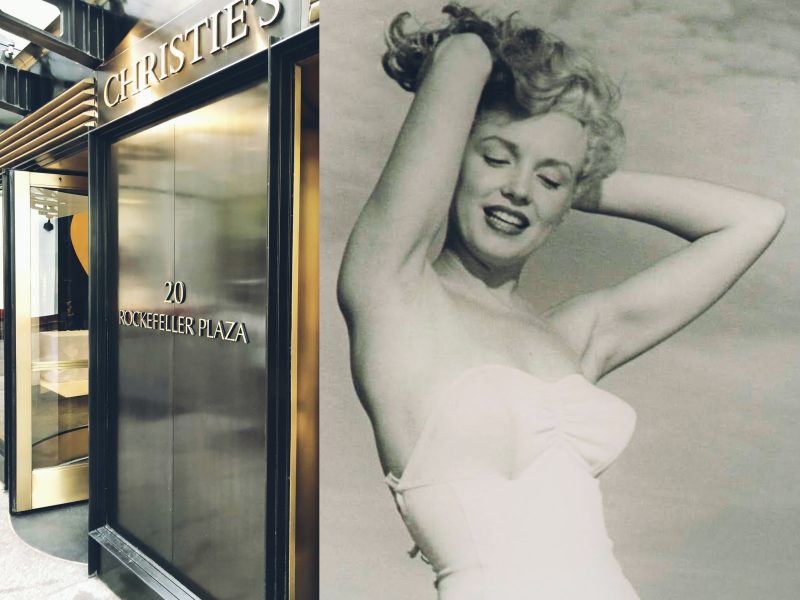
In my second post on American Greats, this week’s auction at Christie’s in New York, I’m looking at items from the collection of Dr. G.B. Espy pertaining to the early life of Norma Jeane Baker, before she became Marilyn Monroe.
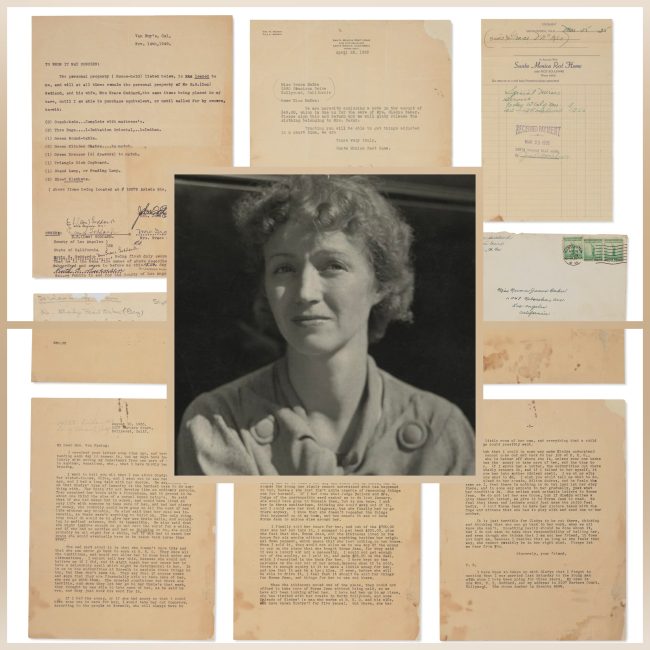
Firstly, a bundle of ephemera and letters dating from 1935-1952, which sold for $1,890, includes a 1936 citizenship certificate from Vine Street Elementary School presented to 10 year-old Norma Jeane Baker for her excellent record in citizenship during the current semester, multiple fan letters, a suggested diet, and newspaper clippings.
These papers also shed further light on the tragic life of Marilyn’s mother, Gladys Baker Eley.
1) A receipt for $13.50 paid by Grace McKee for nursing services at the Santa Monica Rest Home on Pico Boulevard, where Gladys had recently been a patient, dated March 25, 1935.
2) An invoice for $49.30 made to Grace McKee by the same establishment, dated March 25, covering the period from March 20-26, including care, board and laundry ($35); two nurses’ board ($14); and two packs of cigarettes (30c.)
3) A covering letter, dated April 22, reads: “Please sign this and return and we will glady release the clothing belonging to Mrs. Baker. Trusting you will be able to get things adjusted in a short time.”
4) An Internal Revenue letter dated March 26, 1935, regarding income tax arrears of $64.62 from 1933, addressed to Gladys at 333 North Sycamore Avenue.
5) A response from Grace McKee at 2595 Graciosa Drive, Hollywood, to Internal Revenue, dated April 3, 1935:
“[Gladys] had a complete physical and mental breakdown the first part of January, and since that time has been in three sanitariums that have taken all of her money. She lost her job at RKO through this illness, and it may be a year before she can possibly return to work. On March 27, 1935, she was committed to the state institution at Norwalk, and naturally will not be able to pay any of her bills. She has a little nine-year-old daughter, and friends are having to care for her. I am her very closest friend, and have been trying to take care of all of her affairs for her, and would appreciate your telling me just what can be done regarding her income tax, as I haven’t the money to pay it for her.”
6) A letter from Grace McKee to the Santa Monica Rest Home, dated April 19, following her fiancé Erwin ‘Doc’ Goddard’s attempt to collect Gladys’ possessions on the previous day. She also mentions having recently been appointed as legal guardian to both Gladys and Norma Jeane, and alludes to money problems and drug misuse as underlying factors behind Gladys’ breakdown.
“There seems to be quite a misunderstanding as to her financial situation. At the time I sent her to your Rest Home, I did not know that it was drugs that had caused her condition this last time, and thought it would only be temporary, and that she would not have to stay there long, for if I had known it, I would have had her sent to Norwalk in the first place, as I realised her money was very limited. I have no idea where you obtained the information that she had loaned a thousand dollars to anyone, she never loaned any money to anyone, and the main reason for her present condition was financial worry … Also, when I sent her down to your Rest Home, a man friend of hers told me to spare no expense, but when it came down to getting any money, he did not seem to have any, and besides that, she has a little nine-year-old daughter that we are going to have to care for while Gladys is in Norwalk, so where the money is coming from, I do not know. I talked to the secretary of the head of the cutting department at RKO this morning, and she told me that they mere planning on having some sort of a benefit for Gladys, either a dinner dance, or proceeds from a couple of picture shows, which will help me pay her expenses.”
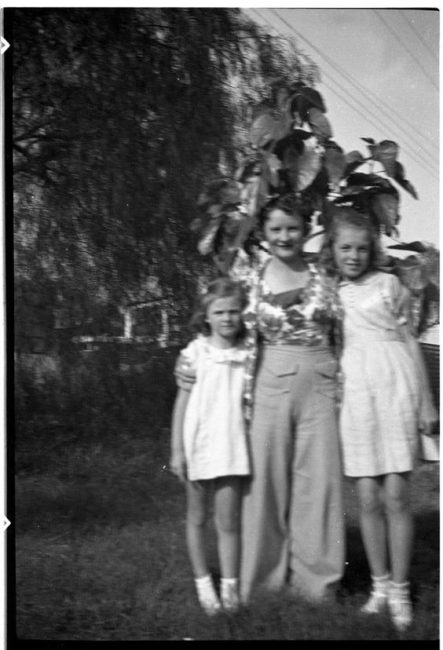
7) A four-page, type-written letter from the newlywed Grace Goddard to a ‘Mrs. Van Hyming’ of Long Beach, California, dated August 15. Grace mentions that Norma Jeane was then living with a family she and Gladys knew from work at RKO. This may have been Harvey and Ellie Giffens, who allegedly wanted to adopt Norma Jeane although this was not to be.
“I want to tell you all that I can about Gladys’ condition. Her sister-in-law, Olive [Martin], and I went out to see her some time ago, and I had a long talk with her doctor. He explained to me that Gladys type of insanity is the hardest case to do anything with … The sad part about it is that she doesn’t know this and that she can never go back to work at RKO. They know all the conditions, and would not allow her to come back under any circumstance. I cannot tell her this, because she would not believe me if I did, and it might upset her and cause her to have a melancholy spell which might be detrimental to her … According to the people at Norwalk, she will always have to be watched and taken care of, for she will sneak out and take that luminal [Pentobarbital] any time she gets a chance. when she gets a little bit too much of it in her system, she goes completely insane, and that is what we have to guard against … I know that she doesn’t remember the things that happened up at my house, and how unsafe it was to have Norma Jean or anyone else around her.
I finally sold her house for her, and out of the $700.00 that she had put into it, I managed to get back $325.00, plus the fact that she, Norma Jean, and the Atkinsons [George Atkinson and his wife were Gladys’ former lodgers] lived in the house for six months without paying anything besides her original down payment, which means that she lost nothing on her house. When I sold it, they would not allow me to use any of the money to pay on the piano that she bought Norma Jean, for they said it was a luxury and not a necessity. I could not get enough out of the equity, so I sold it, and made $25.00 on the deal, which I deposited in the bank for her. I have kept up the payments on the car out of her money, because when it is sold, there is enough equity in it to make a little money for her, and now that it may be a long time, if ever, before she will be able to drive it, I feel that it should be sold for things for Norma Jean, and things for her to use out there. When the Atkinsons moved out of the place, they could not afford to take care of Norma Jean without being paid, so we have all been looking after her. I have had her up to my place, she has visited with her cousin in North Hollywood, and some friends of Gladys (a man who works at RKO and his wife.) Out there, she has a lovely little room of her own, and everything that a child of her age could possibly want.”
8) Legal notice of furnishings loaned by the Goddards to Colonel John Stewart Eley, dated November 14, 1949. Eley was then married to Gladys, who had been released from hospital a few years before. Unfortunately, the relationship would not last as Eley was later discovered to be already married, and he died in April 1952.
9) Addressed ‘to whom it may concern,’ handwritten note by Grace on September 12, 1952, regarding Gladys’ deteriorating mental health, ahead of her being committed to Rockhaven Sanatorium, with her now famous daughter paying for her care.
“Mrs. Eley has tried to do nursing (a combination of medicine and Christian Science) … She was rejected in 1947 to admittance to the Christian Science Benevolent Home in San Francisco because they didn’t feel she was capable. She has been dismissed from every nursing job she has had since 1946 … She should not be attempting to nurse except in an institution under proper supervision … she doesn’t eat properly, she has sudden fits of temper and is entirely irrational at times …”
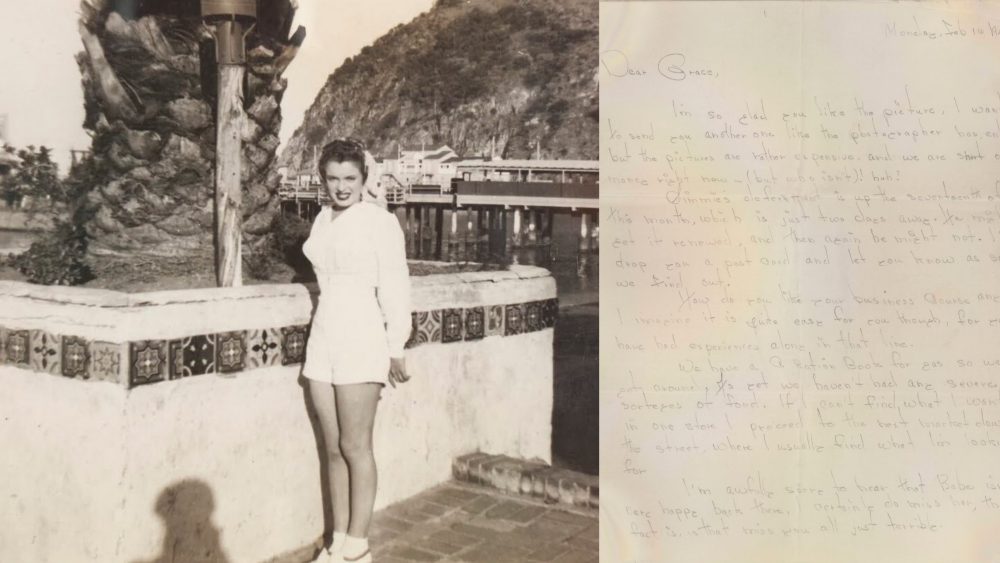
At left, a snapshot of 17-year-old Norma Jeane in 1943, while living on the naval base at Catalina Island where her husband, Jim Dougherty, was in training for the Merchant Marines (sold for $6,300.) And at right, a five-page letter from Norma Jeane, dated February 16, 1943, and signed off as ‘N.J.’, to Grace Goddard, who was then living in Huntington, West Virginia. Acquired by Dr. Espy in 2001 at a charity auction for Hollygrove Children’s Home (where Norma Jeane lived from 1937-38), the letter sold for $35,280 at Christie’s this week.
In the letter, Norma Jeane revealed her plan to meet her natural father, having tracked down his business address at a dairy in Hemet, California. Her hopeful words are all the more poignant knowing that he turned her away.
“I’m going into town one of these days to see Mr. S. Gifford. Oh Gracie, you just can’t imagine how excited I am, to think I’m really going to see him at last. Golly, I just hope that he will want to see me. I think he might though, after he gets use[d] to the idea. Ever since I found out, it has practically made a new person of me. It’s something I have to look forward to with the greatest of pleasure, seeing him I mean. I had my fortune told by a friend just for fun and guess what? My fortune read that I was going to come into contact with him and that he was going to become very fond of me etc. Oh doesn’t that sound wonderful, if only things would work out that way. I’m just praying with all my heart and soul they will. Keep your fingers crossed for me, Gracie if you ever do come across that picture of him please send it to me, I surely would appreciate it.”
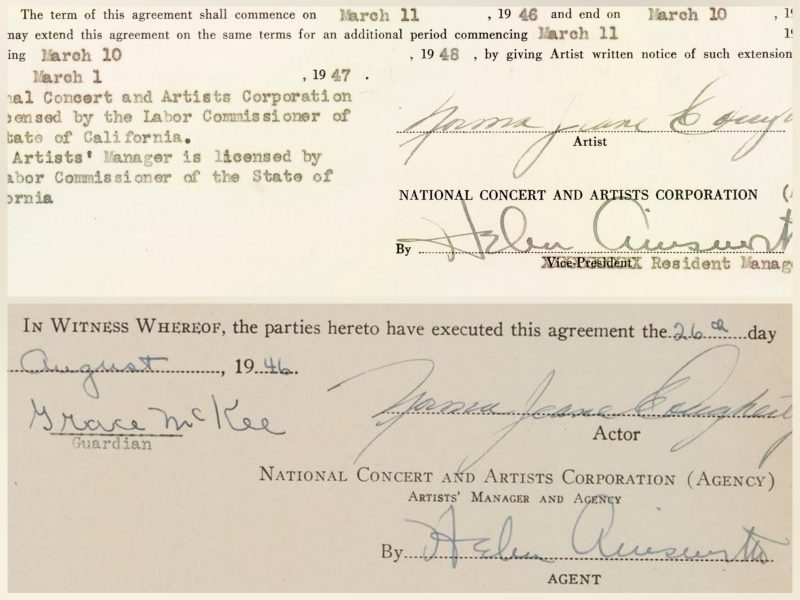
A one-page contract dated March 11, 1946, dating how the National Concert and Artists Corporation will represent the 19-year-old ‘N.J.D.’ over the next year. Co-signed by agent Helen Ainsworth, this document has sold for $18,900. And another NCAC contract, dated August 26, 1946, and now sold for $10,080, is signed by Norma Jeane Dougherty – by now separated from Jim, and soon to commence her film career – plus Ainsworth, and Grace Goddard, who would remain as Norma Jeane’s legal guardian until her 21st birthday.
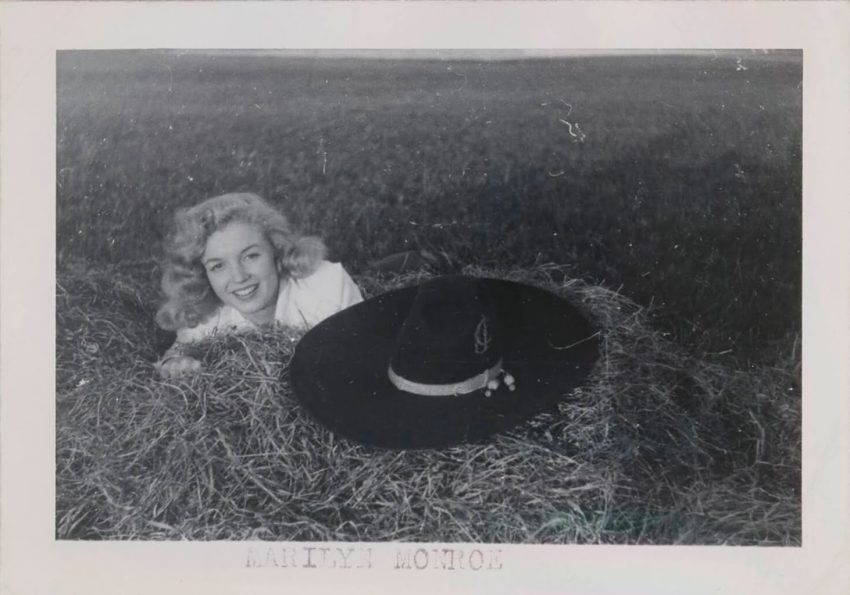
This snapshot from 1947, captioned ‘MARILYN MONROE‘, sold for $1,260. It is thought to have been taken at the Granada Hills ranch of actor turned agent John Carroll and his wife, MGM talent scout Lucille Ryman, who took Marilyn under their wing after her studio contract with Twentieth Century-Fox wasn’t renewed.
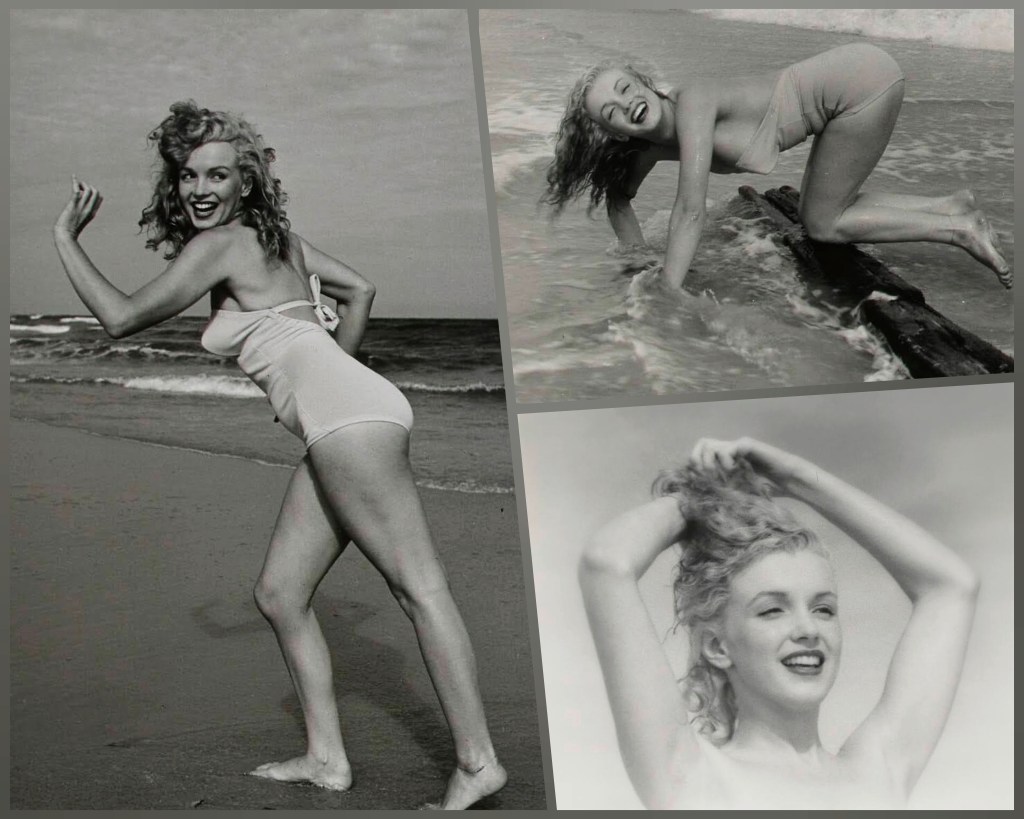
And last for now, three images from a set of five photos by Andre de Dienes, showing Marilyn at Tobay Beach, New York in 1949, which sold for $1,890. Next up, I’ll be exploring Marilyn’s meteoric rise to Hollywood stardom in the 1950s – and you can find all my posts on this auction right here.
 The Marilyn Report