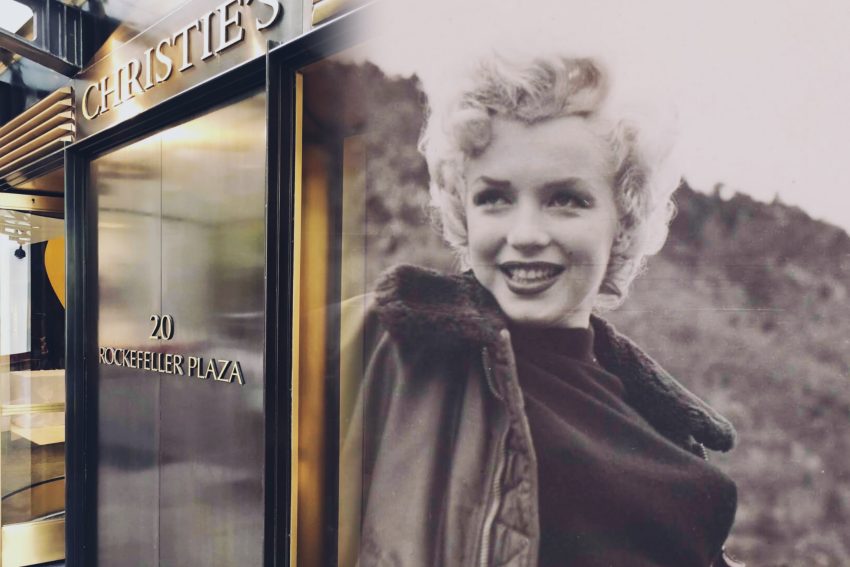
A set of ten snapshots from Marilyn’s Korea trip was sold at Christie’s last week as part of American Greats, an auction featuring items from the collection of Dr. G.B. Espy. In this post, I’m looking at lots relating to Marilyn’s meteoric rise to fame – and her rebellion against it.
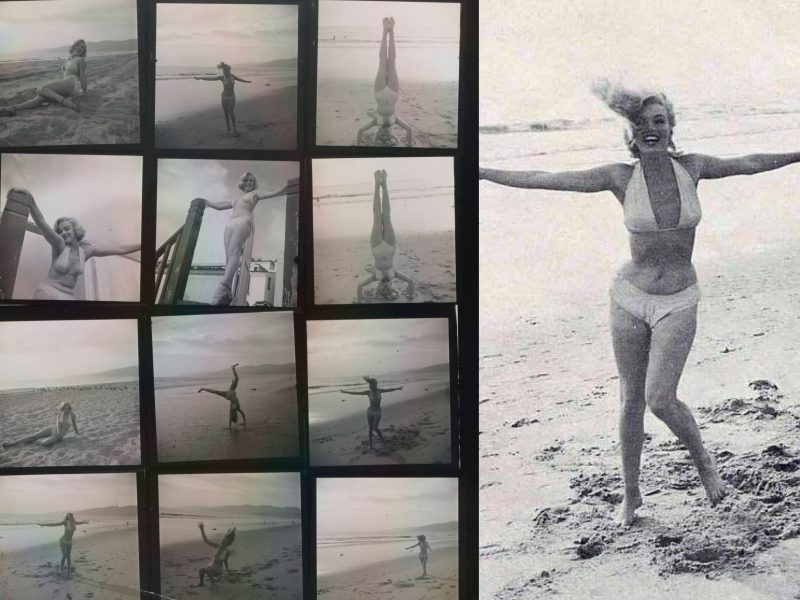
A contact sheet from Marilyn’s 1951 shoot with British photographer Anthony Beauchamp sold for $3,276. She is wearing the same yellow string bikini used in several prior modelling layouts.
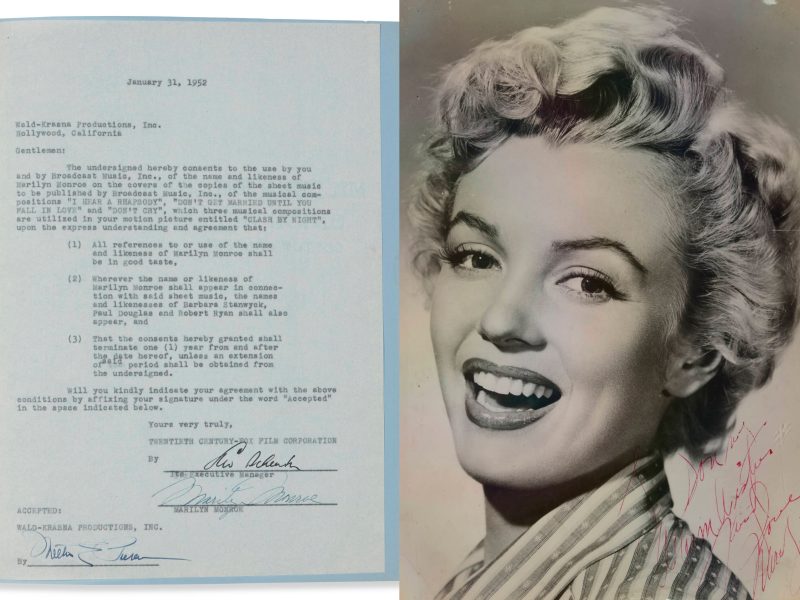
At left, a loan-out agreement in which Twentieth Century-Fox permitted Marilyn to appear in the Wald-Krasna Productions film, Clash By Night, sold for $5,670. The agreement was made on August 21, 1951, with an addendum regarding promotional materials signed by Marilyn on January 31, 1952. And at right, an autographed publicity photo for the movie – from a sitting with Rod Tolme – sold for $11,970. Unusually for this period, Marilyn inscribed the photo as Norma Jeane. Clash By Night was made at RKO where her mother once worked, so the recipient may have been a family friend.
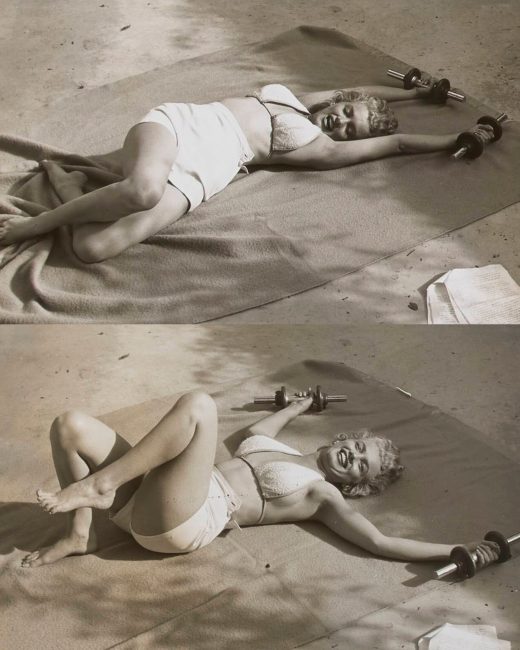
Two photos of Marilyn with barbells – shot by Andre de Dienes at the Hotel Bel-Air, where she lived for several months in 1952 – with photographer’s stamp and brief handwritten notations on the verso, sold for $4,032.
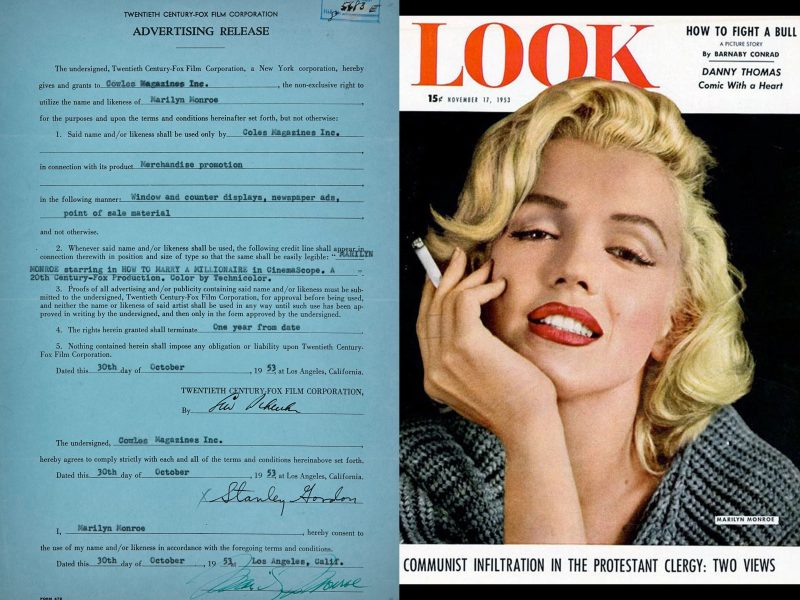
An advertising release from Twentieth Century-Fox, signed by Marilyn on October 30, 1953, sold for $5,292. This document authorised Cowles Magazines Inc., publishers of LOOK, to use Marilyn’s likeness in counter displays and newspaper ads. Marilyn had graced the cover twice in the previous year, and received the Look Magazine Achievement Award in March 1953, which named her as the Most Promising Female Newcomer of 1952. She made the cover again in November 1953, photographed by Milton Greene, who later became her partner in Marilyn Monroe Productions.
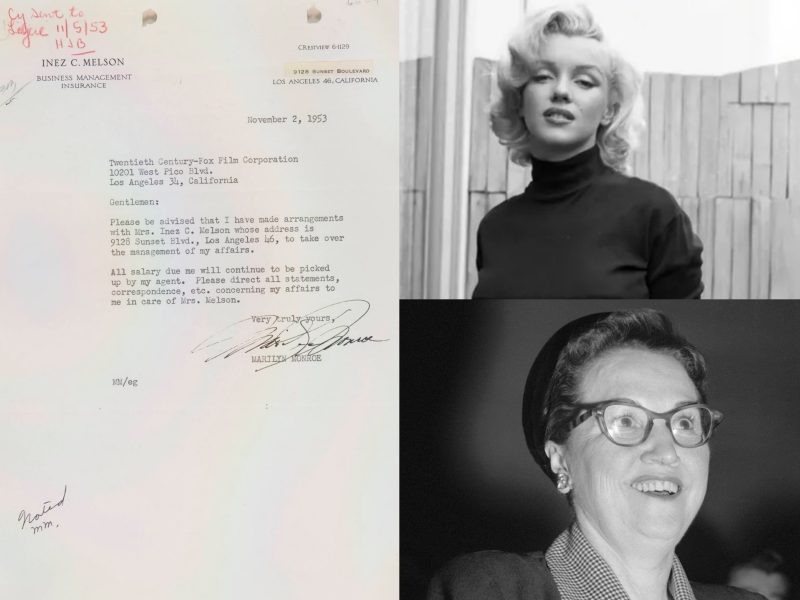
A letter signed by Marilyn on November 2, 1953, authorising Inez Melson to manage her affairs at Twentieth Century-Fox, sold for $6,048. Melson became Marilyn’s business manager in 1952, allegedly recommended by Joe DiMaggio. In early 1953, she helped to arrange the admission of Marilyn’s mother, Gladys Baker Eley, to Rockhaven Sanatorium; and after Grace Goddard’s death in September, Melson was appointed as legal guardian to Gladys. She also served as a court witness in the DiMaggio divorce hearing, and was the executor of Marilyn’s will.
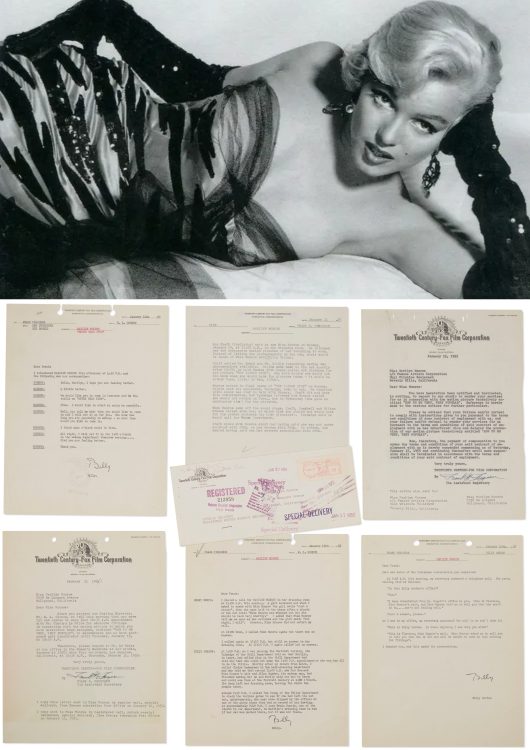
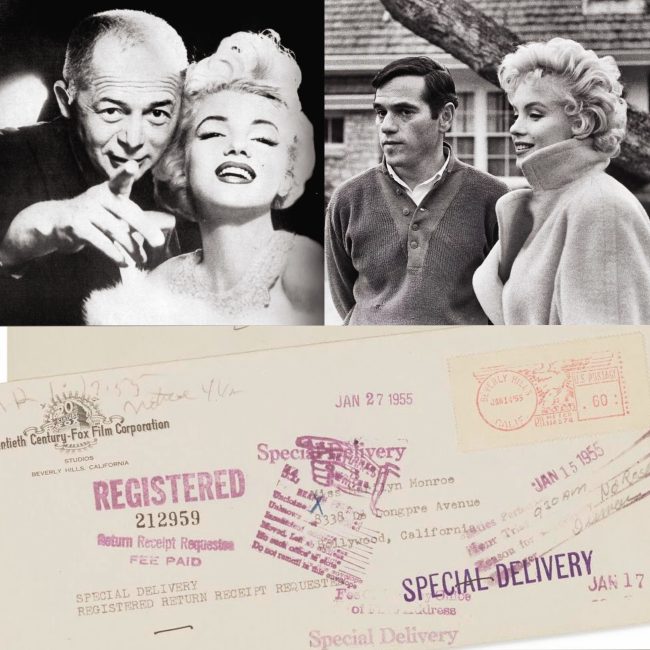
And last for now, an assortment of correspondence regarding Marilyn and Twentieth Century-Fox from early 1955 sold for $2,016. Relations with the studio were already strained, as Marilyn had refused to give them her new address after moving out of her home with DiMaggio and spent the Christmas of 1954 in Connecticut with Milton Greene, as the pair secretly laid plans to form an independent production company. This lot is comprised of telegrams, memos, and typed letters concerning Marilyn’s evasive behaviour, including lax time-keeping and unfulfilled commitments for both The Seven Year Itch and her mooted next project, How to Be Very Very Popular.
1) Inter-office correspondence addressed to the studio’s assistant secretary, Frank H. Ferguson, dated January 11, 1955.
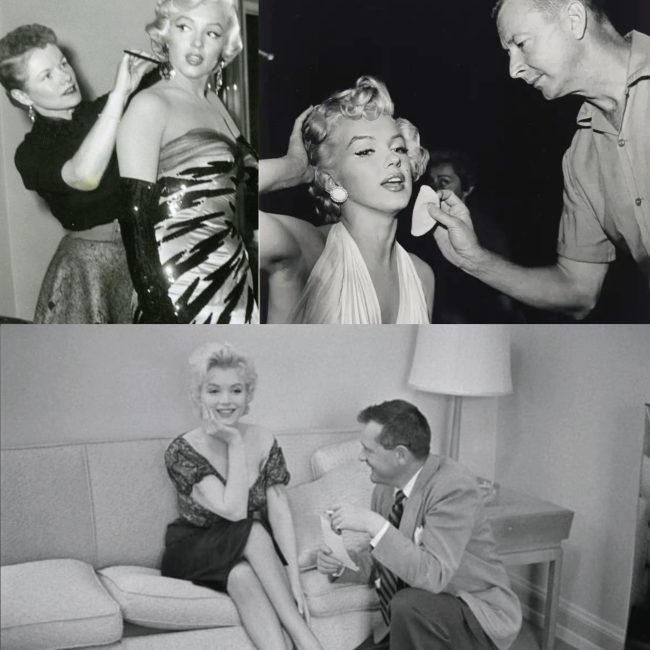
“Roy Craft (publicist) said he saw Miss Monroe on Monday, January 10, at 11:00 A.M., in the dressing room. He informed her the newspapers wanted pictures of her returning to work. Instead of letting the photographers on the set, shots would be taken of Miss Monroe with Billy Wilder.
Craft called Mr. Brand [Harry Brand, Director of Publicity] and Mr. Goldie respecting having two photographers available. Goldie went down to the set shortly after 11:00; he told Monroe 20th needs poster art pictures for her picture The Seven Year Itch. She told Goldie she would let him know when she would have the pictures taken it would be either Tues. (11th) or Wed. (12th).
Monroe worked in final scene of The Seven Year Itch on Monday. Goldie sent his assistant, Talmadge, down to set. He remained until scene was over to talk with Monroe. Craft did not hear this conversation, but Talmadge informed him Monroe stated she would not return on Tues., but on Wednesday (she gave no particular time) for the pictures.
When Monroe came off the sound stage, Craft, Campbell and Milton Greene talked with her, at which time she stated she would pose for the poster pictures (no time discussed). Talmadge said he would call the Makeup Department.
Craft spoke with Monroe about her having said she was not under contract with 20th, or had broken with 20th. In effect, she denied having said she had severed connections with 20th.”
2) Inter-office correspondence from casting director W.L. ‘Billy’ Gordon to Frank Ferguson, dated January 11, noting that at 9:45 am, Marilyn’s maid Florence Thomas called to inform him that Marilyn was feeling ill and would not be coming in for fittings that day.
3) Inter-office correspondence from Billy Gordon to Frank Ferguson, dated January 11, transcribing a phonecall to Marilyn at 4:35 pm. She was feeling “a little better,” and agreed to come into the makeup department at 9am the next day to prepare to shoot publicity stills for The Seven Year Itch.
4.) Letter from Frank Ferguson dated January 11, addressed to Marilyn at 8338 DeLongpre Avenue in West Hollywood.
“Since you advised our Casting Director, Mr. W. L. Gordon, at 9:45 this morning that you were ill and unable to keep your 10:30 A.M. appointment with Mr. Charles Le Maire for wardrobe fittings in connection with the motion picture to which you have heretofore been assigned, entitled How to Be Very Very Popular, to accommodate you we have post-poned said appointment until Thursday, January 13, at 10:30 Α.Μ.
Therefore, please report to Mr. Le Maire at his office in the Women’s Wardrobe at our studio, located at 10201 West Pico Boulevard, Los Angeles, California, at 10:30 A.M., Thursday, January 13, 1955.”
5.) Inter-office correspondence dated January 13, 1955, addressed to Frank H. Ferguson.
GERRY NOMIS: “I placed a call for Marilyn Monroe in her dressing room at 11:00 A.M. this morning. A girl answered and when I asked to speak with Miss Monroe the girl said: ‘Just a minute’, then she came back to the phone after a minute or two and said: ‘Miss Monroe has stepped out but she should be back very shortly.’ I asked that Miss Monroe call me as soon as she returned and the girl said: ‘All right, I will’. However, Miss Monroe did not return my call …”
BILLY GORDON: “At 1:00 P.M. as I was passing the Portrait Gallery, Jim Talmadge of the Still Department told me that Marilyn, in tears, had called Alex in the Still Department and told him that she could not keep the 1:00 P.M. appointment as she was too ill to do the stills. Shortly after my return from Lunch, I called Gladys Rasmussen in the hairdressing department and she told me that around 11:00 A.M. she had dressed Miss Monroe’s hair and Allan Snyder, the makeup man, had finished making her up and Marilyn said she had to leave and would see them at the Portrait Gallery at 1:00 o’clock. She then left her dressing room, leaving the above two people there.
Around 2:30 P.M. I called Tom Young of the Police Department to check the various gates to see if she had left the lot but, unfortunately, she must have slipped by the officer at one of the gates since they had no record of her leaving.
At approximately 2:40 P.M. I sent Ernie Guarin, one of the clerks in our department, to Marilyn’s dressing room to see if her car was parked there, but it was not there.”
6) A letter from Frank Ferguson, dated January 15 and addressed to Marilyn c/o her agency, Famous Artists Corporation, on Wilshire Boulevard in Beverly Hills.
“You have heretofore been notified and instructed, in writing, to report to our studio to render your services for us in connection with the motion picture tentatively entitled How to Be Very Very Popular. Reference is hereby made to the various notices for further particulars.
Please be advised that your failure and/or refusal to comply with instructions given to you pursuant to the terms and conditions of your contract of employment with us, and your failure and/or refusal to render your services for us pursuant to the terms and conditions of said contract of employment with us has interfered with and delayed the production of our motion picture tentatively entitled How to Be Very Very Popular.
Now, therefore, the payment of compensation to you under the terms and conditions of your said contract of employment with us is hereby suspended commencing as of Saturday, January 15, 1955 and continuing thereafter until such suspension shall be terminated in accordance with the terms and conditions of your said contract of employment.”
And so Marilyn left Hollywood for New York, and How to Be Very, Very Popular was made with Betty Grable and Sheree North. After a year-long dispute, she returned to Fox for Bus Stop in February 1956 on a higher salary, with director approval (but not script approval) and Milton Greene at her side. Next up, I’ll be revisiting Marilyn’s final years – and you can find all my posts on this auction here.
 The Marilyn Report