Marilyn’s public image will always be associated with diamonds – but behind the scenes, she didn’t own many precious gems, as David Belcher reports for the New York Times. (Oddly, the article doesn’t mention the pearl necklace gifted to Marilyn by the Emperor of Japan in 1954. She later gave it to Paula Strasberg, and it was sold in 1998.)
“Elizabeth Taylor defined the ultimate 20th-century movie star draped in jewellery during her operatic life offscreen, but it was Marilyn Monroe who defined diamonds onscreen like no other.
She was born Norma Jeane Mortenson on June 1, 1926. This year, the centennial of her birth, the world will again celebrate the ultimate celebrity who lived, as Elton John once sang, like a candle in the wind, in her brief 36 years (she died in 1962).
While she was rarely associated with expensive jewellery in her personal life, jewels will be part of that celebration, if only as a reminder of her celebrity, the era that she flourished in and, ultimately, her enduring image of youth, sex appeal and Hollywood glamour turned tragedy.
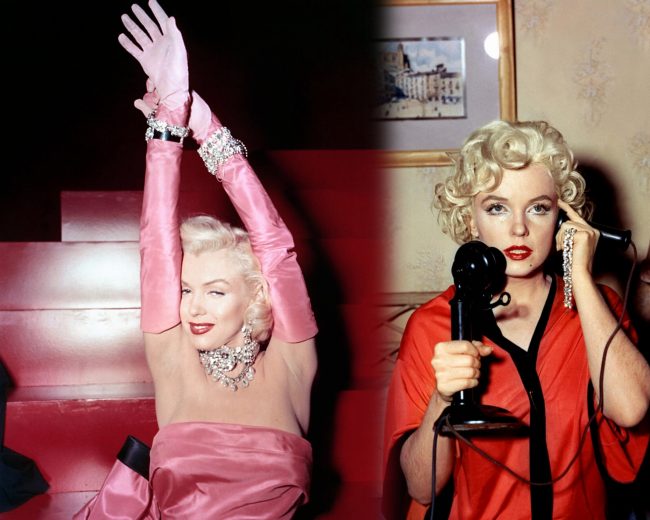
‘Marilyn will forever be associated with jewellery because of her incredible rendition of “Diamonds Are a Girl’s Best Friend” in Gentlemen Prefer Blondes, and even though she really didn’t own much fine jewellery she wore costume jewellery magnificently,’ Marion Fasel, a jewellery historian, author and founder of the Adventurine website, said in a recent video interview.
‘She wore bangles and spangles with her clothes, and I can remember every funny line she had about jewellery from Gentlemen Prefer Blondes and Some Like It Hot. Jewellery was certainly in the atmosphere in the mid-20th century since it was one of those boom periods, so I think that’s why she’s so associated with it.’
Perhaps Monroe’s appeal hearkens to an era long before today’s red carpet, where celebrities arrive draped in jewels (lent by major houses) that often upstage the celebrity and the occasion.
If movie stars in the mid-20th century wore jewellery in public, even to the Oscars, it was usually their own. And before the red carpet even became a publicity stunt, followed by the endless jewellery gawking on social media, a necklace or a pair of earrings was a subtle flourish or something that truly glittered, even on black-and-white TV. Monroe in many ways defined that world.
‘I always think of Marilyn as trying to go off and improve herself and ultimately not having the boyfriend like Elizabeth Taylor, who had the money to buy all of that jewellery,’ Ms. Fasel said. ‘She was married to an athlete and a playwright who didn’t make that much money. There’s really only any mystique around the eternity engagement band from Joe DiMaggio that has gotten quite a bit of play.’
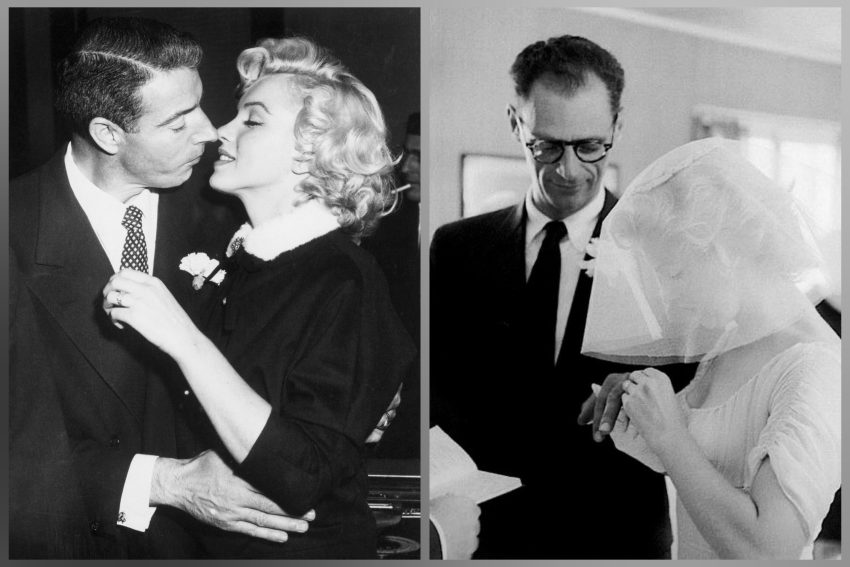
It is thought that the actual engagement ring from DiMaggio, one of baseball’s most celebrated players, was actually a DiMaggio family heirloom that may have been used as a place holder on their wedding day in 1954, which was swarmed by paparazzi in San Francisco. The eternity ring of more than 30 baguette diamonds sold at auction at Christie’s for more than $750,000 in 1999. And her engagement ring from the playwright Arthur Miller in 1956 was a 22-carat-gold wedding band that belonged to his mother. The story is that a Cartier ring he had ordered didn’t arrive in time.
This is quite a contrast to what could be considered her most famous character: the gold-digging showgirl Lorelei Lee, who almost lives and breathes the need to have diamonds, in Gentlemen Prefer Blondes. The Moon of Baroda, a pear-shaped 24.04-carat yellow diamond that has come up at auction more than once, is often thought of as a piece owned by Monroe, but she only wore it during the promotion of Gentlemen Prefer Blondes, lent to her by the Meyer Jewellery Company, an early harbinger of the red carpet glam parade to come decades later.
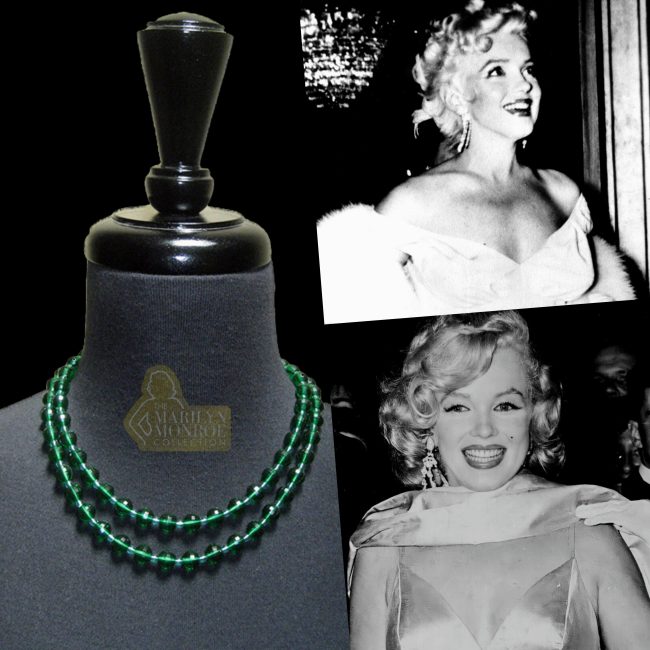
In Los Angeles, the Academy Museum of Motion Pictures exhibition will include several pieces of jewellery, including drop rhinestone ear clips with three strands of teardrop-shaped rhinestones that Monroe wore to the premiere of The Prince and the Showgirl in June 1957. There’s also a pair of simulated diamond triple drop mixed cut fringe ear pendants with clip fitting, which she wore at the world premiere of The Seven Year Itch in June 1955.
There is also a necklace she owned made of emerald-toned beads, 36 inches long with a gold-toned clasp. This necklace was also auctioned in 1999 at that landmark Christie’s sale, The Personal Property of Marilyn Monroe.
In London, the National Portrait Gallery exhibition will have dozens of photographs (along with a few dresses and other memorabilia), several of which depict Monroe in jewellery, both in public as the cameras flashed and in more intimate moments.
‘We had to be selective in that we’re telling a story, and she was a maker of her image as much as the photographers she worked with, such as Cecil Beaton and Eve Arnold,’ Rosie Broadley, the curator of the exhibit, said in a recent phone call. ‘Marilyn was present in her creative process.’
But what struck Ms. Broadley was the lack of staged glamour when telling this story.
‘What is remarkable is that jewellery wasn’t a big thing for her, and a lot of times when you see her draped in furs and diamonds, it’s a studio shot,’ she said. ‘From the beginning of her career they created ultraglamorous shots. But she grew up with nothing, and she never seemed to ever get to a place in life where she was trying to fill that nothingness.’
As a result, the National Portrait Gallery exhibition is about authentically celebrating Monroe’s centennial and telling her story, with jewellery on the periphery, she said, but still part of the story in a more subtle way.
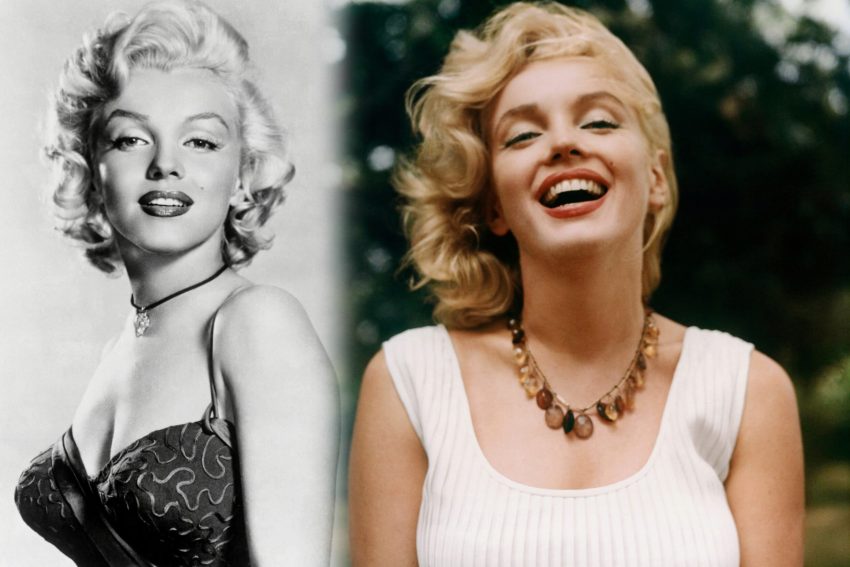
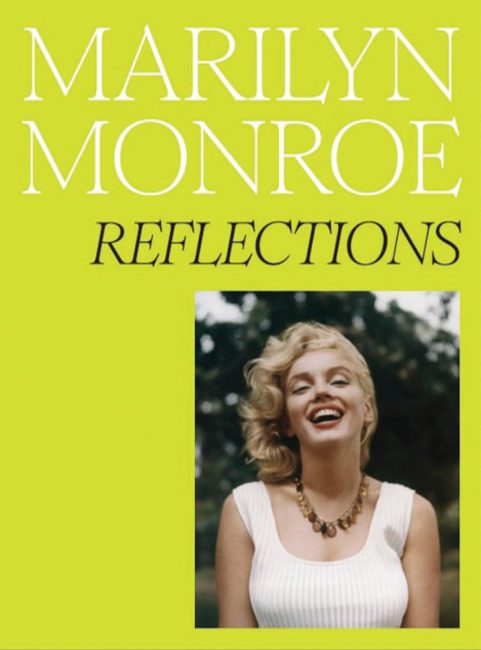
‘There is one picture where she is wearing jewellery, taken by Sam Shaw, with an amber necklace and white dress,’ Ms. Broadley added. ‘It’s a rare shot where she is wearing jewellery. She usually just let her beauty speak for itself.'”
 The Marilyn Report