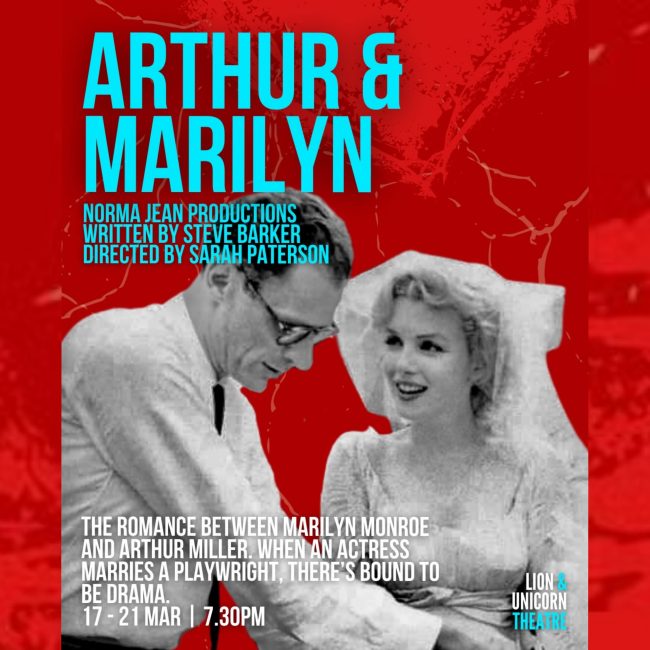
Arthur & Marilyn, a new play about the Miller marriage, concludes a week-long run at the Lion & Unicorn Theatre in Kentish Town, North London tonight.
“Love-match or mis-match?
1956. What happened when America’s most famous celebrity married America’s most celebrated playwright? This thrilling new play delves deep inside the Monroe-Miller marriage, from its harmonious beginnings to its acrimonious end.
A tale of sex and drugs before the Age of Rock ’n’ Roll.
Determined be taken more seriously as an actress and secure more varied roles, Marilyn Monroe moves to New York and enrols at the Actors Studio. Not long after, she begins an affair with Arthur Miller. Suspected of having Communist leanings, Miller is summoned to appear before the House of UnAmerican Activities Committee. Marilyn supports him in public, going against the advice of her Studio and endangering her own career. After Miller divorces his wife, they marry. Nevertheless, even at the start of the marriage, cracks begin to show, A major row almost ends the union before it’s barely started. But the couple weather the storm. Marilyn becomes pregnant and Miller begins writing The Misfits especially for her. However, little by little, Marilyn’s dependence on drink and drugs starts to take its toll. She miscarries their child. Gradually, Miller withdraws from her emotionally. Marilyn has an affair with the co-star of her latest film – Yves Montand. By the time they make The Misfits together they are hardly speaking to each other. In 1961 they divorce.”
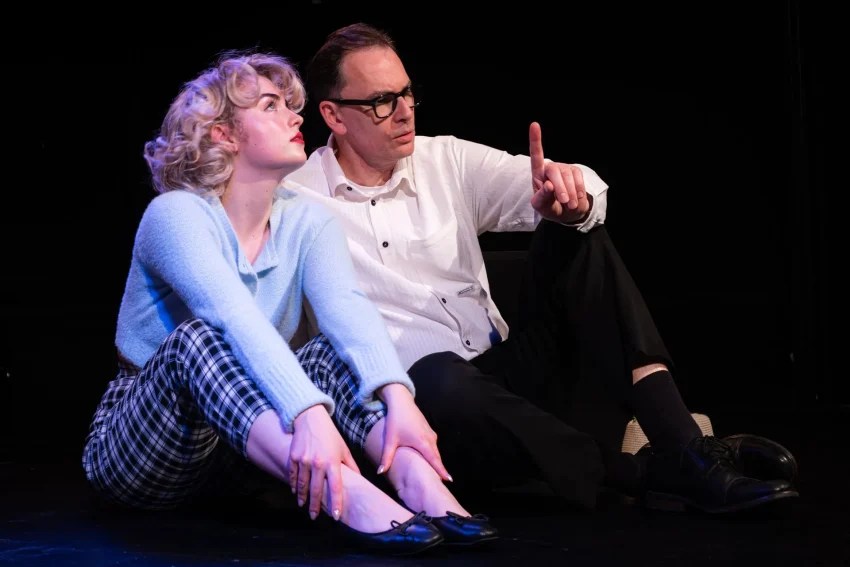
Playwright Steve Barker and director Sarah Paterson spoke about their play with Dan Carrier of the Islington Tribune.
“Steve, who has previously written screenplays, was drawn to the story of how Miller and Monroe met, fell in love and parted just 18 months before Monroe died.
‘They were wildly different,’ he says. ‘One was this serious playwright, whose plays are full of deep social and moral concerns. The other was a comedic actor who had a public persona of being a dumb blonde, ditzy – though she was very intelligent. When Miller married her, people thought: what is going on? It would be like David Hare marrying Taylor Swift.’
‘She was Miller’s complete opposite, but that’s what attracted her,’ Sarah points out. ‘He sees something in her beyond the facade. Her intelligence was really attractive. They were genuinely in love for the first couple of years, before she became more and more difficult … but he was always trying to protect her. He started to withdraw by the end of their relationship.’
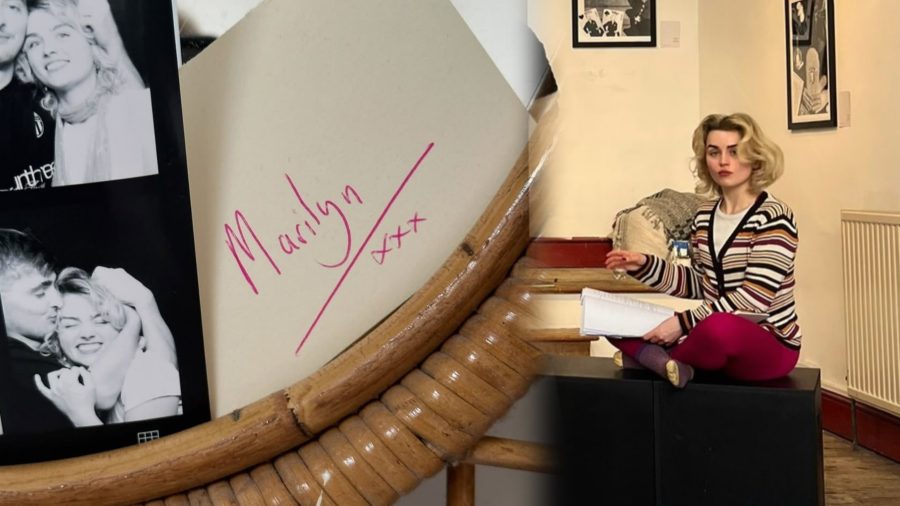
The play is a two-hander starring Daisy Snelson and Marcus Churchill. Sarah has designed a minimal set, allowing the play to be character focused. ‘We did not want it to be an impersonation and we try not to stereotype,’ she reflects.
Monroe’s public and private characters were very different, giving the director plenty to work with. ‘When you see her as Marilyn, it is when she is in front of the press and there is this public persona – otherwise, she is Norma Jean,’ says Sarah. ‘When you cast an actor to be Monroe in a play, the expectation is she must look like Marilyn as much as possible. We needed to get someone who was close. With Daisy, we were struck immediately how she could become Marilyn.’
By the time the couple married in 1956, Miller had a string of hits including Death of a Salesman and View From the Bridge behind him. Marilyn had become the best female comedian in Hollywood.
‘She was a terrific actor,’ reflects Sarah. ‘She stole the show from Lauren Bacall and Betty Grable in How To Marry a Millionaire. But she wanted to be taken more seriously, and was one of the reasons she was attracted to Miller. Arthur did not chase her. He just talked to her when they first met. They got on well. Other men made a move on her within five minutes. For the couple, it was a question of respect.’
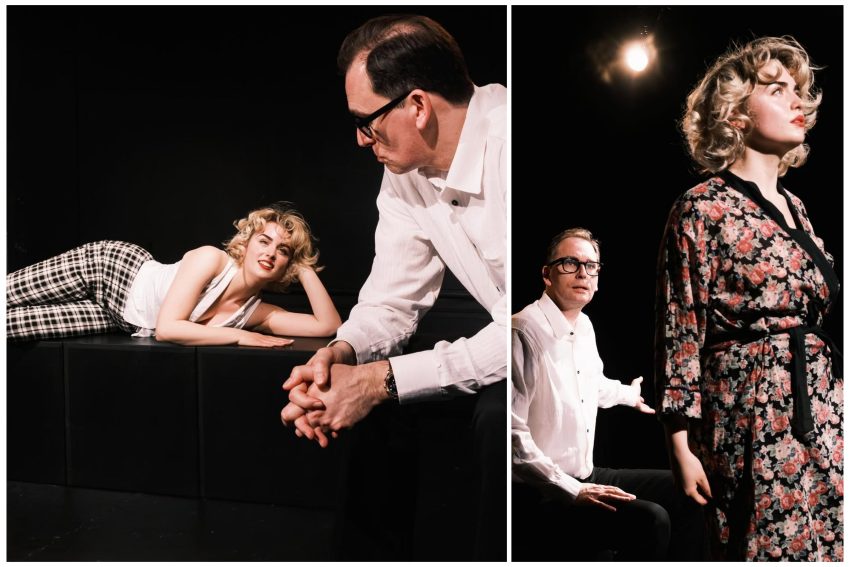
The play follows how they fell in and out of love. ‘It lasted five years and was the longest marriage she had,’ says Steve. ‘I did a lot of research to create snapshots of their married life. I wanted to consider how they spoke to each other and use situations that are historic fact. I wanted to humanise them, ask what they would have said to each other – giving them their voice was really important.’
‘We also wanted to make sure Miller had a voice because he could be a shadowy figure. We wanted to show his personality. The play is very even-handed in that regard. It is very much 50/50 – it is not the Marilyn show … The narrative shows them at first being silly, being happy and having fun together. Then things start to go wrong, and by the end they are on opposite sides of the stage.’
Daisy and Marcus have the challenge of making the audience put away preconceptions. Daisy trained at the Royal Academy of Music while Marcus began acting in his 30s.
‘The important thing was to be inquisitive about her as an individual, and to try and find that essence of her,’ says Daisy. ‘I have always had a love for her and been curious about who she really was. I focused on the fact there are two characters – Marilyn, and then Norma Jean. There is an element of physicality about her and getting that right, but it is about how she thought and felt. She was known to be vulnerable, childlike.
‘I wanted to consider what had come before this period in her life and how that influenced what happened in their marriage, and her response to situations come from this idea of abandonment. She had a childlike wish to be seen and heard.’
While Daisy has plenty of footage to draw on to help her inhabit Norma Jean, there is less out there of Miller, though his autobiography, Timebends, lays bare his interior character. ‘He was not a big fan of the limelight,’ adds Marcus. ‘In the book he comes over as being pretty level-headed – the opposite to Marilyn. Arthur saw her for what she was, and she in turn was inspired by him …'”
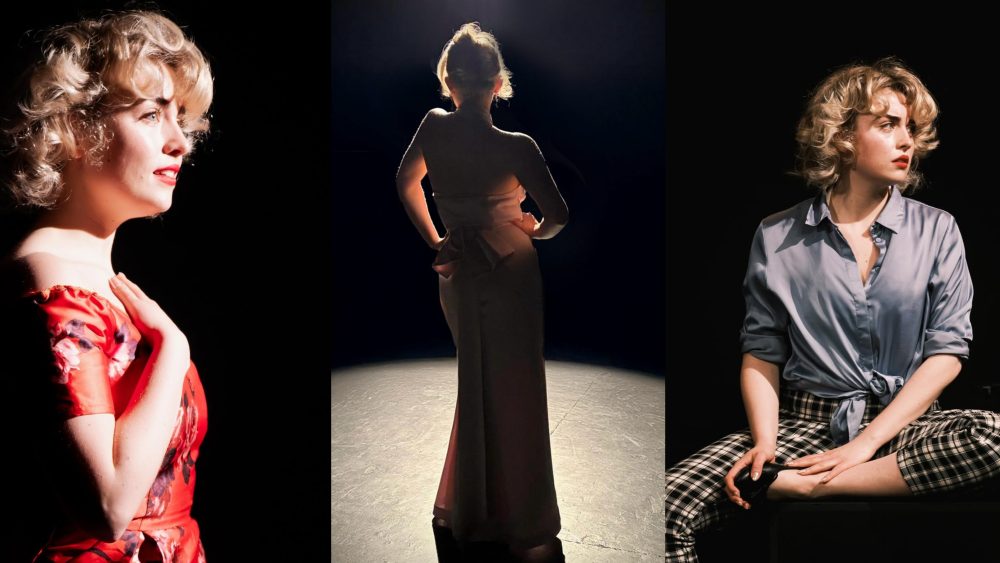
And finally, Jessica Stean-Gail gave Arthur & Marilyn a 3-star review for London Pub Theatres magazine.
“Steve Barker’s 90-minute play tells the story of Monroe and Miller’s relationship from their Hollywood introduction through their 1961 divorce and suggests that our cultural inability to reconcile their relationship against their incongruous reputations and roles in our collective memory just might reflect the paradoxical reality of the relationship itself … For Monroe, intellectual Miller is an opportunity to be taken seriously by association and to experience male protection over abuse. For Miller, Monroe represents the ideal of mainstream America at the precise time that his American-ness and assimilation as a Jew is in question. Arthur and Marilyn does not suggest the two were not authentically in love but, rather, that the very differences that attracted them to each other would become their eventual undoing.
Barker’s script is, of course, fictional. Though it is based on real people and events, the play does not purport to meet journalistic standards. Nevertheless, it is notably sympathetic and arguably biased towards Miller. Arthur remains the voice of reason throughout the play, but his rationality becomes increasingly mythologised against entirely irrational Marilyn … Daisy Snelson manages to deliver an effervescent and powerful performance of a character who would likely come off far less sympathetic on the page. Snelson’s Marilyn is charming, innocent, shy, arrogant, sad, vivacious, right, wrong and human, something Marilyn Monroe rarely gets to be.
The show also features excellent direction by Sarah Paterson. The performers manage to tell the entirety of Arthur and Marilyn’s story using just a few stage cubes and two liquor bottles. Music is expertly employed to evoke 1950s New York City and the costuming is genuinely transformative. Snelson brings Marilyn to life in both performance and look.
Unfortunately, though the play recounts the facts of Marilyn and Arthur’s story, it does not justify its significance … Nevertheless, Arthur & Marilyn is a fantastic example of what can be accomplished when two excellent actors are put on stage with a clear story to tell, sans gimmicks. The show’s 90-minute run-time flies and audiences of all ages, with any level of familiarity with the real Marilyn Monroe and Arthur Miller, will be thoroughly entertained.”
 The Marilyn Report