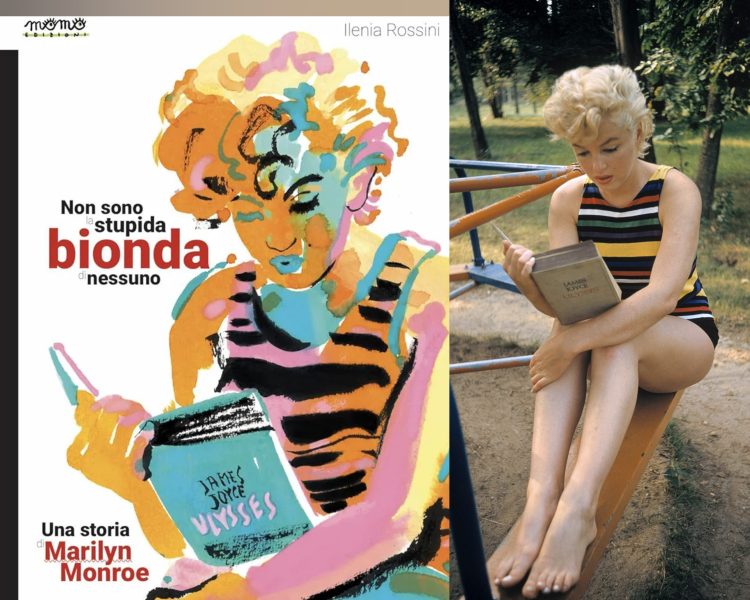
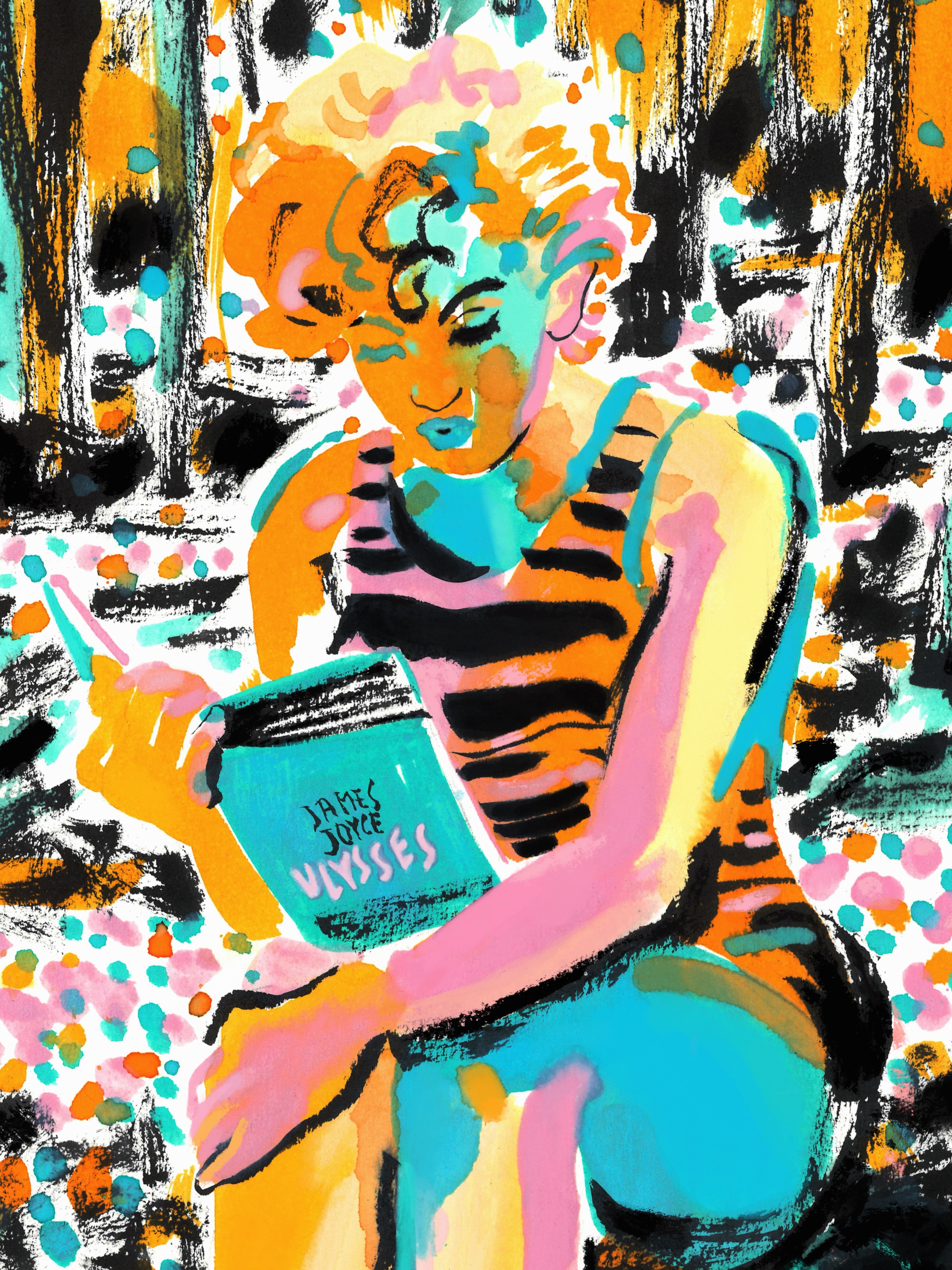
Marilyn is the subject of several new Italian books, including Ilenia Rossini’s I’m Nobody’s Dumb Blonde, featuring a cover illustration by Chiara Fazi based on Eve Arnold’s iconic 1955 photo of Marilyn reading James Joyce’s Ulysses.
«Please, don’t make me look like a joke».
“Marilyn Monroe asked this a few weeks before her death. It is from that desire—to finally be taken seriously, not transformed into an empty icon or a convenient symbol—that this book was born.
Far from the comforting myths and simplifications that have dogged her for decades, I’m Nobody’s Dumb Blonde portrays a woman who was strategic and vulnerable, self-aware and contradictory. A showbiz worker who lucidly crafted her public image, crushed by a system that didn’t know what to do with her talent.
Between performance and identity, between control and confusion, the portrait of an extraordinarily modern figure emerges: an actress who fought for professional respect, a self-taught intellectual, a woman who never stopped questioning who was truly behind the persona the world demanded of her. A Marilyn finally returned to her time and its complexity. Not a victim. Not an icon. But a human being.”
As we celebrate Marilyn’s centenary, an Italian translation of Norman Mailer’s controversial Marilyn (1973) uses a cover image showing her sitting inside a car in New York on her thirtieth birthday (June 1st, 1956), blowing out a single candle on a cake provided by reporters. (A close-up photo from the same press call graces the cover of a new Spanish translation – see here.)
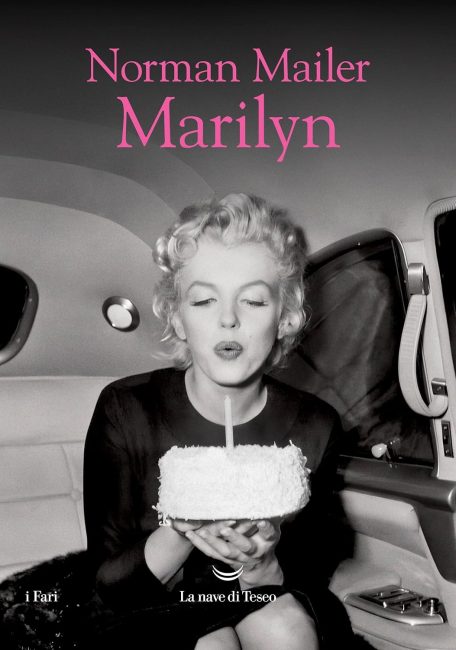
“When Marilyn was first released in 1973, it was greeted as a literary and media event. Norman Mailer, then already a renowned author and a central figure in American culture, didn’t simply recount Marilyn Monroe’s life: he reinvented it, reintroducing her as an epic and tragic figure of modernity. Mailer composes a true novel in the form of a biography, written with the passion of a narrator and the precision of a historian. Page after page, Marilyn emerges as a figure of magnetic power and absolute vulnerability: a woman who, behind her perfect image, hid an abyss of loneliness, ambition, and wounded intelligence. Mailer recounts her birth as Norma Jean, her first modelling poses, her dizzying rise and inevitable fall, constructing a portrait that blends reality and myth, like Marilyn herself. His interpretation, at times unprejudiced, doesn’t just explain the icon, but questions her. What does it mean to be desired by all and known by no one? What remains of a person when their image becomes legend?
A biography, a novel, a meditation on the destructive power of success, a book that transcends and transcends genres, in Marilyn Mailer transforms the greatest diva of all into a symbol of beauty and sacrifice, of freedom and condemnation, an allegory of America itself, which creates its idols only to devour them.”
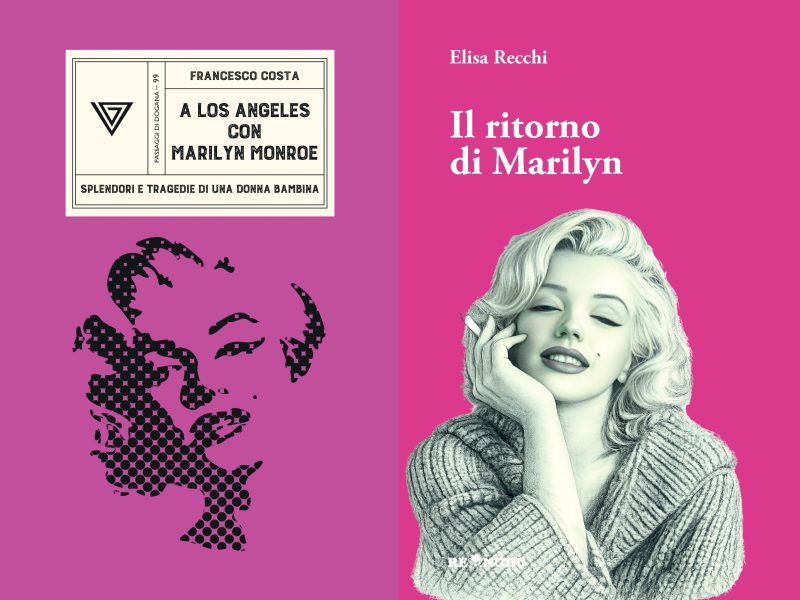
Both covers shown above are set against similar violet and fuschia pink backgrounds. However, while Francesco Costa’s geocentric tome uses a graphic rendition of a Hollywood studio portrait by Frank Powolny, Roberta Rosso chose a more candid photo by Milton Greene as a basis for her cover illustration for a novel by supermarket cashier turned author Elisa Recchi.
Los Angeles With Marilyn Monroe: The Splendour and Tragedy of a Child-Woman by Francesco Costa
“The human and artistic trajectory of Marilyn Monroe, one of the most enduring myths in the history of cinema, is evoked through all her Los Angeles addresses, from the hospital where she was born to the cemetery where she is buried, in a progression that marks every phase of her life: her miserable childhood, her difficult beginnings, her career punctuated by resounding successes, her stormy love affairs, and her tragic end, still shrouded in mystery. Against the backdrop of Hollywood, the scene of her triumphs and her downfall, the portrait is painted of a fragile and contradictory woman, destined for immortality by having polarised the dreams, projections, impulses, and everything unspoken condensed in the erotic imagination of the twentieth century.”
The Return of Marilyn by Elisa Recchi
“Given the opportunity to return to Earth, Marilyn will relive and recount the most significant moments of her life. One hundred years after her birth—June 1, 1926—this biographical novel dedicated to Marilyn Monroe unfolds with a crescendo of situations and anecdotes capable of captivating the reader.
The book begins immediately after the tragic event that occurred on the night between August 4 and 5, 1962, when the diva lost her life at the young age of 36.
From there begins an imaginary journey to the afterlife and then a return to Earth. She will find herself confronted by her beloved acting coach Lee Strasberg, will learn of a song composed for her by Elton John, of Andy Warhol’s paintings, and of the fortune many photographers have built around her image. And then she will meet her grandmother Della Mae Hogan and her mother Gladys Pearl Baker.
Passing through her loves, Joe DiMaggio, her singer friend Ella Fitzgerald, up to Queen Elizabeth, her contemporary …”
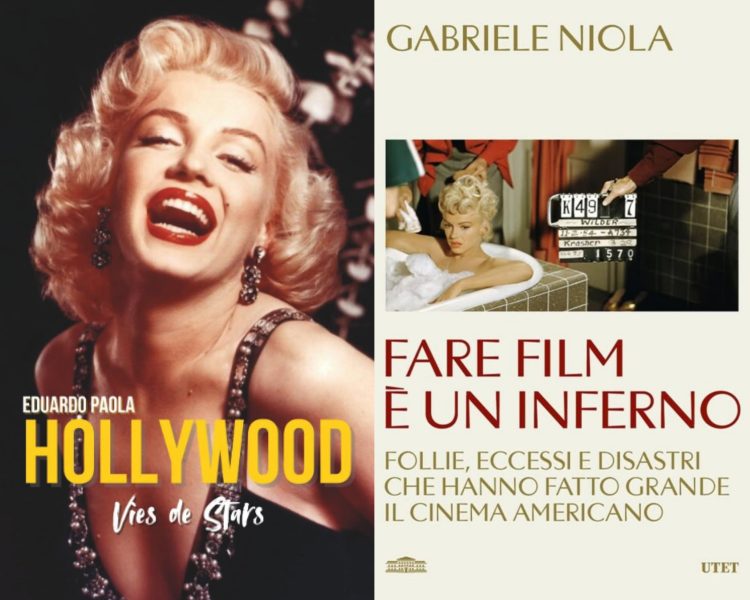
Marilyn is not the main focus of these film-oriented books, but her image is so cinematic that she makes a perfect cover girl. Another Powolny image illustrates Eduardo Paola’s biographical study of Hollywood’s female icons; and Sam Shaw’s on-set photo from The Seven Year Itch covers Gabriele Niola’s journey behind the scenes of classic films.
Hollywood: Lives of the Stars by Eduardo Paola (Self-Published)
“The stories of female stars who left an indelible imprint, facing and defeating social conventions and public opinion. Through the remarkable episodes of human and artistic life, one can find unique psychological profiles, which make one’s extraordinary life unique. Marilyn Monroe, Greta Garbo, Rita Hayworth, Grace Kelly, Marlene Dietrich, Hedy Lamarr, Vivien Leigh, Sophia Loren, Joan Crawford, Elizabeth Taylor: at the heart of a voracious cinematographic industry, they bring love to life. Hollywood isn’t just a place, it’s a world of illusion.”
Making Movies is Hell: The Follies, Excesses, and Disasters That Made American Cinema Great by Gabriele Niola
“In this exhilarating and rigorous book, Gabriele Niola recounts the essence of American cinema through the daring production stories of great masterpieces and minor cult classics, from the old Hollywood of the 1930s to the explosive Hollywood of the 1970s, from the blockbusters of the 1990s to auteur cinema.
From film to film, we will discover how difficult it is to get Marilyn Monroe to act (but what a joy when you succeed) … But most of all, we’ll learn the one thing everyone in Hollywood knows: making movies is hell.
Inside you’ll discover curiosities and behind-the-scenes information on films such as: Snow White and the Seven Dwarfs; Some Like It Hot; Apocalypse Now; Dune; Dirty Dancing; Titanic; and many others.”
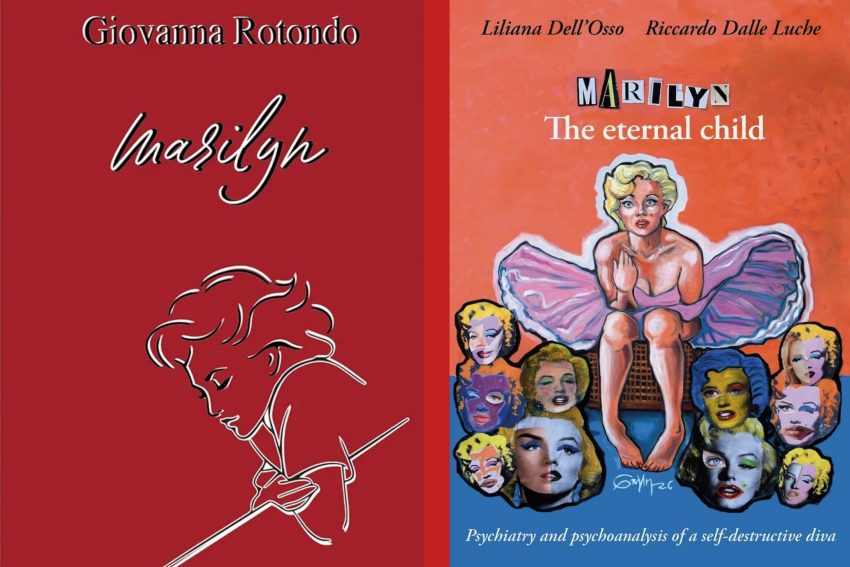
And finally, Giovanna Rotondo‘s Marilyn uses the outline of an Ed Feingersh photo against a bold red background; and a psychological study pits a central image from Milton Greene’s ballerina sitting against a cluster of Warholian disembodied heads. Marilyn, Eternal Child is an updated and revised version of The Other Marilyn (2016), and is also available in English. Author Liliana Dell’Osso, who is Chair of Psychiatry at the University of Pisa, also co-wrote Elena and the Others (2021), an exploration of how Marilyn and other beautiful women have been treated throughout history.
Marilyn by Giovanna Rotondo (Self-Published)
“A bilingual English-Italian text that moves between theatre, poetry, and reflection, inviting the reader into an intimate and fragmented conversation with one of the most luminous and fragile myths of the twentieth century.
This is not a book about Marilyn.
Or perhaps it is—but not in the way we expect.
Not a biography, but a theatrical investigation in five scenes: five encounters, five mirrors, five possible truths. On stage, Marilyn engages in dialogue with the figures who shaped her life and imagination: her mother, Joe, her psychiatrist, Norma Jeane, her own conscience, Andy Warhol. Voices that intertwine, contradict, and echo one another.
At its core lies an unresolved tension: the longing to be loved and the need to be seen.
Who was Marilyn, beyond the icon? And what remains when the gaze of others fades?”
Marilyn, Eternal Child: Psychiatry and Psychoanalysis of a Self-Destructive Diva (Territories of the Psyche) by Liliana Dell’Osso & Riccardo Dalle Luche
“Who really was Marilyn Monroe, beyond the myth and the image the world has come to love? The fruit of careful biographical and scientific research, this essay reinterprets her brief and tragic life as the story of a woman caught between the ghosts of childhood and the illusory glory of the star system, constantly torn between the need for love, the desire for recognition, and the fear of abandonment. In light of current clinical knowledge, Marilyn’s suffering is interpreted through the lens of borderline personality disorder, now widely recognised but often misunderstood. Far from myth and sensationalism, the book shows how this very vulnerability gave rise to her magnetic power, but also the psychological price she paid to become an icon in a culture that has often transformed female fragility into spectacle. This intense and accessible essay restores Marilyn Monroe’s humanity and invites the reader to question, through her story, what happens when being desired by the entire world is not enough to feel loved.”
 The Marilyn Report