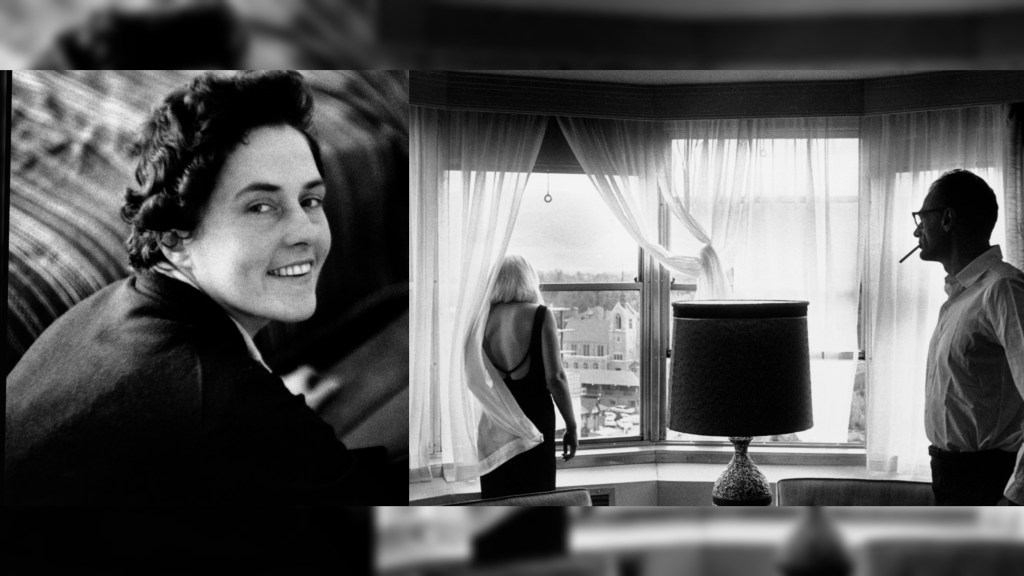
Inge Morath, one of the Magnum agency’s leading photographers, who documented the shooting of The Misfits in 1960 – and later became Arthur Miller’s third wife – was born 100 years ago today (she died in 2002.)
Writing for the Magnum Photos website, Marigold Warner explores Morath’s creative legacy.
“Born in Graz, Austria, a century ago on May 27, 1923, Morath lived in several countries throughout her life … She grew up in the shadow of Nazi Germany, and her first encounter with modern art was in 1937 at the notorious Entartete Kunst exhibition organized by the Nazi Party in Munich, consisting of 650 pieces of ‘Degenerate Art’.
The works were captioned with labels denouncing their moral and aesthetic value, in order to ‘educate’ the public on the ‘art of decay’. For 14-year-old Morath, the exhibition had quite the opposite effect … she later described her photographic practice as ‘a search for inner truth.’
In 1945, a Russian air raid forced Morath to flee Germany by foot. She had moved to Berlin to study linguistics, but was drafted to work at a munitions factory alongside Ukrainian prisoners of war. Morath, 22 at the time, joined thousands of refugees, walking 455 miles to her parents’ home in Salzburg, Austria. The journey took almost a week, and at one point it drove her to the brink of suicide.
Morath wouldn’t become a photographer for another decade, but when she did, she refused to photograph war … A prolific diarist throughout her life, Morath began working as a journalist after the war. She became the Austrian editor for Heute, a publication based in Munich, which is where she worked alongside the photographer Ernst Haas.

In writing articles to accompany his images, Morath began to develop an affinity for working with words and pictures, and in 1949 she joined the newly formed Magnum Photos as an editor. There, she became enamored by contact sheets sent in by Henri Cartier-Bresson … She borrowed her first husband’s (the British journalist Lionel Birch) camera, and the results were impressive. ‘It was instantly clear to me that from now on I would be a photographer,’ she wrote.
In the following years, Morath continued to work on photo stories, eventually moving to Paris, where she assisted Cartier-Bresson. In 1953, after presenting her first long-form story about the ‘worker-priests’ of Paris, she was officially invited to join Magnum as a photographer. Two years later, aged 33, she became the first woman to be a full member.
She traveled extensively in Europe, North Africa and the Middle East, and became known as a sensitive, clever and elegant image-maker — whether it was shooting fashion editorials, passers-by on the street, or sitting with world-renowned artists. She was an early pioneer of colour photography, a talented technician, and an experienced editor.

Morath once spoke about the challenges she encountered: ‘Being one of the then rather rare women photographers … was often difficult for the simple reason that nobody felt one was serious … I certainly do not think that I got the same forceful male brotherhood support the men got.’ But, according to her daughter, ‘she just got on with it … She never felt sorry for herself,’ says Rebecca Miller. ‘She was aware that there were always people who had it harder than she did.’

A significant part of Morath’s archive is her work as a film stills photographer. In 1960, alongside Cartier-Bresson and seven other Magnum photographers, she was commissioned to shoot on set for The Misfits, a blockbuster film starring Marilyn Monroe, Clark Gable and Montgomery Clift, with a screenplay by Arthur Miller.


At the time, Miller was married to Monroe, his second wife, but their relationship was falling apart. In a text written in 2004 and published in Inge Morath: Road to Reno (2006), Miller recalls first meeting with Morath: ‘When she pointed the camera she felt a certain responsibility for what it was looking at. Her pictures of Marilyn are particularly empathic and touching as she caught Marilyn’s anguish beneath her celebrity, the pain as well as her joy in life.’ Following his divorce from Monroe, Miller and Morath married on 17 February 1962.


The couple collaborated on several projects together, including the book In Russia (1969) and Chinese Encounters (1979), which documented their travels through the Soviet Union and the People’s Republic of China. Morath was disciplined and prepared extensively by studying the language, art and literature of the country she was working in. Miller later wrote that to ‘travel with her was a privilege because [alone] I would never have been able to penetrate that way.’
Miller’s literary network provided Morath with incredible access to artists. Some of her most iconic images are of renowned artists and celebrities, including Louise Bourgeois, Saul Steinberg, Audrey Hepburn and Alberto Giacometti … Morath and Miller were together for 40 years until her death. They settled in Roxbury, Connecticut, where they raised their daughter, Rebecca Miller.
In looking back at her mother’s archive, Miller recognizes how so much of her work intersected with key events of the 20th century … Driven by curiosity and empathy, even in the face of hardship, Morath was always searching for beauty — her photographs are proof of this pursuit. And in the beauty that emanates from her images, Morath’s spirit lives on.”

And finally, you can read more of my posts about Inge’s photography and encounters with Marilyn here and at The Marilyn Archive, while my review of the documentary, Arthur Miller: Writer, may also be of interest.
 The Marilyn Report