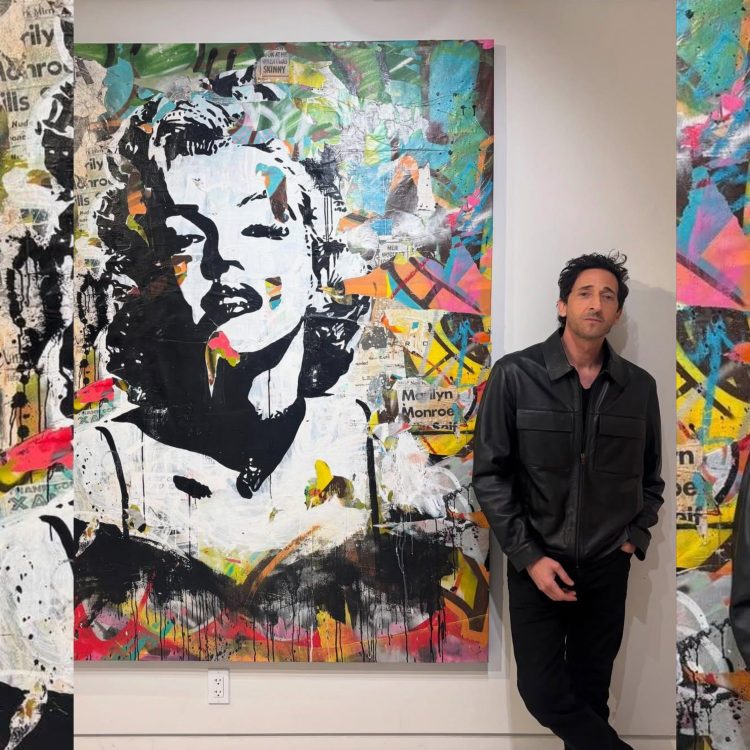
Oscar-winning actor Adrien Brody is trying his hand at pop art – and the response has been explosive, as The Week reports.
“‘Forgive me for adding to the undue attention that Adrien Brody’s current gallery show is receiving, said Alex Greenberger in ArtNews. Unfortunately, ‘I can’t stop thinking about how bad this art is.’ The two-time Oscar winner is exhibiting nearly 30 paintings that are visually ugly and thematically ‘about as subtle as a sledgehammer.’
A Queens, N.Y., native, Brody has adopted a ‘faux naïve aesthetic’ that evokes the hectic city of his 1980s youth. His collage-like canvases juxtapose images of cartoon characters and weapons, with graffiti-like streaks of paint partially obscuring newspaper clippings and other detritus of our visual culture.
Last month, a Brody painting sold for $425,000 at a benefit auction in France and instantly ‘became a source of mockery online,’ said Rachel Sherman in the New York Times. The derivative, Andy Warhol–inspired image centres a blue-eye-shadowed Marilyn Monroe against a muddled background featuring the letters of the Hollywood sign.
Critic Annie Armstrong had recently revived the phrase ‘red-chip art‘ to describe work that celebrates styles that were once considered tacky and that fetch blue-chip prices from a new breed of collectors. The Eden Gallery show prompted her to label Brody an avatar of the trend.
‘The only difference between Brody’s efforts and any garden-variety red-chip artist is how often he peppers in his own visage,’ said Annie Armstrong in Artnet. ‘It’s kind of an interesting move. Red-chip art relies on celebrity iconography … He understands the canon.’
In a twisted way, ‘Made in America might be one of the most significant shows of the past 10 years,’ said gallerist KJ Freeman … ‘Not because it’s groundbreaking,’ but because it makes clear that the market for fine art is not a mechanism for identifying and celebrating talent. The system was ‘never built to recognise anything outside the glow of celebrity, money, and myth.’ Usually, it’s a celebrity buyer that lifts an artist’s market value. Brody brings the celebrity buzz himself, and shouldn’t be faulted for that.”
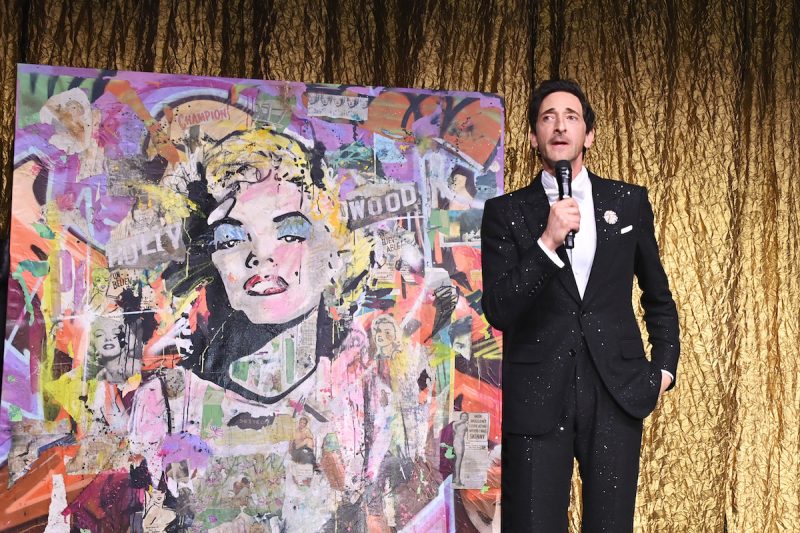
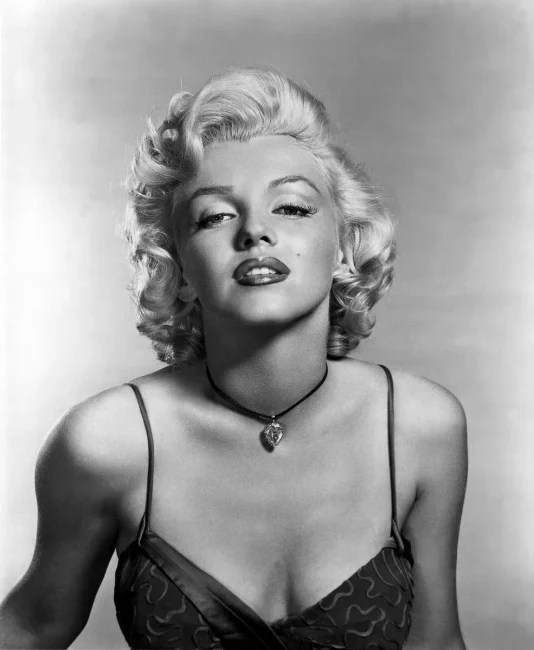
Brody has used a photo from a 1953 sitting with Frank Powolny, when Marilyn was invited to model one of the world’s largest diamonds. The yellow ‘Moon of Baroda‘, originally owned by Indian royalty, was then in the hands of a Detroit jeweller. During the shoot, Marilyn was named ‘the best friend a diamond ever had.’ In popular lore, however, the Moon of Baroda is rumoured to cast a curse upon all who wear it.
Brody’s ‘celebrity buzz’ may have also contributed to his art’s notoriety. While his acting talents have earned him two Academy Awards – first for The Pianist back in 2002, and most recently The Brutalist (2024.) His recent victory was marred by viral footage showing Brody removing a ball of chewing gum from his mouth and tossing it to his girlfriend before taking the stage to give a rambling acceptance speech, the longest in Oscar history.
All this is trivial stuff, of course, but Brody’s slightly pompous image may help to explain why his competent, if mediocre art has been mocked on social media. His work belongs to a growing trend for art by celebrities – also including fellow actor Johnny Depp, comedian Billy Connolly, plus musicians Boy George, Ronnie Wood, and even Bob Dylan. While their work isn’t all bad, they probably wouldn’t be so widely exhibited (and highly priced) without a famous name.
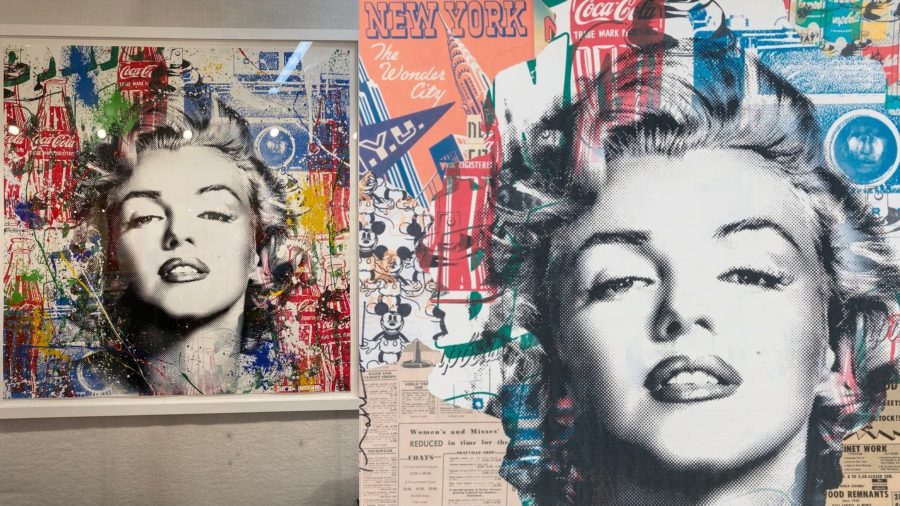
Getting back to Marilyn, Brody’s portrait is strikingly similar to a mixed-media work created by LA street artist turned red-chip brand Mr. Brainwash in 2021. A variant work was displayed in another New York gallery in 2022, as part of a Monroe tribute, The Blonde Bombshell.
Whereas Brainwash surrounded Marilyn with retro images of Mickey Mouse and Coca-Cola, Brody chose to remind us of her tragic demise with newspaper clippings from the same era. But neither artist can claim to be pioneers in Monroe-inspired art, which dates back to 1950s abstract expressionists like William De Kooning; and more pertinently, the Pop Art explosion of the 1960s.
While red-chip art may look great on your wall, it has nothing new to say about Marilyn or any other subject, as Andrew Greenberger noted in his rather scathing review.
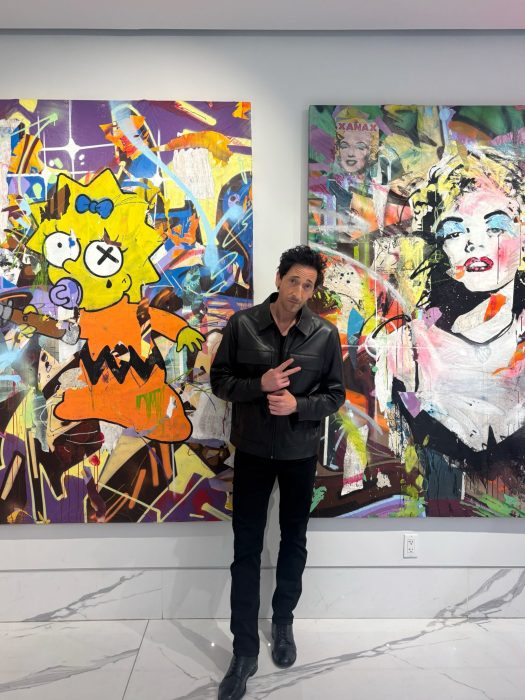
“The Eden Gallery show, titled Made in America, is ostensibly a commentary on the painful experience of residing in this nation. The bulk of what’s on view features distinctly American pop culture icons—Donald Duck, Mickey Mouse, Maggie Simpson—whom Brody represents amid an array of paint streaks and collaged material, including what appeared to be newspaper stories, advertisements, and product labels.
Brody is trying hard to put a contemporary spin on modes recognisable from Pop art from the 1960s. One painting on view at the gallery features a reproduction of Andy Warhol’s Shot Sage Marilyn Monroe (1964) beneath the word ‘XANAX,’ a reference to a medication patented in the United States 14 years after the actress died from a barbiturate overdose, and now popularized as a treatment for anxiety. It’s one of several paintings by Brody of Monroe in the show. Another work features a large image of her above various texts, including some that prominently use the words ‘man’ or ‘men,’ presumably to suggest that the male gaze robbed Monroe of agency.
Warhol’s Monroe paintings are gorgeous—one at the Museum of Modern Art, a few blocks away from Brody’s Eden show, features her portrait set amid a field of gold. On the other hand, Brody’s Monroe paintings are rather ugly: their surfaces are all torn up, as though someone had clawed away at the canvas. Where Warhol’s Monroes feel lush, Brody’s look cheap and defiled.
One could argue that Brody means to intentionally call to mind décollage paintings of the 1960s, for which artists—primarily ones in France—ripped apart layered posters and advertisements to reveal strata beneath, as though their canvases were equal to the walls of urban buildings. That would be giving him too much credit, however … If you look closely, you’ll notice that many of Brody’s prints are pixelated and low-quality. They appear to have been shoddily printed from the internet, not appropriated from his surroundings.”

In addition to Brody’s exhibition, the Eden Gallery’s Madison Avenue branch has similar pop art-inspired pieces in its collection which also draw upon Monroe iconography. ‘I Am Free‘ by Cocoon S replicates Warhol’s Marilyn in Swarovski diamonds, while Gal Yosef’s ‘Pretty in Pink‘ puts Minnie Mouse in Marilyn’s ‘skirt-blowing’ pose from The Seven Year Itch. Is their art any less ‘ugly’ than Brody’s?
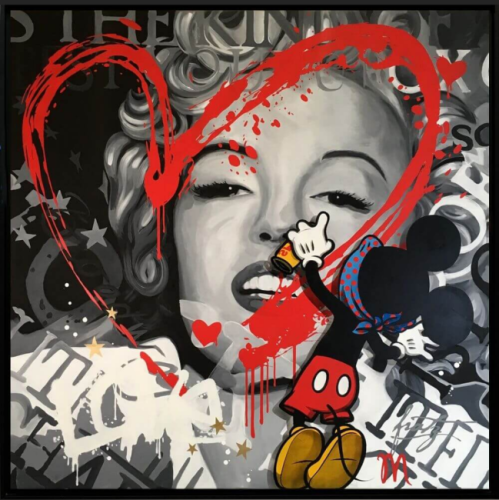
Elsewhere, F&G’s ‘Norma Jeane‘ takes a closer path to Brody and Brainwash, once again blending MM and Disney via graffiti art – combining two central tropes of ’50s Americana (although Marilyn never worked for Uncle Walt.)

Brody’s interest in Marilyn may stem from his role as Arthur Miller in the widely-panned Blonde (2022.) His sympathetic performance was arguably one of the few bright spots in Andrew Dominik’s lurid and sensationalist depiction of Marilyn’s story, based on Joyce Carol Oates’ novel.
“Marilyn Monroe is so deeply a part of so many people’s lives in so many ways … I’ve always felt a degree of empathy for her and her struggle as an artist, as a woman. This story really immerses people into those aspects of her hardships and the universality of those hardships. In seeing someone who’s so widely celebrated live a reality that’s so far from that adulation speaks to me so much.
The relationship between the playwright and her and Arthur Miller’s history and that time in Hollywood is fascinating as well. So all of it was pretty intriguing … Her life was incredibly complex, as was his. What I tried to convey within all of that was a sense of hopefulness and love; whether it fully manages to come to fruition or not is a different story.
There’s a need for some of her longing and loneliness to be fulfilled, and she sees a great deal in him. Her aspirations as an artist, as an actor, were always to bring a thoughtfulness to her work, an approach to character work that is honoured and cultivated within theatre more so than in the film work that was being done at that time. I think he saw a lot in her as well. And obviously she was very alluring.”
– Adrien Brody, W Magazine
 The Marilyn Report
1 Comment
Comments are closed.