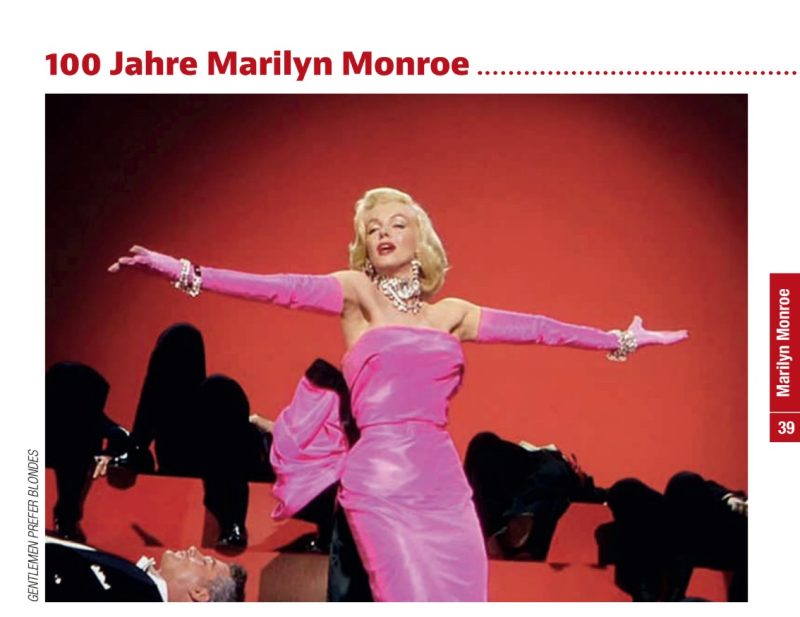
A major film retrospective marking Marilyn’s 100th birthday begins at Munich City Museum this weekend.
“Even decades after her death, Marilyn Monroe remains the epitome of the classic Hollywood star. How could her radiance ever fade? The promise she embodied was irresistible. It led into a realm of exuberant pleasure, generous seduction, and a life of abundance conceivable only in America. The dark side of this fame contributed just as much to her myth: she is saddled with the image of the saddest, most tragic of all Hollywood stars.
She herself struggled deeply with this fame. Part of her legend is that she despised her own films. But then why did she act in them with such unparalleled verve? Where did the radiance she brought to the screen come from—if not from an inner glow she absolutely had to share with the world?
Yet her fame seems to be inextricably detached from her work. How many scenes from her films truly remain in our memories? Isn’t it rather the gazes of the photographers that still make her an icon today? Eve Arnold, Richard Avedon, Inge Morath, Bob Willoughby, and finally Bert Stern captured her sense of loss and thoughtfulness, her willpower and zest for life.
But as her centenary approaches on June 1st, it presents the ideal opportunity to rescue her from the realm of legend and rediscover her in her true medium.”
– Gerhard Midding
The series includes seventeen Monroe films – from The Asphalt Jungle to The Misfits – and the feature-length documentary, Love, Marilyn (2012.) A full programme (in German) is available here.
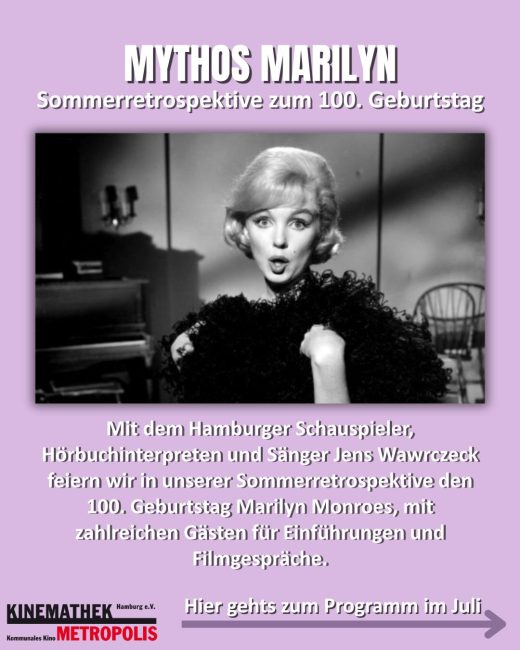
And looking ahead, on Monday, June 1st – Marilyn’s 100th birthday – The Marilyn Myth opens at Kino Metropolis in Hamburg – the first of several retrospectives coming to German cinemas in June.
“Marilyn Monroe was one of the greatest phenomena of the 20th century. A pop icon and a projection screen for millions. An actress whose art was long overshadowed by her sex symbol image. She possessed intuition, wit, timing, musicality, emotional openness, and an almost magical screen presence. She worked with some of the most important directors and stars of her time, and her courage to repeatedly defy Hollywood and assert her own decisions reveals her as an emancipated, self-determined artist. Yet, to this day, she is primarily seen as a victim and reduced to her tragic end: misunderstood, exploited, an early death that remains shrouded in mystery … Together with Hamburg-based actor, audiobook narrator, and singer Jens Wawrczeck, we celebrate Marilyn Monroe’s 100th birthday in our summer retrospective, featuring a total of 30 films. Numerous guests are invited for introductions, film discussions, and debates surrounding the ‘Marilyn myth.’ The retrospective kicks off with a double feature on June 1st …”
The June 12 screening of The Seven Year Itch (at 7pm) will be introduced by Jenni Zylka, author of a new book, Marilyn Monroe: 100 Pages.

Additionally, two of the better films depicting Marilyn herself will be screened. Insignificance, starring Theresa Russell as ‘The Actress’, is also showing on June 12. (Interestingly, Tony Curtis appears as ‘The Senator.’) And My Week With Marilyn (2011) – a fictionalised account of her time in England – is showing on June 16, and again on June 29. Michelle Williams earned an Oscar nomination and won the Golden Globe for her performance.
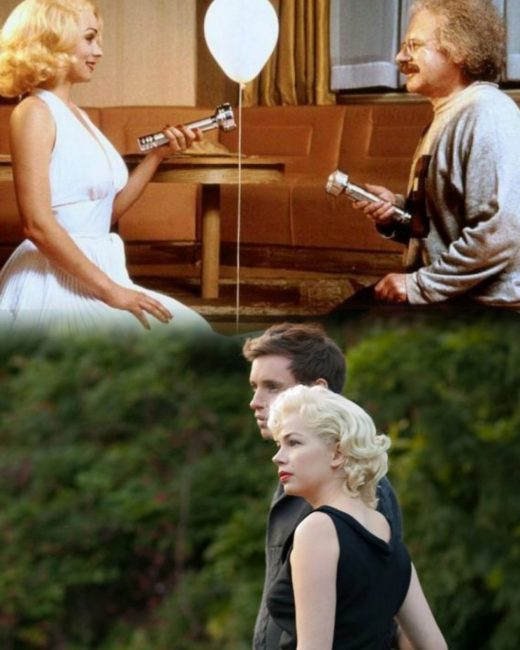
And finally, Move Over Darling – the 1963 reboot of the unfinished Something’s Got to Give, with Doris Day in Marilyn’s role – is showing on July 31.
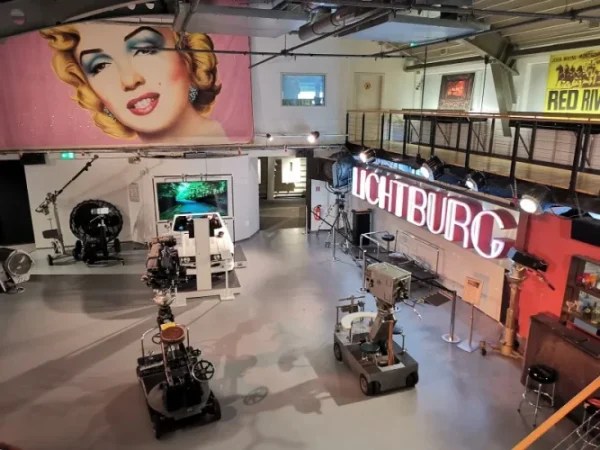
Some Like It Hot is coming to the Black Box Film Museum in Düsseldorf on Tuesday, June 2 at 8 pm; and again on June 7 at 12:30 pm, as part of another centennial series, Celebrating Marilyn! (And while you’re there, a studio exhibition – Becoming Marilyn – is on display until September 30.)

On Tuesday, June 2, another film series opens at Cinema Quadrat in Mannheim.
“Marilyn Monroe presented her sensational sexual allure with the innocence of a child, becoming the dream woman of the 1950s – and far beyond. But she never wanted to be seen as a mere sex symbol, but rather as an actress. With five films, we showcase the breadth of her acting talent.”
On Wednesday, June 3, Marilyn comes to the German Film Institute (DFF) in Frankfurt.
“Marilyn Monroe, who would have turned 100 on June 1st, is one of the greatest film stars in American cinema. Predominantly perceived by the public as a pin-up girl and sex symbol, she resisted the limitations of the roles offered to her throughout her career, seeking opportunities to demonstrate her intelligence, comedic talent, and emotional depth. It was only after her death that her full artistic range was widely recognised.
This small tribute honours an icon of her time, whose influence extends far beyond her short life. It brings together five of the eleven films in which Marilyn Monroe played a leading role … The film series is accompanied by a photo exhibition in the cinema foyer of the DFF.”
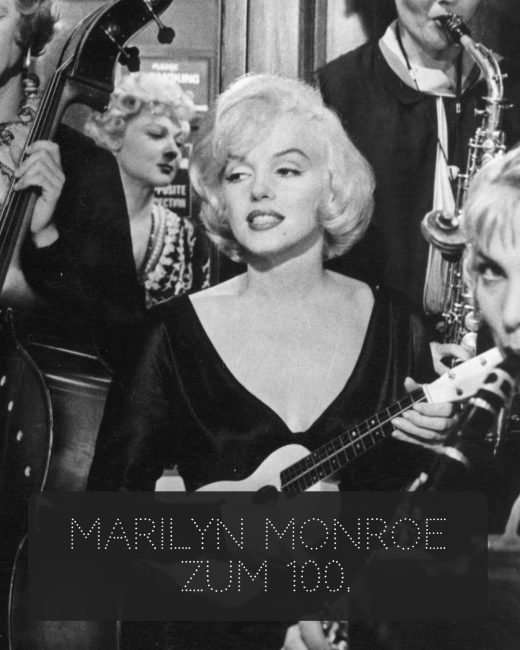
Another retrospective opens at Nuremberg Filmhouse on Friday, June 5.
- SOME LIKE IT HOT: June 5 – Introduced Dr. Kathleen Loock, whose research focuses on reboots; Some Like It Hot was a remake of the German movie, Fanfaren der Liebe (1951.)
- THE ASPHALT JUNGLE: June 6
- THE MISFITS: June 8 – introduced by the film club’s team, followed by a post-screening discussion in the foyer.
- GENTLEMEN PREFER BLONDES: June 15 – Introduced by artist Simona Leyzerovich
- DON’T BOTHER TO KNOCK: June 19
- CLASH BY NIGHT: June 20
- NIAGARA: “In the pre-show, Viennese artist Karin Fisslthaler, whose work has for years explored the persona of Marilyn Monroe and the role of women (and their bodies) in Hollywood cinema, presents her short films and collages … Since 2003, Fisslthaler has also been creating experimental electronic pop music under the pseudonym Cherry Sunkist.”
A fifth retrospective opens at the Karlstor Cinema in Heidelberg on Saturday, June 6. The programme includes a rare screening of Love Happy (1949.)
- SOME LIKE IT HOT: June 6 – Introduced by Gilda Hysaj
- BUS STOP: June 7 – Introduced by Dr. Franz Schneider
- LOVE HAPPY: June 9 – “Marxism meets the Monroe Doctrine? Yes, but in a very unique way in Love Happy, which supposedly began as a solo project by Harpo Marx and ended up as the last official Marx Brothers film, including a brief but memorable cameo by Marilyn Monroe. This not only landed her a promotional tour for the film but also caught the attention of Hollywood producers. The film wasn’t released in German cinemas until 1981 … A defining moment in Marilyn Monroe’s career can now be relived on the big screen.” (Introduced by Alexander Pawlak)
- GENTLEMEN PREFER BLONDES: June 13 – Introdued by Ferhat Neptune
- NIAGARA: June 18 – Introduced by Franziska Wenig
- THE MISFITS: June 27 – Introduced by Anna Rottländer
- THE SEVEN YEAR ITCH: June 30 – Introduced by Renate Karst-Matausch

Everyone Likes It Hot: Marilyn Monroe’s 100th Birthday, a summer movie retrospective, opens on July 10 at the German History Museum in Berlin.
“If she were still alive, Marilyn Monroe would be 100 years old today. Her beautiful face would likely have become a beautiful, wrinkled one; her strikingly proportioned, camera-friendly body would have shrunk a bit; and her hair would no longer be peroxide blonde, but would shine with a proud white glow.
Perhaps she would have gone through a few more marriages, or might still be in the middle of a relationship. She always wanted children; perhaps her wish would have come true—when Monroe died of a drug overdose in 1962, she was only 36 years old.
More intriguing than speculations about her personal life, however, is the question of what roles she might have played: Would she eventually have moved beyond the showgirls, the ‘bombshells,’ the gold diggers (on the hunt for rich men), the ‘ingenues,’ the naive, unconsciously attractive seductresses? Would she, perhaps in the context of the second wave of the women’s movement in the late 1960s, have continued to strive for self-empowerment, for artistic self-determination? Would she have encountered (female) allies who shared her views—female directors, screenwriters, cinematographers, and producers—who offered a different perspective on her, allowing her characters their own development, motivations, and storylines that went beyond simply finding ‘Mr. Right’? Would she have escaped the covetous male gaze, the male restriction of her scope of action?
Some of her films followed this trend: In Bus Stop and The Prince and the Showgirl, a (co-)production of her own short-lived company, there are relatively few traditional shots of her body; in the latter, she even saves a country from a political scandal. How to Marry a Millionaire, The Misfits, and River of No Return (barely) pass the Bechdel Test, which evaluates the representation of women in films. Supporting roles, such as in Clash by Night or All About Eve, feature self-assured—or at least fatalistic—female characters; the now-forgotten B-movie Ladies of the Chorus, Monroe’s early first leading role, presents a warm mother-daughter relationship and a Marilyn who, when singing, is not yet breathy but vibrates with a bluesy quality. Gentlemen Prefer Blondes invites a queer reading and offers a female gaze on muscular men in skimpy briefs; in Niagara and Don’t Bother to Knock, Monroe delivers performances with the utmost psychological insight. Of course, the successful, perfectly timed comedies Some Like It Hot and The Seven Year Itch are also worth watching—even if her character in the latter isn’t even given a name, and this film is arguably the most famous case of upskirting.
Incidentally, peeking up a woman’s skirt—and thus sexually objectifying an unsuspecting woman without her consent—is now a criminal offense almost everywhere. Things have certainly changed. It’s a shame Marilyn Monroe didn’t live to see it.”
– Jenni Zylka
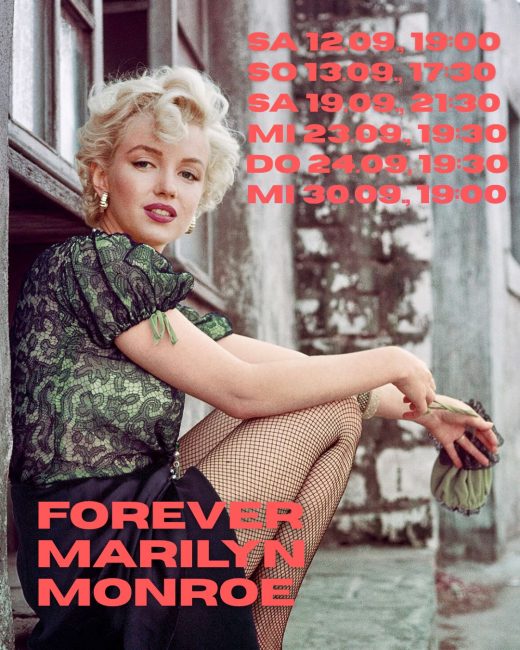
Meanwhile at KOKI Freiburg in Germany, a dual retrospective for Marilyn and novelist Ingeborg Bachmann – both born 100 years ago – opens in September.
“At first glance, they could hardly be more different – the great writer and the Hollywood icon. And yet, both share a life shrouded in myth, a life that continues to fascinate, idealise, and reinterpret. Their tragic end transformed them into timeless icons and projection screens for societal longings.
That they themselves partly perpetuated these images can only be understood within the context of the deeply patriarchal, male-dominated culture of the 1950s and 1960s. In this sense, Bachmann coined the famous phrase that fascism did not end in 1945, but lives on in the relationships between men and women. While her literary work—such as the novel Malina—is read as a merciless reckoning with these destructive structures, this very struggle for female self-determination is also reflected in the tragic biography of Marilyn Monroe.
Step by step, the dream factory moulded her into a perfect projection screen: the seemingly naive blonde whose blend of vulnerability, subtle humour, and overt eroticism took the world by storm. While Hollywood saw her as the embodiment of male fantasies, for Norma Jeane Baker, ‘Marilyn’ was a persona created by an actress who dreamed of playing Dostoevsky’s Grushenka. Despite the industry’s ridicule and plagued by self-doubt, Monroe fought for her artistic freedom. She left Hollywood to study at the prestigious Actors Studio and eventually founded her own production company. In doing so, she rebelled against the rigid, exploitative studio system – a system whose final demise she impressively embodied in her last completed film, THE MISFITS, in 1961.
We celebrate Marilyn Monroe’s 100th birthday with some of her most famous films. Accompanying introductions invite you to rediscover Marilyn Monroe’s cinematic legacy and to view her struggle against the conventions of the Hollywood studio system with fresh eyes.”
 The Marilyn Report