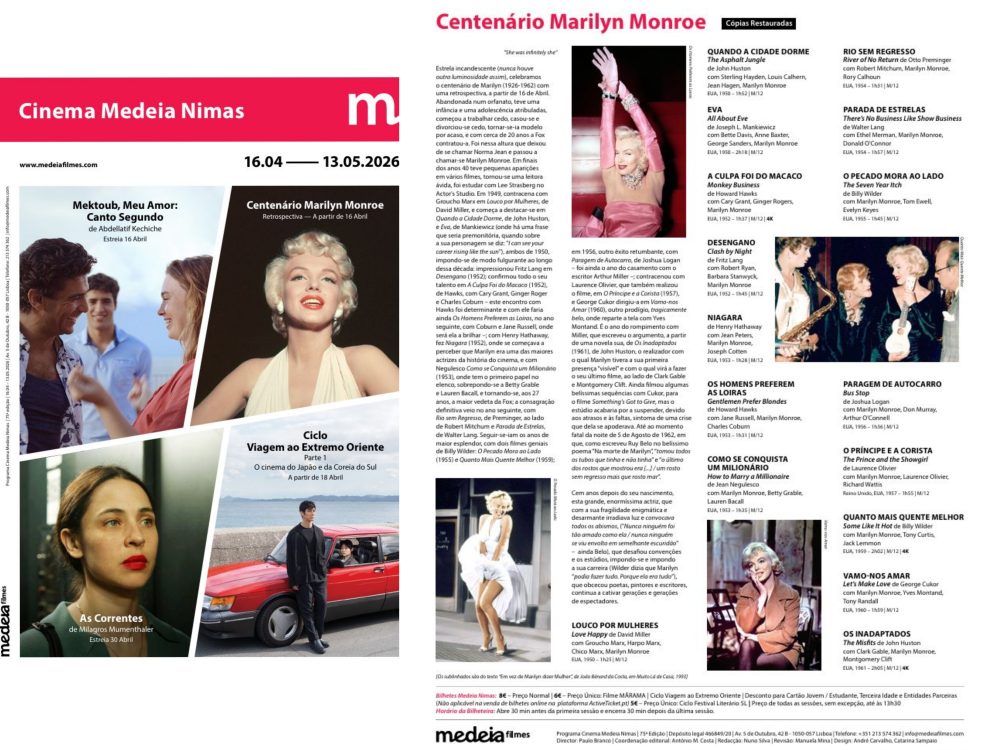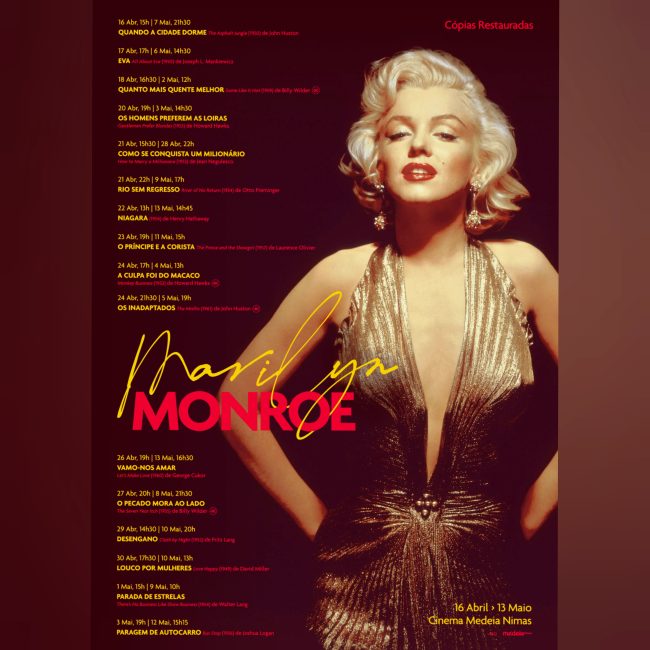
A month-long Marilyn retrospective comes to Lisbon this week, with sixteen of her films showing at the Medeia Nimas Cinema in the Portuguese capital.
“A blazing star (there has never been another light so bright), we celebrate the centenary of Marilyn (1926-1962) with a retrospective, starting April 16th.
Abandoned in an orphanage, she had a troubled childhood and adolescence, started working early, married and divorced early, became a model by chance, and at around 20 years old Fox hired her. It was at that time that she stopped being called Norma Jeane and started being called Marilyn Monroe. In the late 1940s she had small appearances in several films, became an avid reader, and went to study … In 1949, she co-starred with Groucho Marx in Love Happy; she stood out in John Huston’s The Asphalt Jungle and Mankiewicz’s All About Eve (where there is a line that would be premonitory, when about her character it is said: ‘I can see your career rising like the sun’), both from 1950, establishing her brilliantly …
She impressed Fritz Lang in Clash By Night (1952); and confirmed her talent in Hawks’ Monkey Business (1952) – this encounter with Hawks was decisive, and she made Gentlemen Prefer Blondes with him in 1953; with Henry Hathaway she made Niagara, and with How to Win a Millionaire, she overshadowed Betty Grable and Lauren Bacall – becoming, at 27, the biggest star at Fox … this was confirmed the following year with Preminger’s River of No Return, alongside Robert Mitchum, and Walter Lang’s There’s No Business Like Show Business…
The years of greatest splendour followed, with two brilliant films by Billy Wilder: The Seven Year Itch (1955) and Some Like It Hot (1959); in 1956, another resounding success with Bus Stop, by Joshua Logan – it was also the year of her marriage to the writer Arthur Miller; she co-starred with Laurence Olivier, who also directed the film, in The Prince and the Showgirl (1957), and George Cukor directed her in Let’s Make Love (1960) … It was the year of her break from Miller, who wrote the screenplay for The Misfits (1961), directed by John Huston, with whom Marilyn had her first ‘visible’ presence and with whom she would make her last film …
She filmed some beautiful sequences with Cukor for Something’s Got to Give, but the studio would eventually suspend her due to delays and absences, a symptom of a crisis that was taking hold of her. Until the fatal moment of the night of August 5, 1962, when, as Ruy Belo wrote in the beautiful poem On the Death of Marilyn, ‘she took all the pills she had and didn’t have’ and ‘the last face she showed was a face of pain / a face of no return …'”