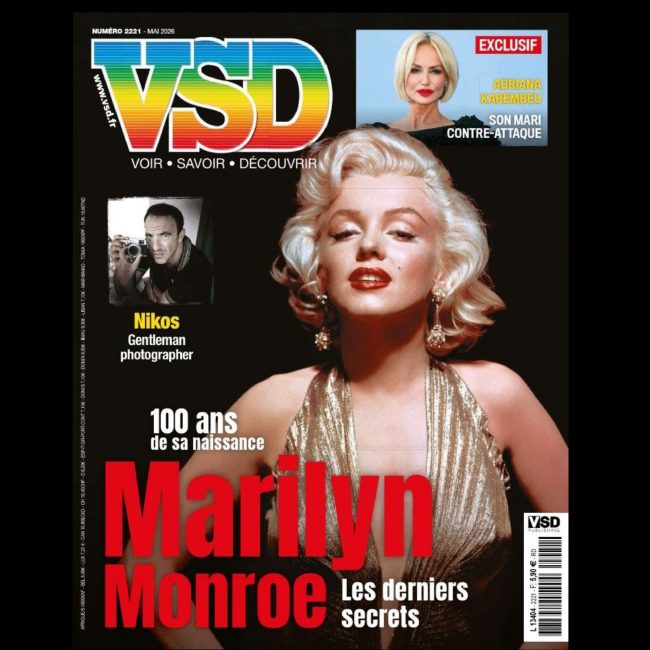
Marilyn covers May’s edition of the French magazine, VSD, with a ten-page feature inside marking her centenary. The initials stand for ‘Voir, Savior, Découvrir’ – meaning to see, know, and discover. Gene Kornman’s iconic photo of Marilyn wearing a gold lamé dress also made the cover of the Anglo-French magazine, Vocable, in April.
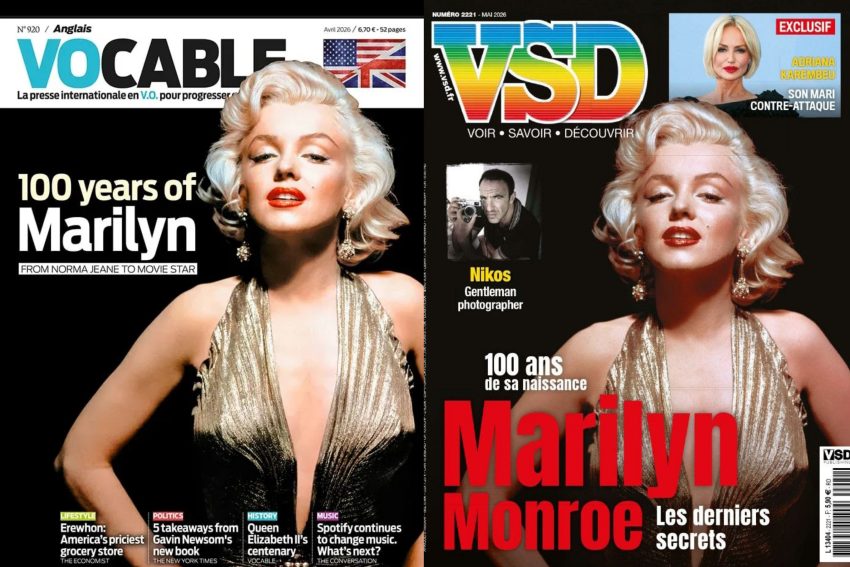
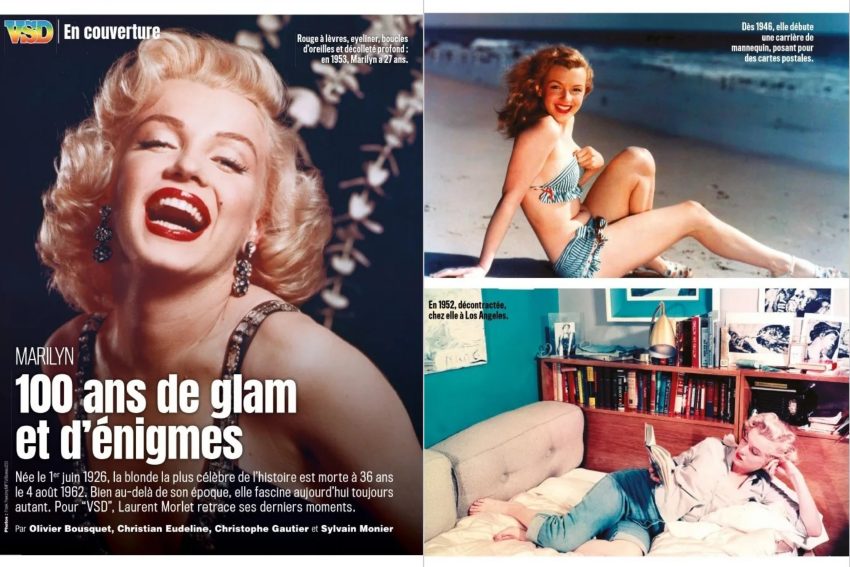
The tribute begins with an insightful article by film scholar Christophe Gautier, exploring why Marilyn’s fame has endured, while others faded.
“June 1st marks the centenary of the birth of Marilyn Monroe. A century has passed, and yet the image remains intact: a silhouette in a white dress lifted by the draft of a subway grate, a smile both candid and a whispered, timeless voice. How can we explain that an actress who died in 1962 continues to haunt the collective imagination with such intensity? Why does Marilyn Monroe, beyond her films, remain one of the most enduring figures in world culture? The answer lies less in her career than in a rare alchemy: the convergence of a person, an era, and a myth in the making.
Marilyn Monroe was born Norma Jeane Mortenson or Baker on June 1, 1926, in Los Angeles, in an America undergoing profound transformation: the Great Depression, Roosevelt’s New Deal, and then the war that redrew the map of the world. The 1950s saw the rise of television, advertising, and mass culture. Hollywood was no longer content with simply producing films; it manufactured icons. Marilyn became one of the most perfect embodiments of this system.
But unlike other studio-shaped stars, she understood the power of her image very early on. Rather than submit to the machine, she preferred to tame it. In a bold move for the time, she founded her own production company, defying the rules imposed by major studios like 20th Century Fox. This often underestimated act places her among the first actresses to reclaim artistic and financial control over their careers—a battle that Jane Fonda and Reese Witherspoon would later wage.
What is fascinating about Marilyn is the constant tension between two contradictory images. On one hand, the innocent blonde, the embodiment of naive sensuality in films like Some Like It Hot or Gentlemen Prefer Blondes. On the other hand, a woman aware of the role she plays, often more lucid than the characters she is given. This duality is at the heart of the myth. It anticipates a contemporary issue: the image we project. Long before the era of social media, Marilyn Monroe was a constructed identity, a public persona distinct from Norma Jeane. This dissociation, commonplace today, was then profoundly modern and profoundly schizophrenic.
Marilyn Monroe belongs to a rare category: that of faces immediately recognisable, almost abstract in their perfection. Her platinum blonde hair, her flamboyant lipstick, her beauty mark—these are elements that compose a graphic icon as much as a person. Artists like Andy Warhol captured this dimension by transforming it into a repetitive, almost industrial-In his silkscreen prints, she ceases to be an actress: she becomes a symbol, a surface onto which desire, nostalgia, and consumption are projected. This transition from flesh to image partly explains her longevity. Marilyn is not only a star of classic cinema, she is one of the first fully ‘media-driven’ figures, infinitely reproducible.
Every legend needs an ending worthy of its aura. The actress’s premature death, at 36, her image was definitively inscribed in a suspended temporality. She didn’t age, didn’t transform: she remained frozen in eternal youth. This disappearance also fueled a conspiratorial and romantic imagination. Her proximity to political figures like John F. Kennedy nourished a narrative where glamour, power, and tragedy intertwine. As with James Dean or Elvis Presley, death didn’t end the fascination: it transformed it into a cult.
Each generation rediscovers Marilyn Monroe in its own way. In the 1970s, she became an ambivalent feminist icon: a symbol of oppression for some, a model of emancipation for others. In the 2000s, she was revisited through the prism of celebrity and media voyeurism, a trajectory that foreshadowed that of contemporary stars.
Today, Marilyn resonates particularly strongly in a world obsessed with image and public validation. She embodies both the ultimate dream of being seen, desired, adored, and its flip side: loneliness, pressure, and loss of self. If Marilyn Monroe still fascinates a century after her birth, it is perhaps because she acts as a mirror. Each era projects its own obsessions onto her: beauty, success, vulnerability, the construction of identity.
She is not merely a figure of the past; she is an open question. What does it mean to be a visible woman? Where is the line between authenticity and performance? Can one possess one’s image without being imprisoned by it? In this, she far transcends Hollywood. She becomes an almost mythological figure, in the ancient sense of the term, a narrative that allows us to reflect on the present. In the age of constant flux, where images are born and disappear in seconds.
Marilyn Monroe’s enduring presence seems almost unreal. And yet, it persists. Perhaps because she embodies something our era struggles to replicate: a certain mystery. Everything about her seems visible, exposed, and yet, something always remains elusive.
One hundred years after her birth, Marilyn Monroe is not simply a star. She is a luminous enigma, suspended between reality and fiction, between vulnerability and power. And as long as this enigma remains unsolved, the world will continue to scrutinise her again and again.”
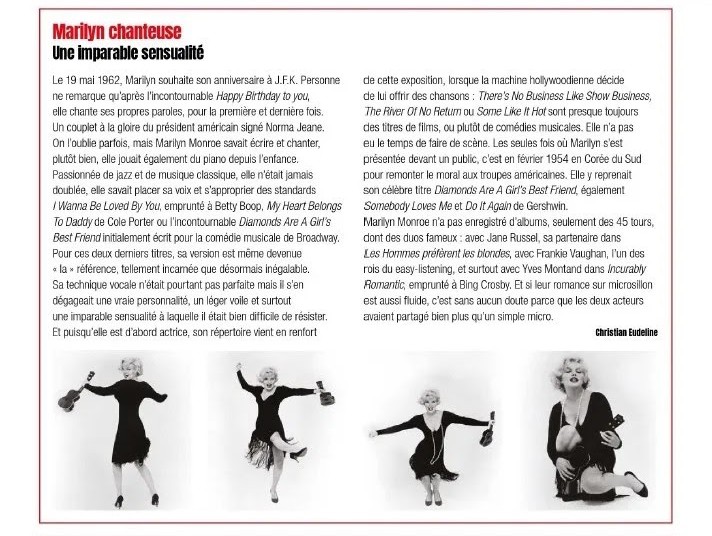
Elsewhere, Christian Eudeline reflects upon Marilyn’s musical legacy…
Marilyn the Singer: An Unstoppable Sensuality
“On May 19, 1962, Marilyn wished JFK a happy birthday … She knew how to project her voice and make standards her own, such as ‘I Wanna Be Loved By You,’ borrowed from Betty Boop, ‘My Heart Belongs To Daddy’ by Cole Porter, or the unforgettable ‘Diamonds Are A Girl’s Best Friend,’ originally written for the Broadway musical. For these last two songs, her version has even become the benchmark, so perfectly captured that it is now unsurpassed. Her vocal technique wasn’t perfect, but it exuded a genuine personality, a slight veil, and above all, an irresistible sensuality that was very difficult to resist. And since she is primarily an actress, her repertoire provides further support.
From this exposure, the Hollywood machine decided to offer her songs: There’s No Business Like Show Business, River of No Return, and Some Like It Hot are almost always film titles, or rather, musical comedy titles. She didn’t have time to perform on stage. The only other time Marilyn appeared before an audience was in February 1954 in South Korea to boost the morale of American troops. There, she performed her famous song ‘Diamonds Are a Girl’s Best Friend,’ as well as ‘Somebody Loves Me’ and Gershwin’s ‘Do It Again.’
Marilyn Monroe didn’t record any albums, only 45 rpm records, including famous duets with Jane Russell, her co-star in Gentlemen Prefer Blondes, with Frankie Vaughan, one of the kings of easy listening, and especially with Yves Montand in ‘Incurably Romantic,’ borrowed from Bing Crosby. And if their romance on vinyl is so seamless, it’s undoubtedly because the two actors shared much more than just a microphone.”
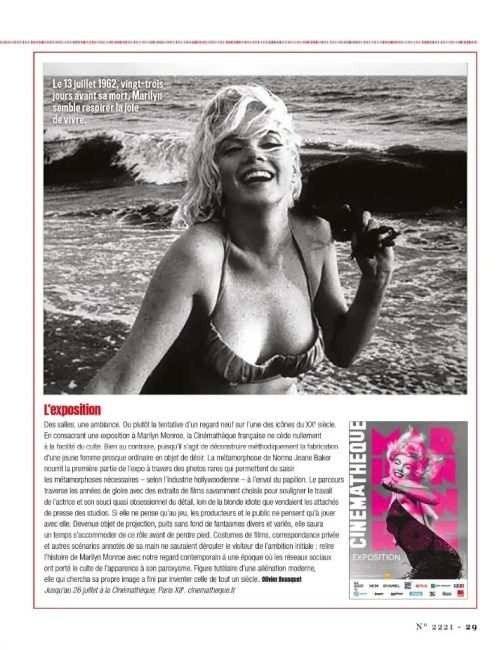
There are also short pieces on Marilyn’s marriages and romances; an interview with the author and filmmaker Laurent Morlet; and Olivier Bousquet visits Marilyn Monroe: 100 Years, the ongoing exhibition and movie retrospective in Paris.
“An attempt to offer a fresh perspective on one of the 20th century’s icons. By dedicating an exhibition to Marilyn Monroe, the Cinémathèque Française avoids the easy path of cult worship. Quite the contrary, its aim is to methodically deconstruct the transformation of an almost ordinary young woman into an object of desire. The metamorphosis of Norma Jeane Baker informs the first part of the exhibition through rare photographs that allow us to grasp the transformations deemed necessary—according to the Hollywood industry—for the butterfly to take flight. The exhibition traverses her years of glory with carefully chosen film excerpts that highlight the actress’s work and her almost obsessive attention to detail, far removed from the ditzy blonde portrayed by studio publicists. While she thought only of acting, the producers and the public thought only of playing with her. Having become an object of projection, a bottomless well of diverse and varied fantasies, she would initially adapt to this role before losing her footing. Film costumes, private correspondence, and other screenplays annotated in her own hand should not distract the visitor from the initial ambition: to reread the story of Marilyn Monroe with our contemporary perspective in an era where social media has brought the cult of appearance to its peak. A tutelary figure of modern alienation, she who sought her own image ended up inventing that of an entire century.”
And finally, you can view the complete feature on the Divine Marilyn Monroe blog.
 The Marilyn Report
1 Comment
Comments are closed.