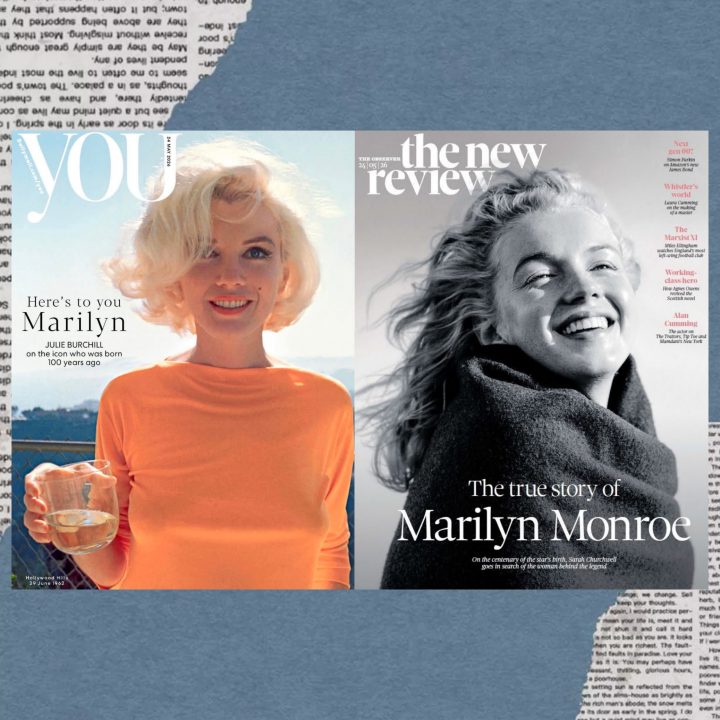
Marilyn is featured in four of Britain’s national newspapers this weekend…
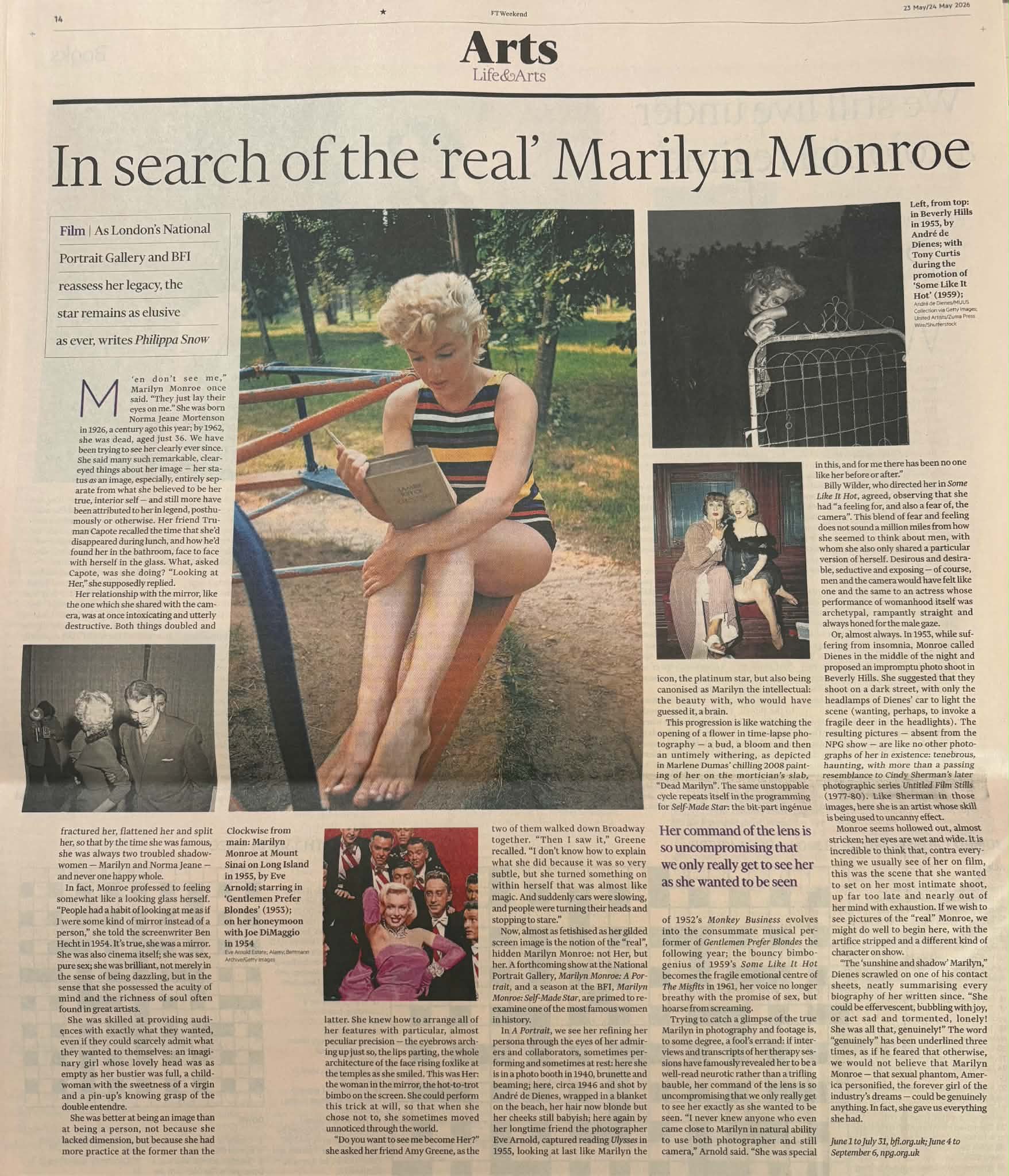
Writing for the Financial Times, Philippa Snow – who previously wrote about Marilyn and other female celebrities (including Anna Nicole Smith) here – focused on a mysterious nocturnal photo shoot.
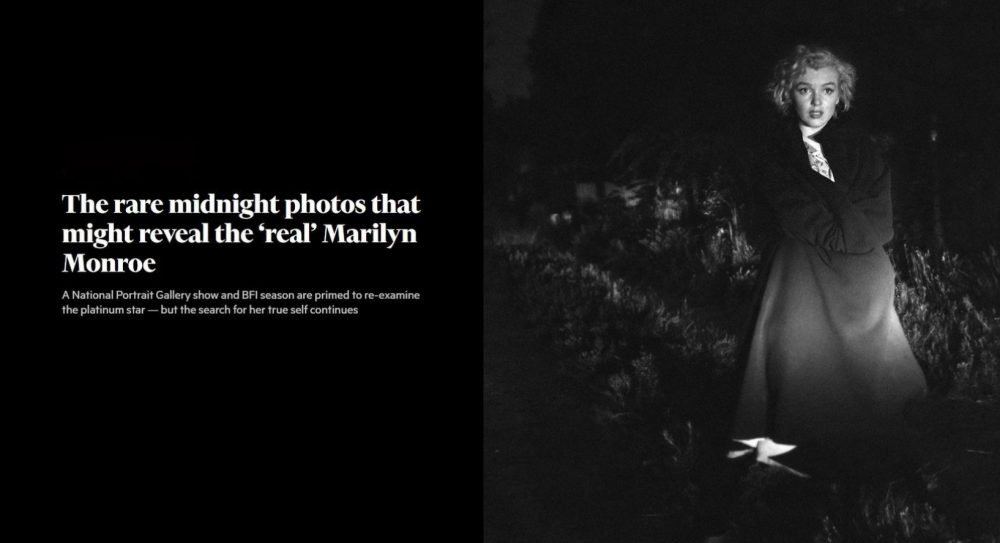
“In 1953, while suffering from insomnia, Monroe called Andre de Dienes in the middle of the night and proposed an impromptu photo shoot in Beverly Hills. She suggested that they shoot on a dark street, with only the headlamps of Dienes’ car to light the scene (wanting, perhaps, to invoke a fragile deer in the headlights). The resulting pictures are like no other photographs of her in existence: tenebrous, haunting … Monroe seems hollowed out, almost stricken; her eyes are wet and wide. It is incredible to think that, contra everything we usually see of her on film, this was the scene that she wanted to set on her most intimate shoot, up far too late and nearly out of her mind with exhaustion. If we wish to see pictures of the ‘real’ Monroe, we might do well to begin here, with the artifice stripped and a different kind of character on show … Otherwise, we would not believe that Marilyn Monroe — that sexual phantom, America personified, the forever girl of the industry’s dreams — could be genuinely anything. In fact, she gave us everything she had.”
Sarah Churchwell – author of The Many Lives of Marilyn Monroe – writes for The Observer‘s arts supplement, The New Review, about the Norma Jeane/MM paradox.
“Hollywood routinely rewrote the names and lives of its stars, softening hardship, fabricating romance. But in Monroe’s case, her renaming is treated as a kind of original sin, into which her doom was written. The idea that changing her name marked a tragic schism defines virtually every version of the story … In fact, Monroe had plenty of agency in the process. Her mother’s maiden name was Monroe, and none of the swirling patronyms from her childhood seem to have meant much to her daughter – why should they? So, when she agreed with a producer that Marilyn would be a better stage name than Norma Jeane, she chose her mother’s surname to match it. Marilyn Monroe was the name she legally adopted, the name she preferred. No one called her Norma Jeane as an adult – only biographers, after her death, insisting on an identity she had relinquished.
She was punished for being a sex symbol and punished for wanting to be more than one. Her body became a battleground, and public property … The madness in the story was never really hers, in other words. It was ours: a culture addicted to sex, secrecy and power, that took pleasure in humiliating her, then built a myth to cover its tracks. To treat her only as a symbol – of tragedy, of sex, of fame – is to lose her all over again. She was neither a fantasy nor a construction. She was a woman: beautiful, flawed, driven, funny, frightened, smart. She made choices, some wise, some disastrous. She struggled to define herself within institutions built to undermine her. And she kept trying. To look at her now is to confront the machinery of fame, the economics of beauty, the cultural logic that turns women into symbols and then reviles them for refusing to stay still.”
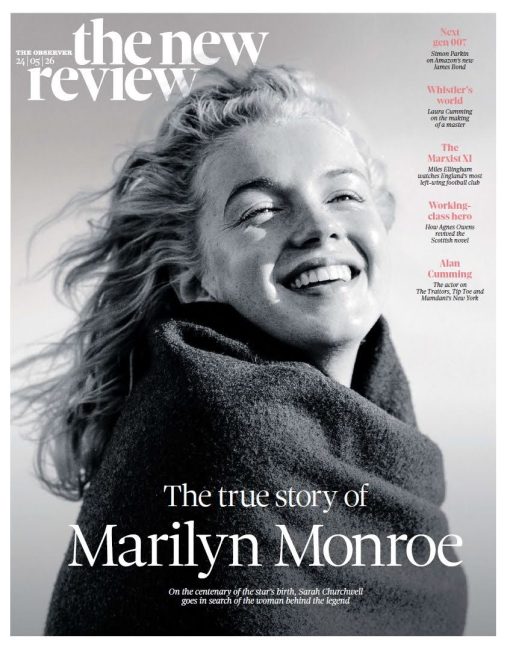
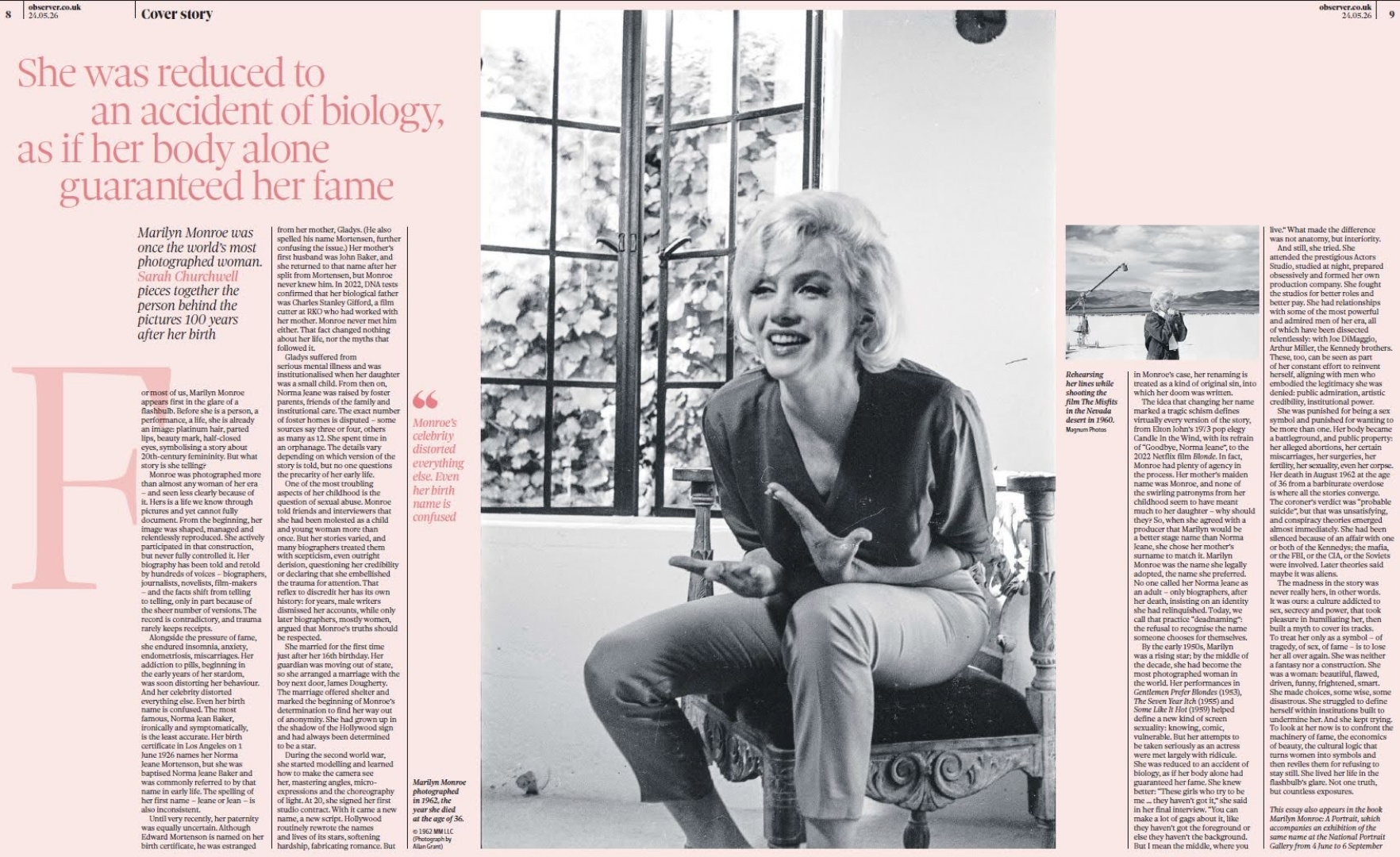
Churchwell’s essay was written for the catalogue accompanying Marilyn Monroe: A Portrait, which opens at the National Portrait Gallery in London on June 4. This 1946 photo (also by Andre de Dienes) is on the cover of the paperback edition – a gallery exclusive – while images by Allan Grant and Eve Arnold are featured in the Observer layout.
In the Sunday Times, actress and activist Rose McGowan reflects on Marilyn’s career in an essay for another new book, The Marilyn Monroe Century, showcasing the photography of Bruno Bernard (aka ‘Bernard of Hollywood.’)
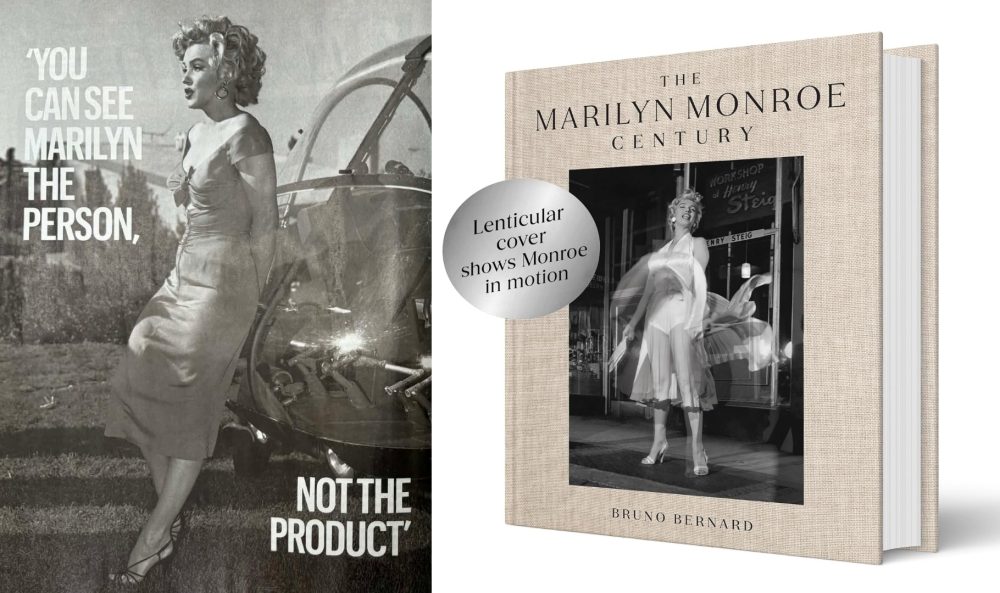
“Not many people survive exiting Hollywood. I know this because I lived it. And I know it because I spent years studying the face of Marilyn Monroe, the woman who lived it before me. She was one of many who did not survive fame. There’s a myth that fame will solve things, every ache, abandonment, every wound, and it’s one society has been selling itself for a long time — that if you shine brightly enough, you’ll be safe and loved. The reality is often the opposite.
In 2017 I was part of the MeToo movement. This was an intense personal goal for me. I admit my goal was unusual. To shift the shame from the abused to the abuser and set off a seismic global change. Using Hollywood as an example for others worldwide to recognise patterns in their own life was a huge undertaking.
When you’re sold as a sex symbol, there is no choice in the matter. You are told: ‘This is how we are going to market you’ … To reduce Marilyn to a pin-up is a flattening of someone who had so much more to give. I know how isolating that erasure is. Women keep their distance and almost everyone else thinks they can touch you. When agents and handlers craft your narrative, as Marilyn’s did, as mine did, it can feel like a direct order coming down from Olympus: this is who you are now. In obeying, the true self starts to vanish. Norma Jeane became Marilyn.
Still, I resist the urge to reduce big lives to tragedy. Marilyn was joy and sorrow, comedic brilliance and fragility. She was building a craft under intense pressure while trying to maintain some inner life. She wanted to better herself. She made a heroic effort to become a fully realised artist and businesswoman and that should be acknowledged.”
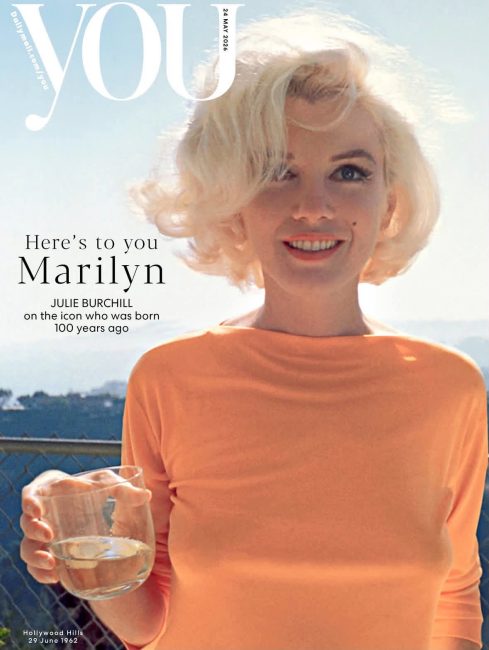
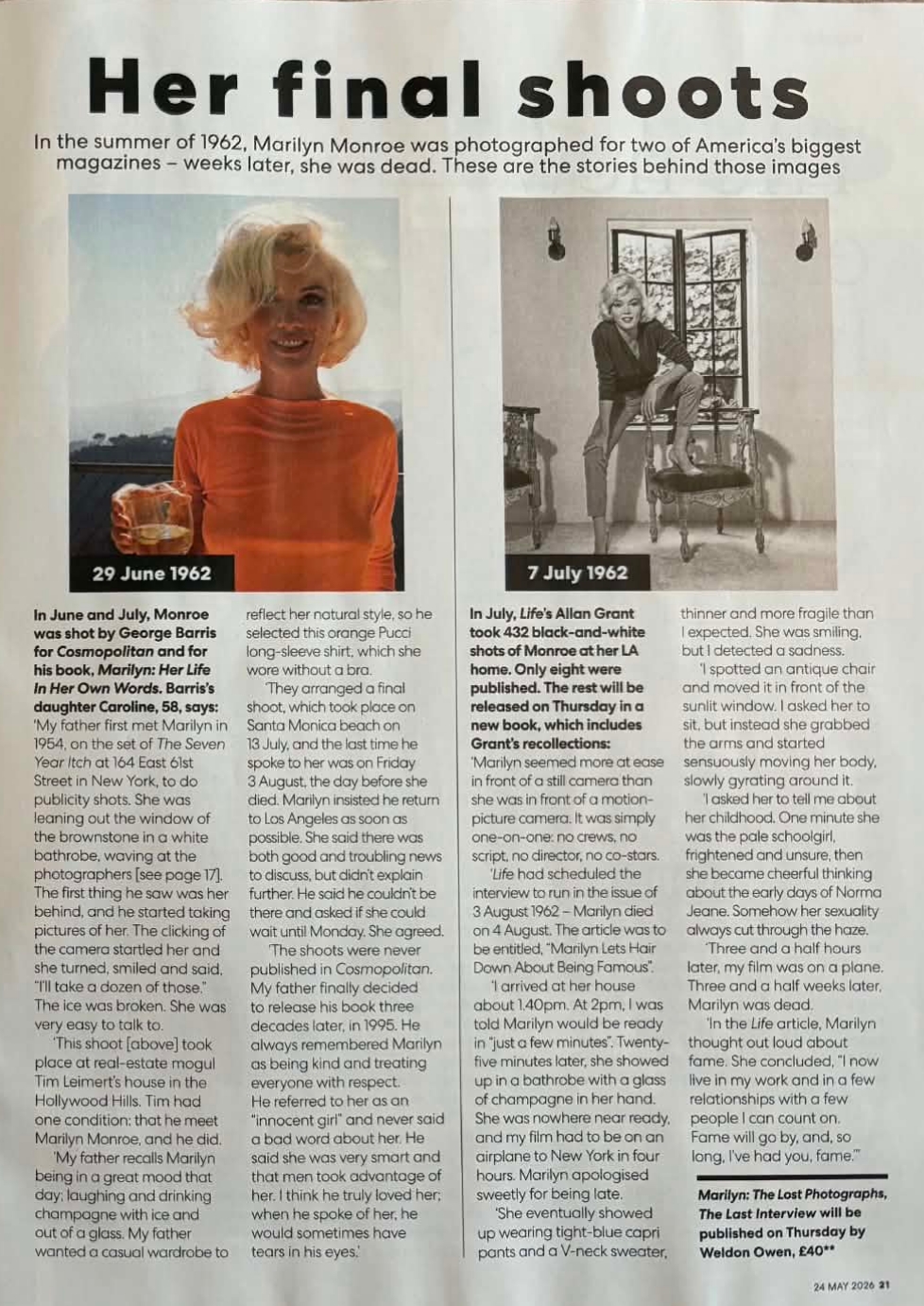
Meanwhile, You Magazine – a supplement for the Mail On Sunday – features a cover photo showing Marilyn sipping champagne in the Hollywood Hills in the summer of 1962. Inside, columnist Julie Burchill gushes: ‘I Shall Always Love Her.’
“Are there lessons to be learned from the short life and sad death of Norma Jeane? That she disproved the moronic modern cliché ‘If you look good, you feel good’, maybe. Or perhaps don’t look for salvation in any human being, for they are just as imperfect as you. But then, I’m not the most logical thinker when it comes to Marilyn; personally, I shall always love her as much as I did when, as a bored teenager watching her in The Misfits on a rainy Sunday afternoon in the 70s, I thought, ‘She seems even sadder than me.'”
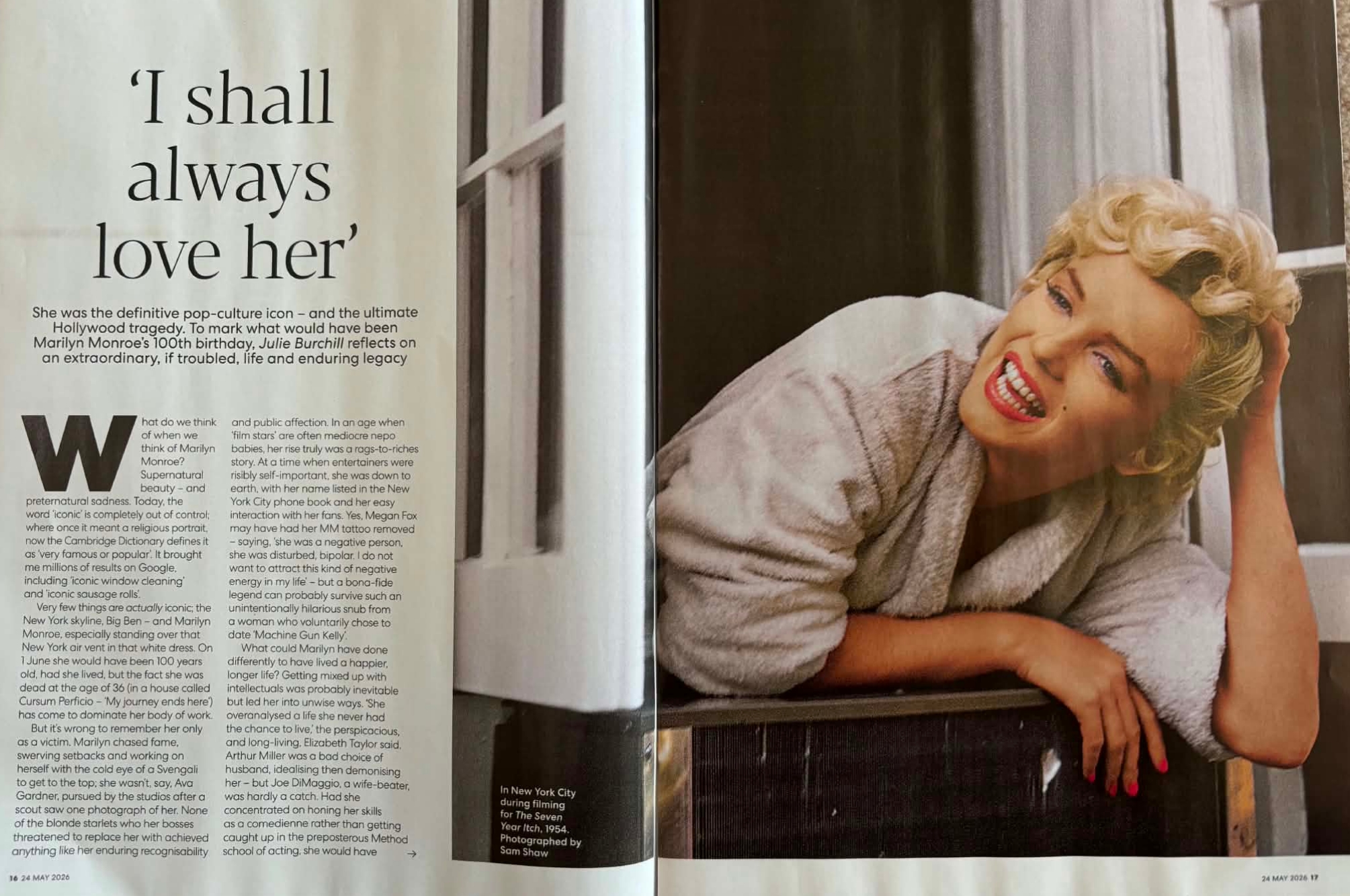
And finally, the six-page spread includes personal memories from Marilyn’s last photo shoots with George Barris and Allan Grant.
Thanks to Fraser Penney

