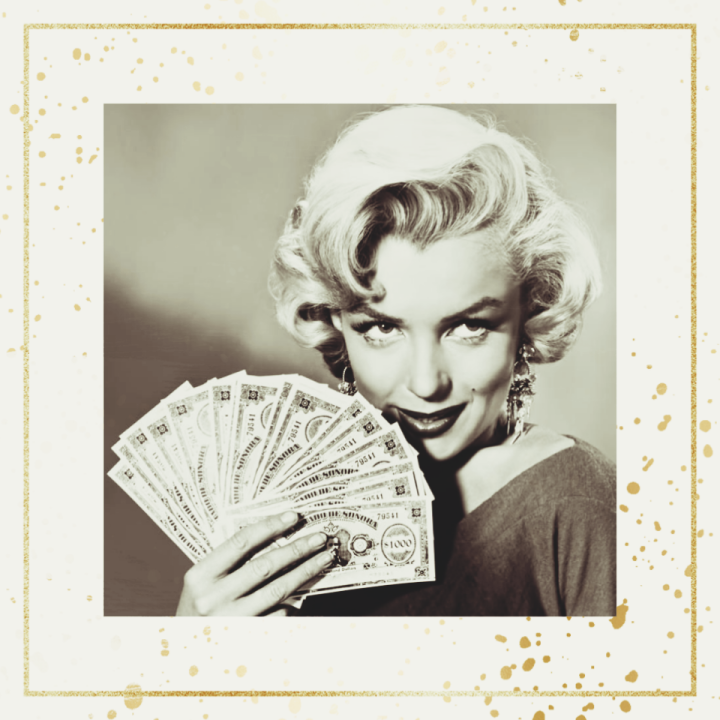
Marilyn last made the Forbes 12 Highest Paid Dead Celebrities list in 2023, and it seems likely she’ll return soon, as The Economist reports. (However, I can’t wholly agree with the claim that ‘thanks to Authentic, people will know her for longer than she could have imagined.’ After all, Marilyn was a legend long before her estate was sold for an undisclosed sum in 2011 …)
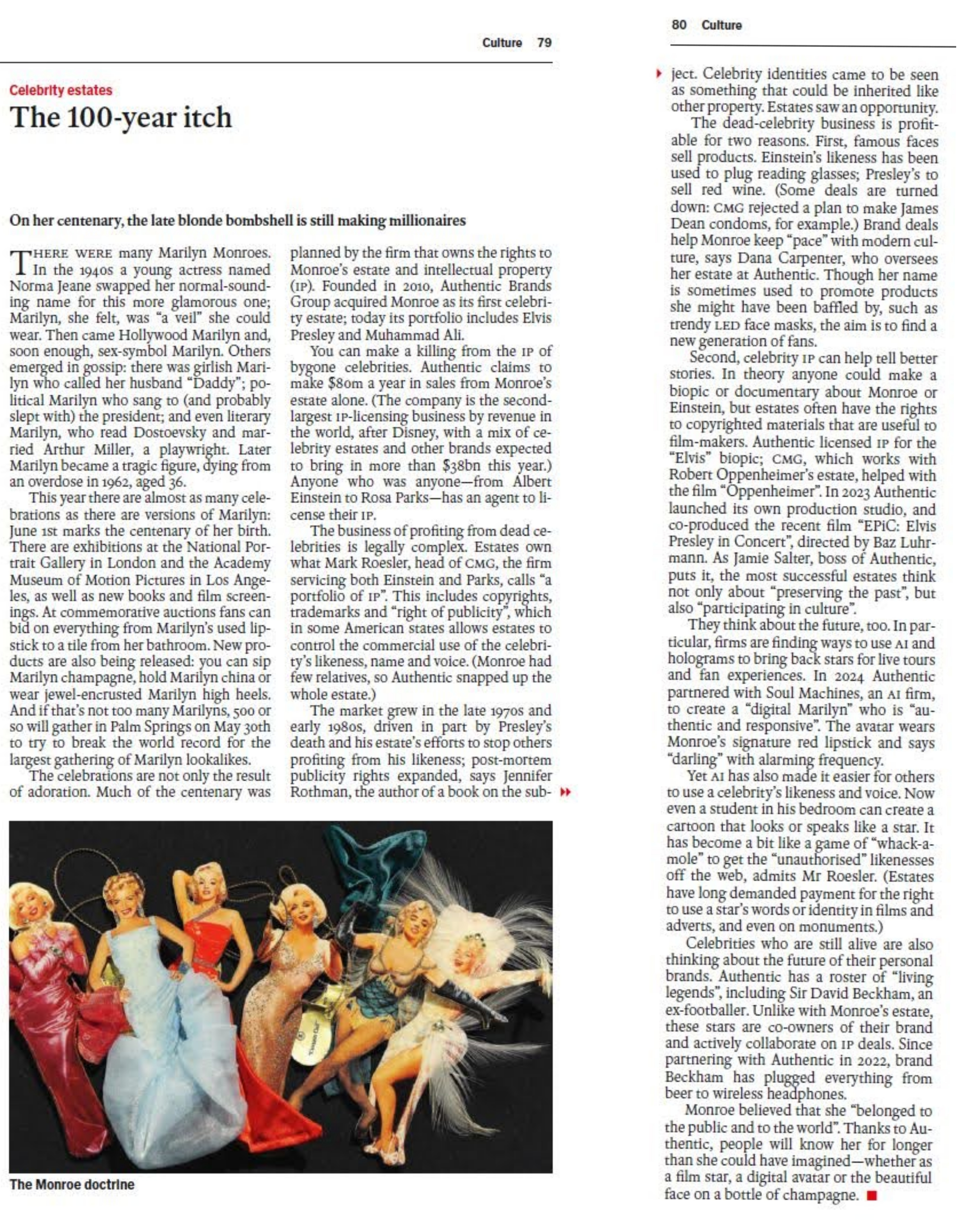
“This year there are almost as many celebrations as there are versions of Marilyn: June 1st marks the centenary of her birth … The celebrations are not only fuelled by adoration. Much of the centenary was planned by the firm that owns the rights to Monroe’s estate and intellectual property (IP). Founded in 2010, Authentic Brands Group acquired Marilyn as its first celebrity estate; today its portfolio includes Elvis Presley and Muhammad Ali.
You can make a killing from the IP of bygone celebrities. Authentic claims to make $80m a year in sales from Monroe’s estate alone. (The company is the second-largest IP-licensing business by revenue in the world, after Disney, with a mix of celebrity estates and other brands expected to bring in more than $38bn this year.) Anyone who was anyone—from Albert Einstein to Rosa Parks—has an agent to license their IP.
The business of profiting from dead celebrities is legally complex. Estates own what Mark Roesler, head of CMG, the firm servicing both Einstein and Parks, calls ‘a portfolio of IP’. This includes copyrights, trademarks and ‘right of publicity’, which in some American states allows estates to control the commercial use of the celebrity’s likeness, name and voice. (Monroe had few relatives, so Authentic snapped up the whole estate.)
The market grew in the late 1970s and early 1980s, driven in part by Presley’s death and his estate’s efforts to stop others profiting from his likeness; post-mortem publicity rights expanded, says Jennifer Rothman, the author of a book on the subject. Celebrity identities came to be seen as something that could be inherited like other property. Estates saw an opportunity.
The dead-celebrity business is profitable for two other reasons. First, famous faces sell products … As Jamie Salter, boss of Authentic, puts it, the most successful estates think not only about ‘preserving the past’, but also ‘participating in culture’ … Brand deals help Monroe keep ‘pace’ with modern culture, says Dana Carpenter, who oversees her estate at Authentic. Though her name is sometimes used to promote products she might have been baffled by, such as trendy LED face masks, the aim is to find a new generation of fans.
Second, celebrity IP can help tell longer stories. In theory anyone could make a biopic or documentary about Monroe or Einstein, but estates often have the rights to copyrighted materials that are useful to film-makers … They think about the future, too. In particular, firms are finding ways to use AI and holograms to bring back stars for live tours and fan experiences. In 2024 Authentic partnered with Soul Machines, an AI firm, to create a ‘digital Marilyn‘ … Yet AI has also made it easier for others to use a celebrity’s likeness and voice … Estates have long demanded payment for the right to use a star’s words or identity in films and adverts, and even on monuments.
Celebrities who are still alive are also thinking about the future of their personal brands. Authentic has a roster of ‘living legends’, including Sir David Beckham, an ex-footballer. Unlike with Monroe’s estate, these stars are co-owners of their brand and actively collaborate on IP deals.”
Writing for The Telegraph, Eleanor Halls ventures ‘inside the Marilyn Monroe grave-robbing business.’
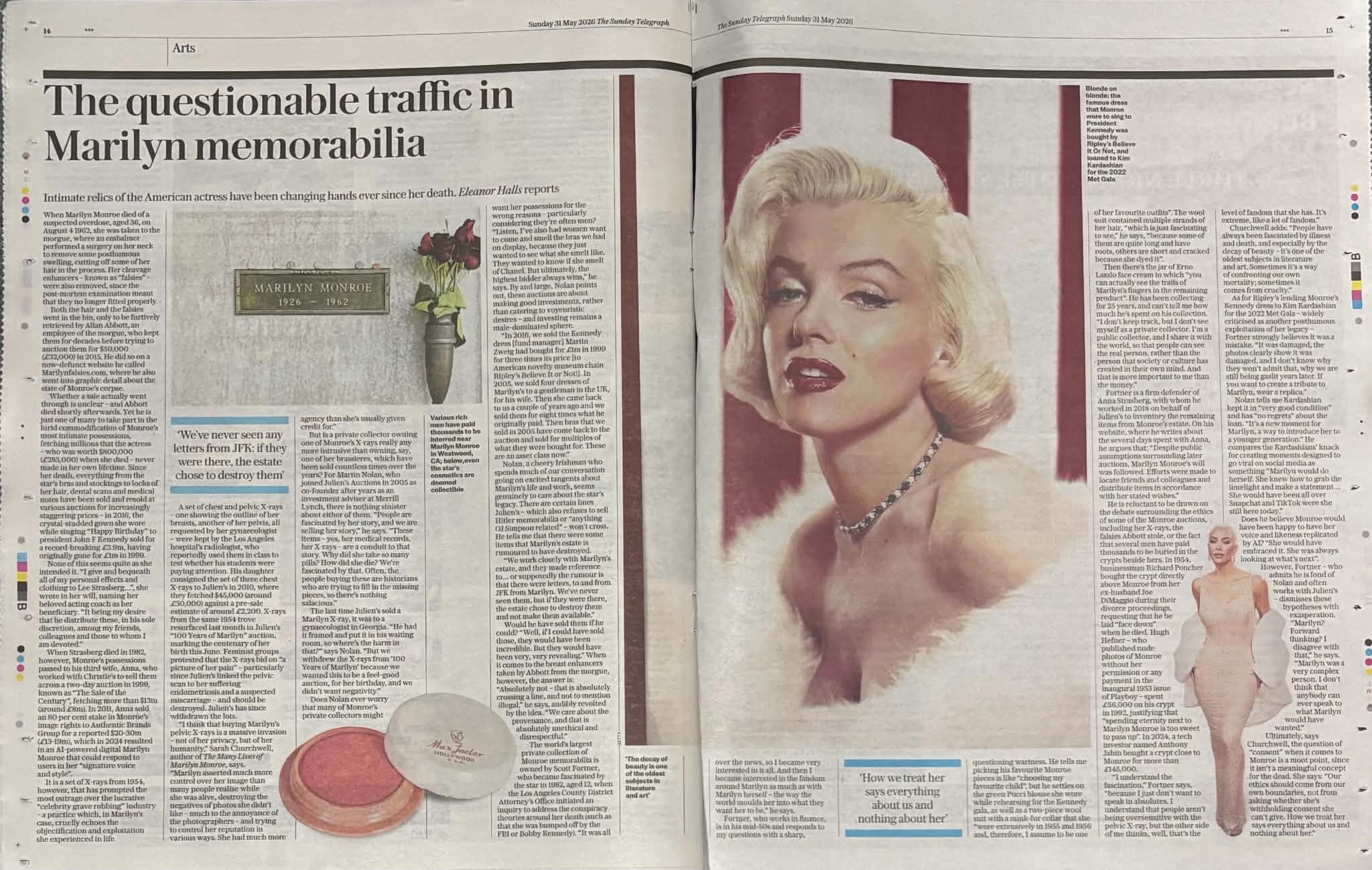
“When Marilyn Monroe died of a suspected overdose, aged 36, on August 4 1962, she was taken to the morgue, where an embalmer performed a surgery on her neck to remove some posthumous swelling, cutting off some of her hair in the process. Her cleavage enhancers – known as ‘falsies’ – were also removed, since the post-mortem examination meant that they no longer fit properly.
Both the hair and the falsies ended up in the bin, only to be furtively retrieved by Allan Abbott, an employee of the morgue, who kept them for decades before trying to auction them for $50,000 (£32,000) in 2015. He did so on a now-defunct website he called marilynfalsies.com, where he also went into graphic detail about the state of Monroe’s corpse.
Whether a sale actually went through is unclear – and Abbott died shortly after. Yet he is just one of many to take part in the lurid commodification of Monroe’s most intimate possessions, fetching millions that the actress – who was worth $800,000 (£285,000) when she died – never made in her own lifetime … None of this seems quite as she intended it. ‘I give and bequeath all of my personal effects and clothing to Lee Strasberg …’, she wrote in her will, naming her beloved acting coach as her beneficiary. ‘It being my desire that he distribute these, in his sole discretion, among my friends, colleagues and those to whom I am devoted.’
When Strasberg died in 1982, however, Monroe’s possessions passed to his third wife, Anna, who worked with Christie’s to sell them across a two-day auction in 1999, known as ‘The Sale of the Century’, fetching more than $13m (around £8m). In 2011, Anna sold an 80 per cent stake in Monroe’s image rights to Authentic Brands Group for a reported $20-30m (£13-19m) … It has been a set of X-rays from 1954, however, that have prompted the most outrage over a lucrative celebrity ‘grave robbing’ industry that, in Marilyn’s case, arguably continues the objectification and exploitation she experienced in life.
A set of chest and pelvic X-rays – one showing the outline of her breasts, another of her pelvis, all requested by her gynaecologist – were kept by the Los Angeles hospital’s radiologist, who reportedly used them in class to test whether his students were paying attention. His daughter consigned the set of three chest X-rays to Julien’s in 2010, where they fetched $45,000 (around £30,000) against a pre-sale estimate of around £2,200. X-rays from the same 1954 trove returned last month in Julien’s 100 Years of Marilyn auction, marking the centenary of her birth this June.
Feminist groups protested that the X-rays bid on ‘a picture of her pain’ – particularly since Julien’s linked the pelvic scan to her suffering endometriosis and a suspected miscarriage – and should be finally destroyed. Julien’s has since withdrawn the lots, acknowledging that this particular auction is a celebration of her birthday.
‘I think that buying Marilyn’s pelvis X-rays is a massive invasion – not of her privacy, but of her humanity,’ Sarah Churchwell, author of The Many Lives of Marilyn Monroe, says … But is a private collector owning one of Monroe’s X-rays really any more intrusive than owning, say, one of her brassieres, which have been sold countless times over the years? For Martin Nolan, who joined Julien’s Auctions in 2005 as co-founder after years as an investment adviser at Merrill Lynch, there is nothing sinister about either of them. ‘People are fascinated by her story, and we are selling her story,’ he says. ‘These items – yes, her medical records, her X-rays – are a conduit to that story. Why did she take so many pills? How did she die? We’re fascinated by that. Often, the people buying these are historians who are trying to fill in the missing pieces, so there’s nothing salacious.’
The last time Julien’s sold a Marilyn X-ray, it was to a gynaecologist in Georgia. ‘He had it framed and put it in his waiting room, so where’s the harm in that?’ says Nolan. ‘But we withdrew the X-rays from 100 Years of Marilyn because we wanted this to be a feel-good auction, for her birthday, and we didn’t want negativity.’
Does Nolan ever worry that many of Monroe’s private collectors might want her possessions for the wrong reasons – particularly considering they’re often men? ‘Listen, I’ve also had women want to come and smell the bras we had on display, because they just wanted to see what she smelt like. They wanted to know if she smelt of Chanel. But ultimately, the highest bidder always wins,’ he says. By and large, Nolan points out, these auctions are about making good investments, rather than catering to voyeuristic desires – and investing remains a male-dominated sphere.
‘In 2016, we sold the Kennedy dress [fund manager] Martin Zweig had bought for £1m in 1999 for three times its price [to American novelty museum chain Ripley’s Believe It or Not!]. In 2005, we sold four dresses of Marilyn’s to a gentleman in the UK, for his wife. Then she came back to us a couple of years ago and we sold them for eight times what he originally paid. Then bras that we sold in 2005 have come back to the auction and sold for multiples of what they were bought for. These are an asset class now.’
The world’s largest private collection of Monroe memorabilia is owned by Scott Fortner, who became fascinated by the star in 1982, aged 12, when the Los Angeles County District Attorney’s Office initiated an inquiry to address the conspiracy theories around her death … ‘It was all over the news, so I became very interested in it all. And then I became interested in the fandom around Marilyn as much as with Marilyn herself – the way the world moulds her into what they want her to be,’ he says.
He has been collecting for 25 years, and can’t tell me how much he’s spent on his collection. ‘I don’t keep track, but I don’t see myself as a private collector. I’m a public collector, and I share it with the world, so that people can see the real person, rather than the person that society or culture has created in their own mind. And that is more important to me than the money.’
Fortner is a firm defender of Anna Strasberg, with whom he worked in 2018 on behalf of Julien’s to inventory the remaining items from Monroe’s estate. On his website, where he writes about the several days spent with Anna, he argues that: ‘Despite public assumptions surrounding later auctions, Marilyn Monroe’s will was followed. Efforts were made to locate friends and colleagues and distribute items in accordance with her stated wishes.’
He is reluctant to be drawn on the debate surrounding the ethics of some of the Monroe auctions, including her X-rays, the falsies Abbott stole, or the fact that several men have paid thousands to be buried in the crypts beside hers … ‘I understand the fascination,’ Fortner says, ‘because I just don’t want to speak in absolutes. I understand that people aren’t being oversensitive with the pelvic X-ray, but the other side of me thinks, well, that’s the level of fandom that she has. It’s extreme, like a lot of fandom.’
As for Ripley’s lending Monroe’s Kennedy dress to Kim Kardashian for the 2022 Met Gala – widely criticised as another posthumous exploitation of her legacy – Fortner strongly believes it was a mistake. ‘It was damaged, the photos clearly show it was damaged, and I don’t know why they won’t admit that, why we are still being gaslit years later. If you want to create a tribute to Marilyn, wear a replica.’
Nolan tells me Kardashian kept it in ‘very good condition’ and has ‘no regrets’ about the loan … Does he believe Monroe would have been happy to have her voice and likeness replicated by AI? ‘She would have embraced it. She was always looking at what’s next.’ However, Fortner – who admits he is fond of Nolan and often works with Julien’s – dismisses these hypotheses with exasperation. ‘Marilyn? Forward thinking? I disagree with that,’ he says. ‘Marilyn was a very complex person. I don’t think that anybody can ever speak to what Marilyn would have wanted.’
Ultimately, says Churchwell, the question of ‘consent’ when it comes to Monroe is a moot point, since it isn’t a meaningful concept for the dead. She says: ‘Our ethics should come from our own boundaries, not from asking whether she’s withholding consent she can’t give. How we treat her says everything about us and nothing about her.'”


2 Comments
Comments are closed.