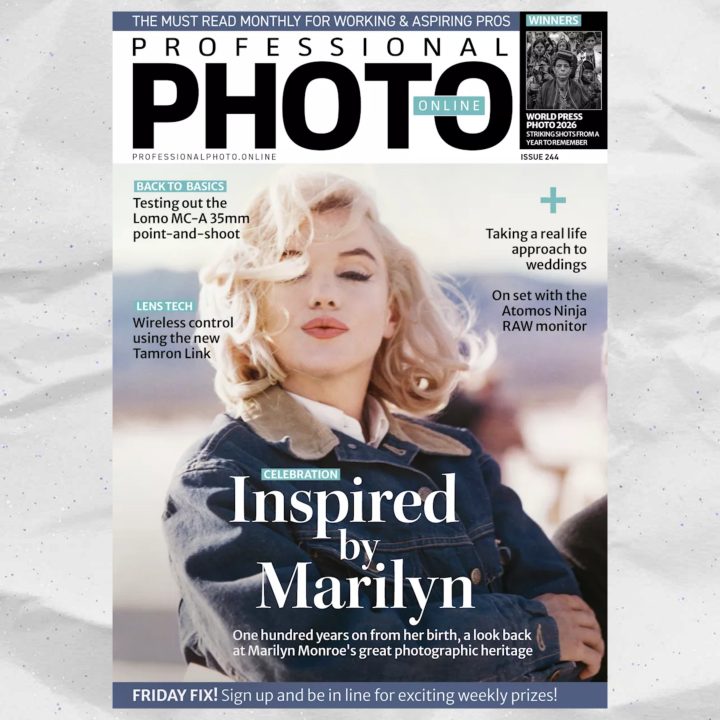
Marilyn covers the latest issue of Professional Photo Online – although sadly this UK monthly magazine no longer has a print edition – as Terry Hope looks back on ‘A Century of Marilyn Monroe,’ focusing on her collaboration with photographer Eve Arnold.
“These were different times, when it was possible for photographers and even the highest of A-List celebrities to mix freely, in the days before the steely control of PRs and publicists conspired to put up barriers. Eve was able, over time, to really get to know her subject, shooting pictures of a complex and multi-faceted character across a variety of situations, who throughout appears fully at ease in front of the camera, and happy to let the photographer shoot uninterrupted.
Candid shots where she was caught unaware were impossible. Eve remarked that Marilyn’s built-in mechanism ensured that, whether she was in a dressing room, resting on a plane or walking in the desert, she always sensed the camera and responded before the first click was heard. ‘She didn’t look in camera direction,’ says Eve. ‘She just knew and projected for a close-up even if there were a long lens trained on her that, to others, would have been invisible. It was like an unseen beam of light that only she picked up.’
‘It might have been easier to set a specific situation, to tell her what to do, to move her through it quickly, click-click and finish,’ says Eve. ‘That would have been efficient, but would have had pre-ordained results – no surprises … I do not work that way. I work intuitively, trying not to impose myself. I let the person come through. I am the medium. She too worked intuitively.’
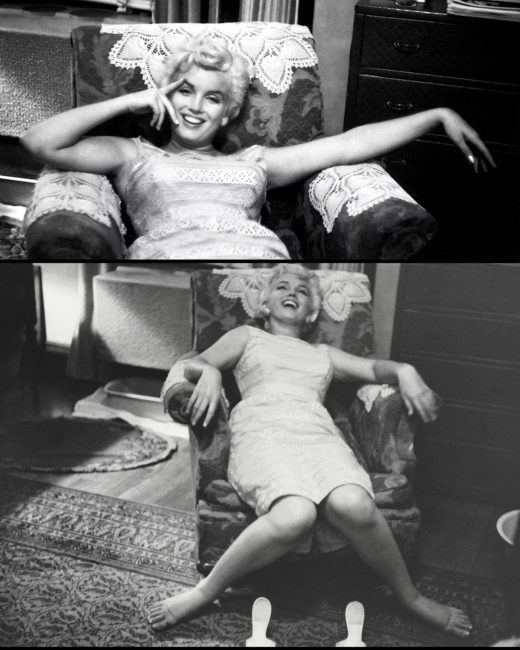
Throughout her career Marilyn and the camera were inseparable. Eve recalls the iconic staged press call for The Seven Year Itch in Lexington Avenue, New York, where the actress stands above a subway grating to cool off, the air whooshing up and lifting her dress above her thighs. Publicists had leaked the story and hundreds, possibly, thousands, of amateur photographers arrived to try to get a picture. The professionals found it impossible to work: every time a train passed through there was mayhem, with everyone trying to get their picture: it was madness, and generated enormous publicity for the film.
When Marilyn travelled to London to film The Prince and the Showgirl, and had her honeymoon with Arthur Miller in a manor house bordering Windsor Great Park, photographers hid in the trees, with telephoto lenses trained on the master bedroom in an attempt to grab a snatched picture. Every moment of her life was liable to be recorded, and it’s little surprise that she became one of the most widely photographed celebrities in history.
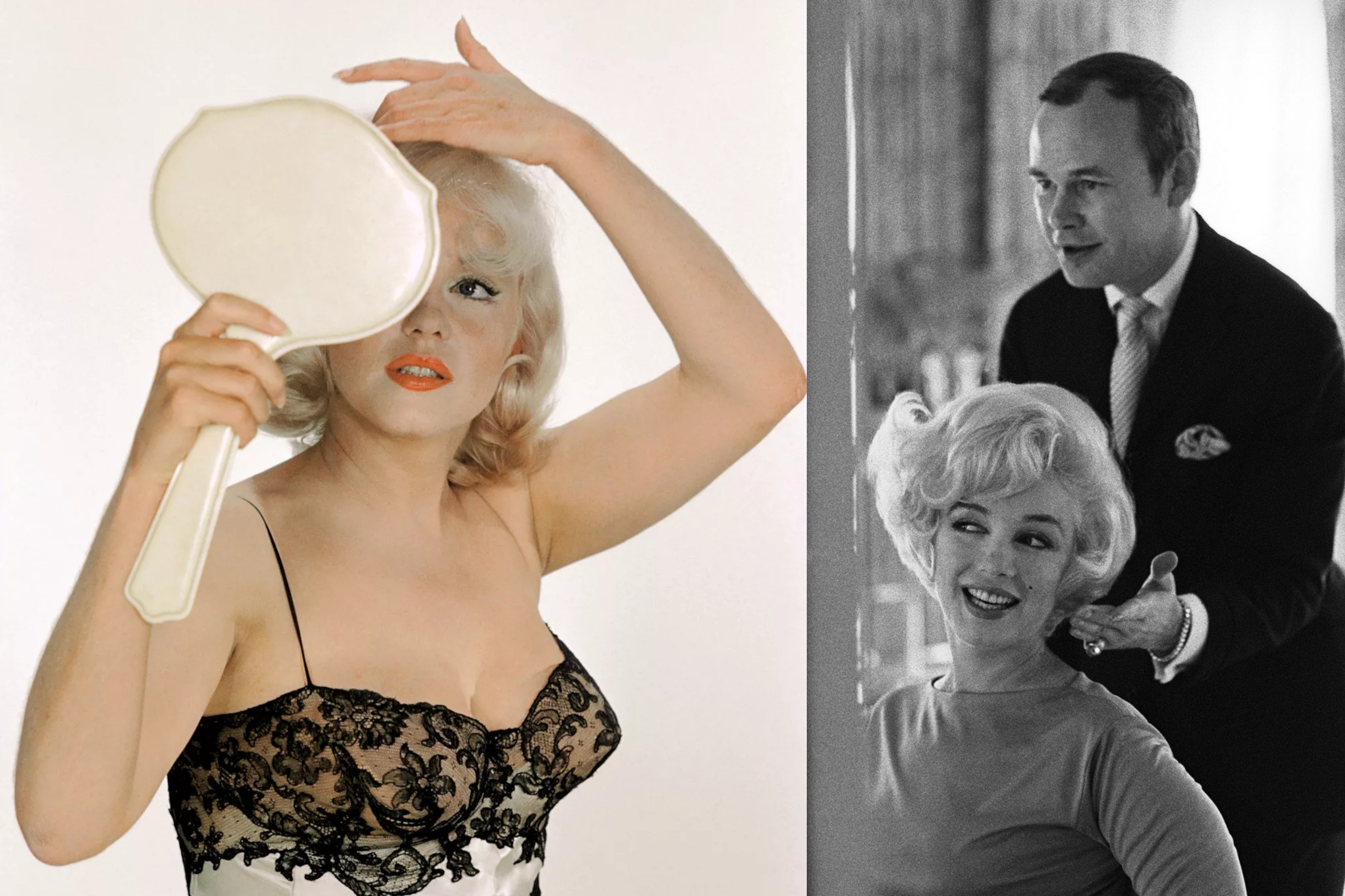
Eve’s very last shoot with Marilyn was a simple one, the actress, who had just come out of hospital following surgery for a kidney ailment, asking her to photograph her with her hairdresser Kenneth. ‘She looked fresh and rested,’ says Eve, ‘and she and Kenneth played up for the camera, she teasing him about his showing the most photogenic side of his face. We did just one roll of film. It was a simple photo, and I did not want to tire her.’
As usual, as Eve left there were reporters and photographers waiting outside the building, one of them asking what it had been like to photograph Marilyn. ‘I waved him off and went on my way,’ says Eve. ‘But the question was not to be denied. What was it like to photograph her? It was like watching a print come up in the developer. The latent image was there … All the photographer had to do was to stop time at any given instant and Marilyn would bring forth a new image.'”

The feature also includes an interview with Eve’s grandson and archivist, Michael Arnold.
I’m astonished by the closeness to her subject that Eve was able to achieve, and there are images here that are just so intimate and personal. Have you been surprised yourself at how close the relationship was, and I’m guessing that we would never see anything like that kind of rapport between a photographer and an A-Lister these days?
“I do think it would be very difficult to recreate that kind of relationship today. The world around celebrity has changed completely. There are publicists, managers, brand teams, social media strategies and far more control around image-making. Eve was working in a different era, where a photographer could spend real time with a subject and allow something to unfold naturally. That patience is part of what gives the photographs their intimacy.”
You mention in your afterword in Eve’s Marilyn Monroe book the tantalising point that Eve’s archive is being digitised. Might there be some previously unseen gems, not necessarily featuring Marilyn, that have emerged in recent times, with perhaps a few more to come?
“There are certainly lesser-known and previously unseen images that have emerged, not only of Marilyn but across the full range of Eve’s work: political reportage, civil rights, women’s lives, travel, film sets and portraits of cultural figures. Eve had an extraordinary range, and one of the aims of the Estate is to help people understand that she was not only the photographer of Marilyn Monroe, remarkable though that work is. She was one of the great humanist photographers of the twentieth century.”
Would you say that perhaps at least some of the chemistry that existed between Marilyn and Eve over the years was down to the fact that she was shooting from a female photographer’s perspective, and perhaps that enabled something extra to be achieved that might have eluded male photographers?
“I think that is almost certainly part of it. Eve never reduced Marilyn to the image of the screen goddess. She photographed her as a complex, intelligent and often vulnerable human being … Eve’s photographs are beautiful, of course, but they are not only about beauty. They show Marilyn thinking, reading, resting, working, waiting and existing as herself.”
Eve Arnold’s photographs of Marilyn were collected in a bestselling 1987 book, Marilyn Monroe: An Appreciation. You can read my review of the 2024 reissue here.

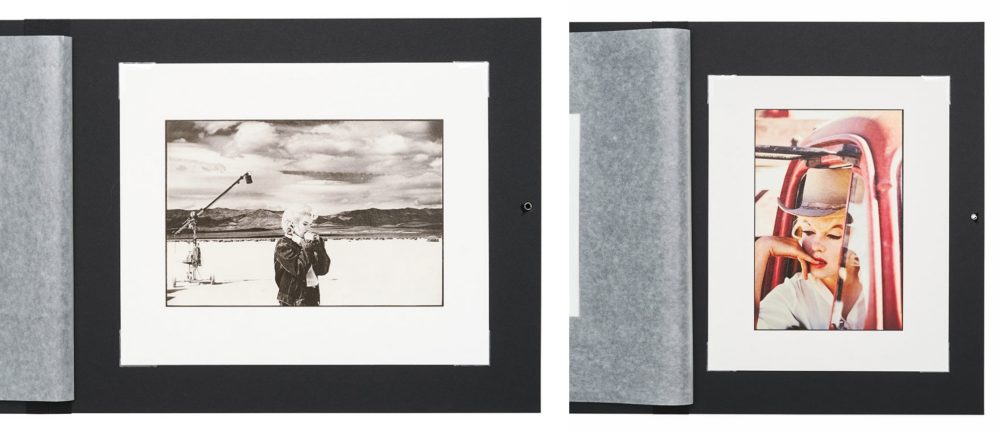
Eve is one of the leading photographers featured in Marilyn Monroe: A Portrait at the National Portrait Gallery in London, where limited edition prints are available to order.
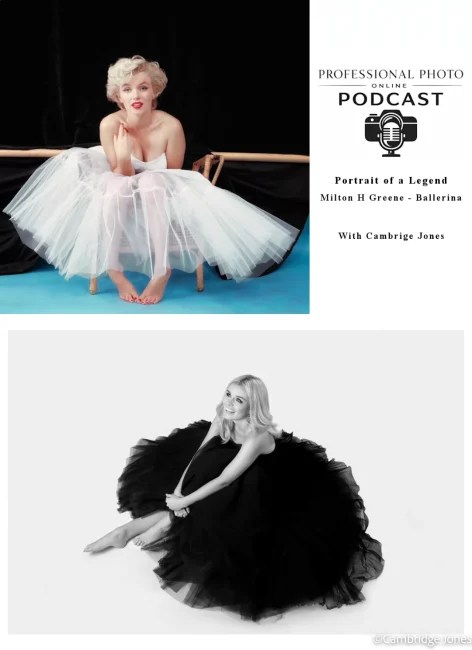
And finally, another classic image of Marilyn is the subject of the latest Pro Photo Podcast episode.
“Many regard Milton Greene’s 1954 ‘Ballerina’ shot of Marilyn as one of the truly great fashion images of the twentieth century, and it’s a highlight of the Marilyn Monroe exhibition which will be running at the NPG in London throughout the summer. It’s a shot that was a natural for Cambridge Jones to focus on for his regular Professional Photo podcast, and it led him to discover that it had become an unintentional influence for a portrait of his featuring Welsh opera singer Katherine Jenkins.”