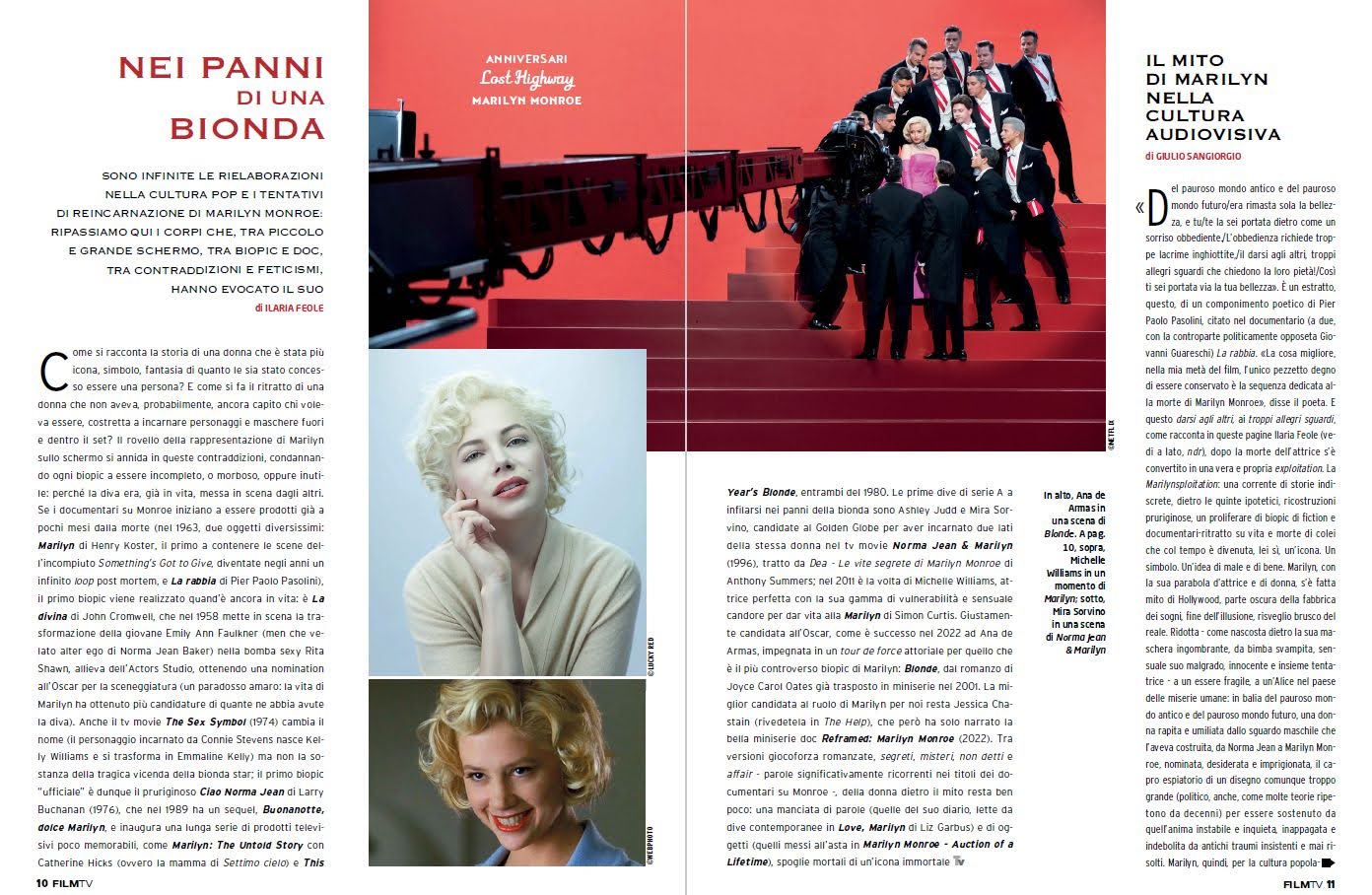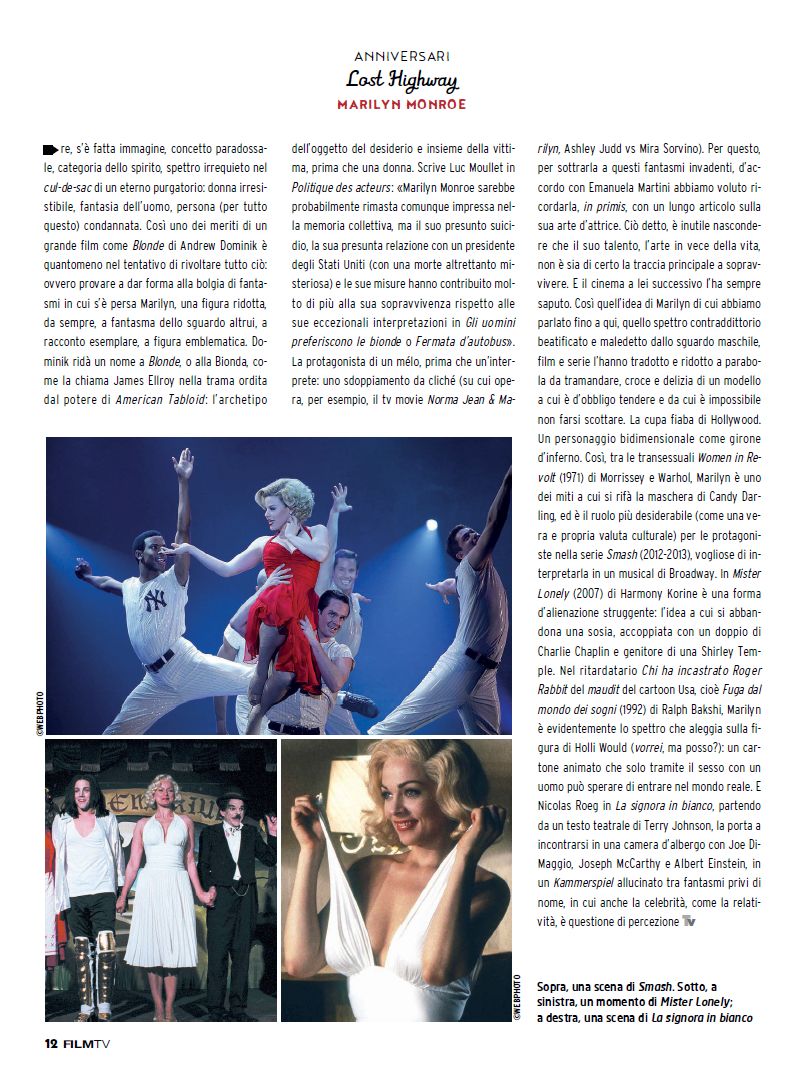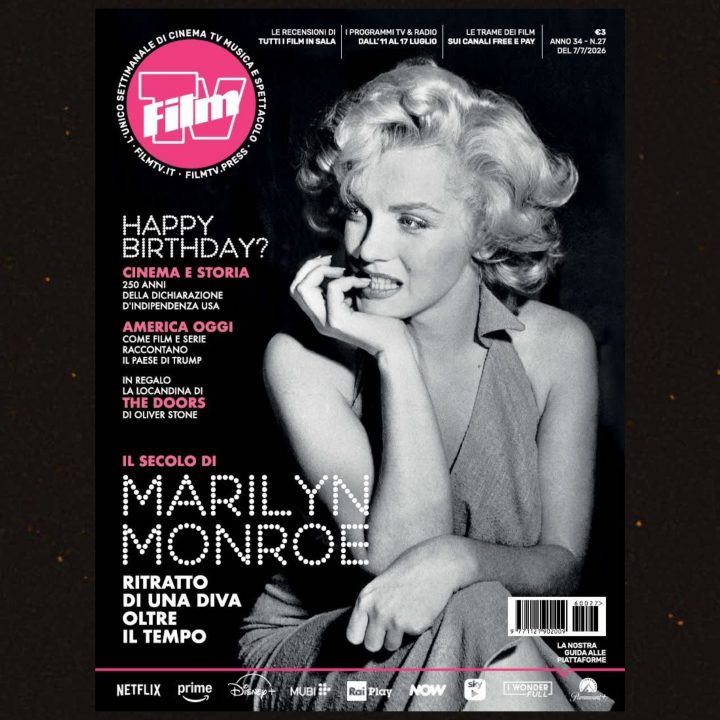
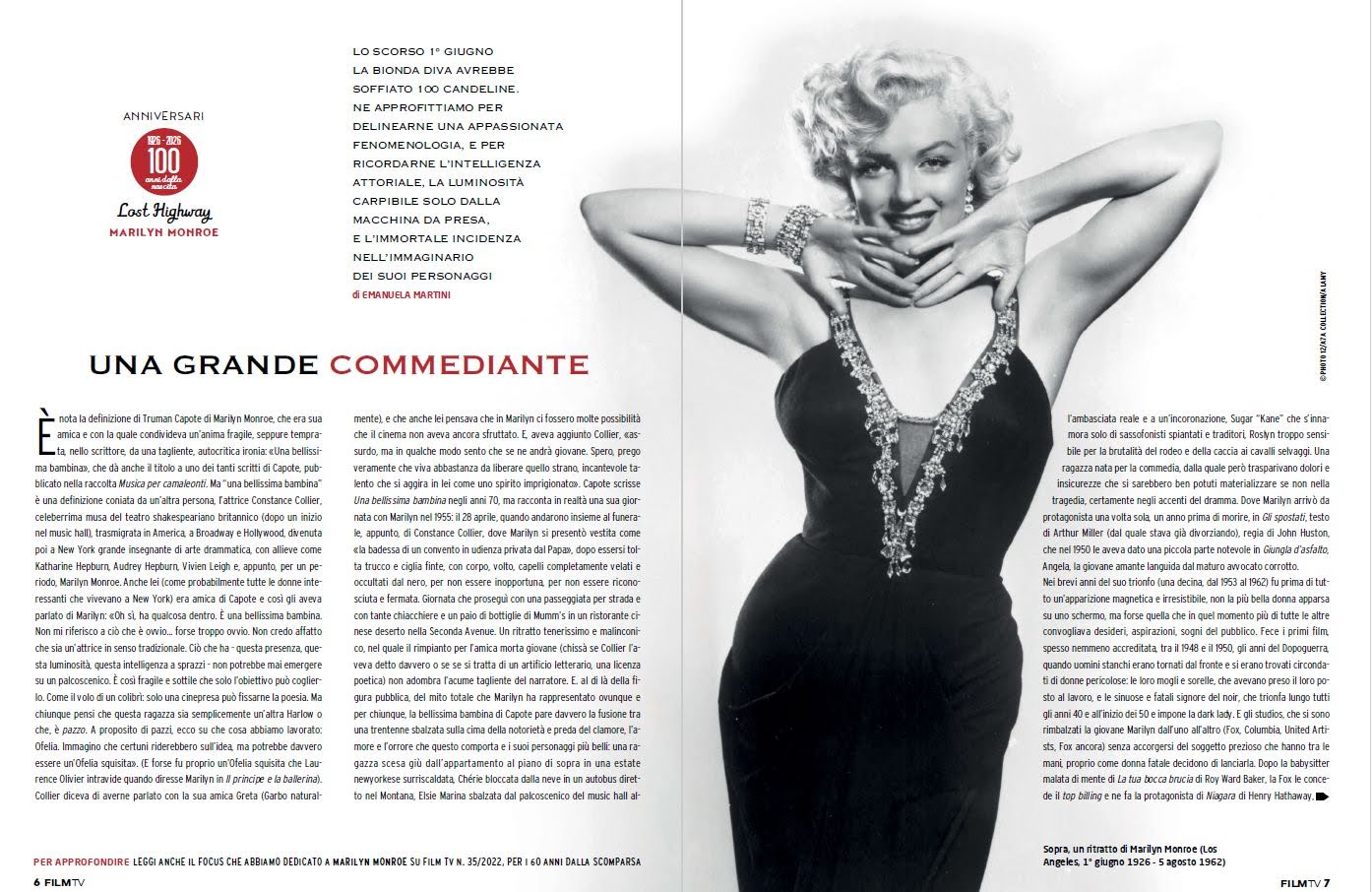
Marilyn recently graced the cover of the Italian magazine, Film TV (July 7 edition), with a photograph taken during a 1952 press party at the Sherry Netherland Hotel in New York, captioned: ‘A Century of Marilyn Monroe: Portrait of a Timeless Goddess.’ (She previously made the cover in 2020, leading a feature on director Billy Wilder.)
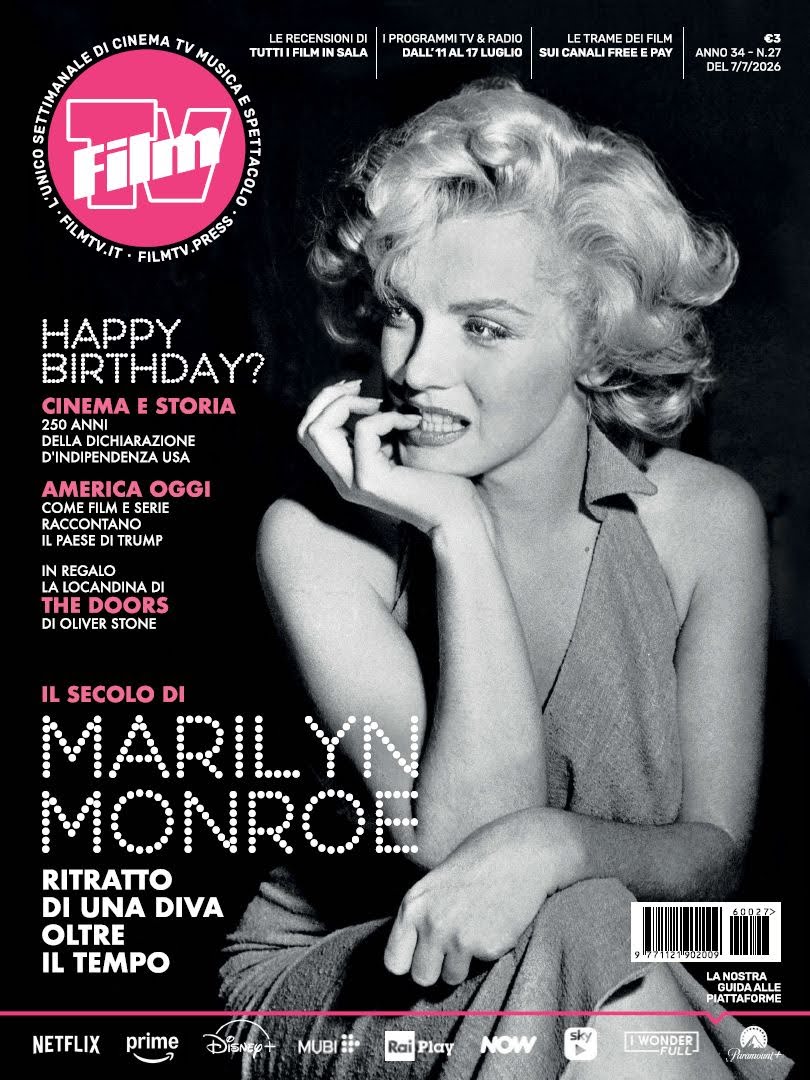
Inside, Emanuela Martini looks back at Marilyn’s film career as a ‘great comedy actor.’ In a 2022 Sight & Sound poll, Emanuela named Some Like It Hot and All About Eve among her top ten movies. She is the editor of Cineforum magazine, devoting its current issue to Marilyn; and director of the upcoming Torino Film Festival, which will also be dedicated to MM.
“Truman Capote’s definition of Marilyn Monroe, who was his friend and with whom he shared a fragile, yet hardened, soul as a writer, a sharp, ironic self-criticism: ‘a beautiful child’ … Cherie stranded by the snow on a bus headed to Montana, Elsie Marina rising from the music hall stage at the royal embassy and a coronation. Sugar Kane who only falls in love with penniless saxophonists and liars. Roslyn, too sensitive to the brutality of the rodeo and mustang hunting. A girl born for comedy, but one who, however, revealed pain and insecurities that could easily have materialised in tragedy, certainly in the tones of drama … During the brief decade of her triumph, from 1953 to 1962, she was first and foremost a magnetic and irresistible apparition, not the most beautiful woman to ever appear on screen, but perhaps the one who, more than any other, captured the public’s desires, aspirations, and dreams.
She made her first films, often uncredited, between 1948 and 1950, the post-war years when tired men had returned from the front and found themselves surrounded by dangerous women: their sister wives, who had taken their places at work, and the sinuous and fatal ladies of noir, which triumphed throughout the 1940s and early 1950s and imposed the dark lady. The studios, which had been surprised by the young Marilyn from one source to another (Fox, Columbia, United Artists, Fox again) without realising her fatal quality, decided to launch her. After playing a mentally ill babysitter in Roy Ward Baker’s Don’t Bother to Knock, Fox gave her a top-billing role and made her the protagonist of Henry Hathaway’s Niagara. A torrid, colourful noir in which a woman in a troubled marriage decides to get rid of her husband with the help of her lover during a vacation at Niagara Falls. The tight-fitting dress, the famous swaying walk … the explosion of a star.
But the Marilyn we know and love was not born here, but in the same year, 1953, thanks to a great of cinema, Howard Hawks, who already in 1952 had given her a comic part alongside Cary Grant, Ginger Rogers and Charles Coburn (whom she also finds in this film) in the same significant joke, offers her one of the fundamental roles of her career and a typical character of the time. Born in 1925 from the pen of Anita Loos, Lorelei Lee, the apparently ditzy blonde always on the hunt for diamonds and millionaires … Gentlemen Prefer Blondes is a masterpiece, not only of musicals but of comedy in general; it created stereotypes and images that are passed down from decade to decade (like the song ‘Diamonds Are a Girl’s Best Friend’, later reinterpreted by Madonna, Beyoncé, Christina Aguilleira, as well as Nicole Kidman and Margot Robbie). The gold digger softens in the immediately following comedy, which she shares with Lauren Bacall and Betty Grable. Jean Negulesco’s How to Marry a Millonaire, where Pola’s stubbornly denied myopia makes her the film’s true comic character; and then, in 1955, her definitive acting performance … The Seven Year Itch created the most complete and complex image of the cinematic Marilyn, that of The Girl, seductive and irresistible, who has to defend herself from men and often ends up falling in love with the wrong ones.
The ‘dumb blonde’, the ditzy blonde that the actress always tried to escape, with one acting teacher after another from Michael Chekhov to Constance Collier to Natasha Lytess to Lee and Paula Strasberg, has a profound humanity and complexity that often went unnoticed by critics of the time, who still tended to underestimate comedy. Six years later, Sugar Kane from Some Like It Hot (certainly one of the 20 films worth saving in the history of cinema) thrives on her own splendour and resigned melancholy, despite being squeezed between two formidable histrionic performances by Tony Curtis and Jack Lemmon. Billy Wilder later admitted that, despite the hours and takes needed to get a three-word line, Marilyn was astonishing on screen, emitting a radiant light.
She managed to make us see the sadness behind the light of her figure. Marilyn, who was above all a body, a face, a voice, emanated from the screen a sort of need for tenderness, for herself but also for the rest of the world, for her inappropriate partners, whether it was a young cattleman who wants to seduce her in Montana (Joshua Logan’s Bus Stop), the haughty, unemotional regent of Carpathia (Olivier’s The Prince and the Showgirl), or a billionaire in disguise (George Cukor’s Let’s Make Love). When she finally landed a coveted dramatic role in The Misfits, she had already developed in comedy the seeds of unhappiness, the ancient bitterness of a woman marked by the awareness of one’s own body and the unconsciousness of one’s own value. Marilyn was a great comedian, far from being a ‘dumb blonde.’ And what’s more bitter than comedy?”
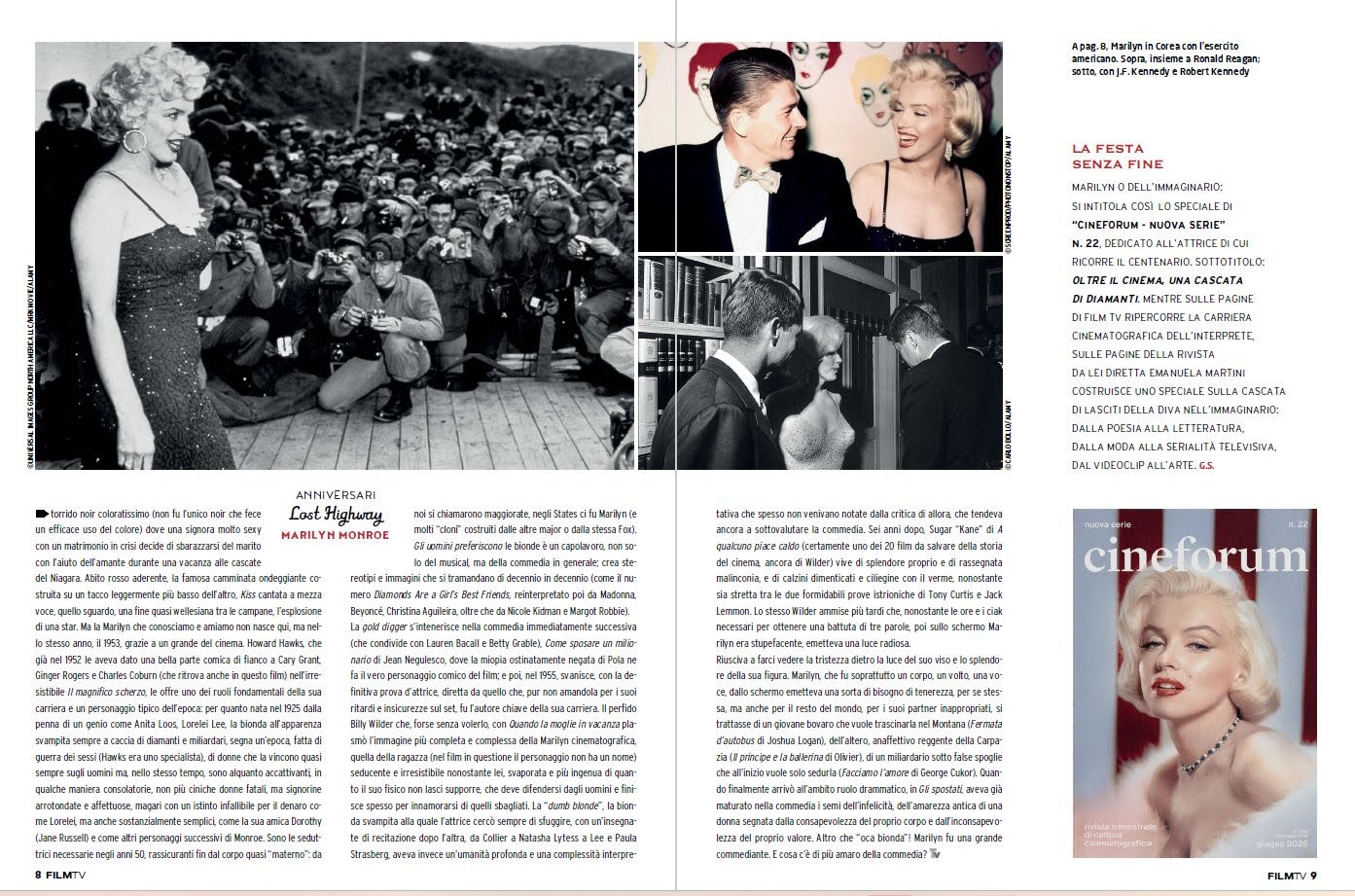
For the second article, headlined ‘In the Role of a Blonde,’ Ilaria Feola looks at how Marilyn has been portrayed in biopics and documentaries.
“How do you tell the story of a woman who was more of an icon, symbol, and fantasy than she was allowed to be? And how do you paint a portrait of a woman who probably hadn’t yet figured out who she wanted to be, forced to embody characters and masks on and off the set? The problem with Marilyn’s representation on screen lies in these contradictions, condemning every biopic to be incomplete, or morbid, or useless: because the diva was, already during her lifetime, staged by others. While documentaries on Monroe began to be produced just a few months after her death (in 1963, two very different objects – Marilyn by Henry Koster, the first to contain the incomplete Something’s Got to Give – and La Rabbia (Rage) by Pier Paolo Pasolini – became a never-ending post-mortem loop). The first biopic was made while she was still alive: The Goddess by John Cromwell, which in 1958 staged the transformation of the young Emily Ann Faulkner (Norma Jean Baker’s alter ego) into the sex bomb Rita Shawn (Kim Stanley), a student at the Actors Studio, obtaining an Oscar nomination for the screenplay (a bitter paradox: Marilyn’s life obtained more nominations than the diva herself). Even the TV movie The Sex Symbol (1974) changes the name (the character played by Connie Stevens is born Kelly Williams and turns into Emmaline Kelly) but not the substance of the tragic story of the blonde star, the first actual biopic is therefore prurient Goodbye Norma Jean by Larry Buchanan (1976), and its 1989 sequel, Goodnight, Sweet Marilyn, which inaugurated a long series of unmemorable TV products, such as Marilyn: The Untold Story with Catherine Hicks (aka the mother of 7th Heaven) and This Year’s Blonde, both from 1980. The first serious divas to slip into the role of the blonde were Ashley Judd and Mira Sorvino, nominated for a Golden Globe for embodying two sides of the same woman in the TV movie Norma Jean & Marilyn (1996) … in 2011 it was the turn of Michelle Williams, a perfect actress with her range of vulnerability and sensuality in Simon Curtis’s My Week With Marilyn. Just the right amount of candour to give life to an Oscar nominee, as happened in 2022 to Ana de Armas, engaged in an acting tour de force for what is the most controversial Marilyn biopic: Blonde, a novel by Joyce Carol Oates already adapted into a miniseries in 2001. The best candidate for the role of Marilyn for us is Jessica Chastain (who played a Monroe-like character in The Help), who however only narrated the documentary miniseries Reframed: Marilyn Monroe (2022). Among necessarily fictionalised versions, secrets, unspoken mysteries and affairs, significantly recurring words in the titles of documentaries on Monroe, there is very little about the woman behind the myth: a handful of words (excerpts from her diary, voiced by contemporary divas in Love, Marilyn (Liz Garbus, 2012) and objects (those put up for auction in Marilyn Monroe: Auction of a Lifetime, 2017), mortal remains of an immortal TV icon.
‘Of the fearful ancient world and the fearful world to come, only beauty remained, and you carried it all with you like an obedient smile/Obedience requires too many swallowed tears/giving yourself to others, too many happy glances asking for their pity/So you took your beauty with you.’ It’s an excerpt. this, of a poetic composition by Pier Paolo Pasolini cited in the documentary (a duet, with the politically opposed counterpart Giovanni Guareschi), La Rabbia … This giving oneself to others, to too many cheerful sparrows, has been converted into a real exploitation. The Marilyn exploitation. A stream of indiscreet stories, hypothetical behind-the-scenes, prurient reconstructions, a proliferation of fictional biopics and documentaries portraits on the life and death of the one who over time has become, yes, an icon, a symbol. An idea of good and evil. Marilyn’s journey as an actress has become a myth of Hollywood, a dark part of the dream factory, the end of illusion, a sudden awakening of reality … a woman kidnapped and humiliated by the male gaze that had constructed her, from Norma Jeane to Marilyn Monroe, named, desired, and imprisoned, the scapegoat of a plan that was in any case too grand (political, too, as many theories have repeated for decades) to be supported by that unstable and restless soul, unsatisfied and weakened by ancient, insistent and unresolved traumas.”