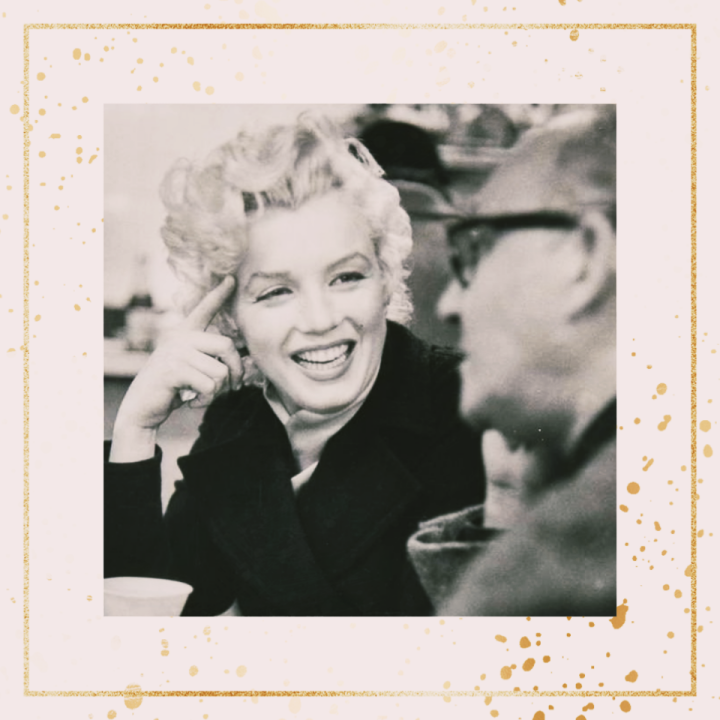
Anna Strasberg, widow of Actors Studio founder Lee Strasberg after and custodian of Marilyn’s estate (although they only met once.) Following her death in 2024, items from the Estate of Anna Strasberg will go under the hammer on Tuesday, August 4 – which also marks the 64th anniversary of Marilyn’s death – in an online event at Julien’s Auctions. In a series of posts, I’m looking at Marilyn-related lots which prove that she remained part of the Strasberg family in more ways than one.

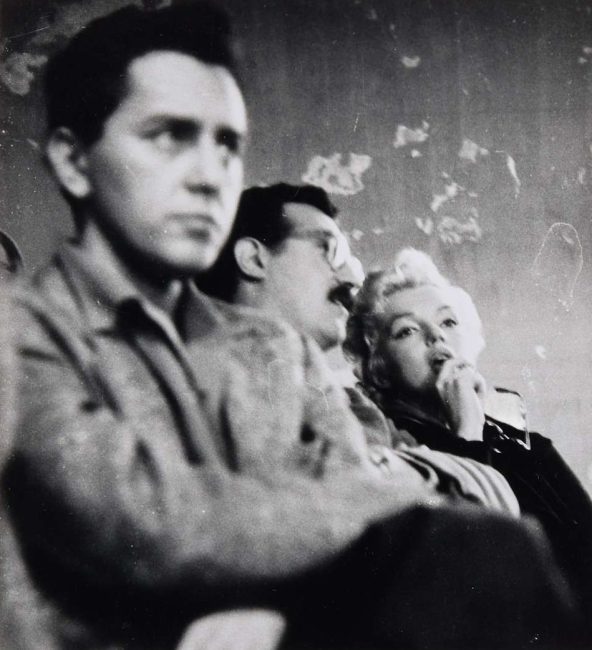
A group of eight 1970s prints by Milton Greene, showing Marilyn with Lee Strasberg in the Carnegie Diner in New York, following the opening of A Hatful of Rain, a gritty drama about drug addiction starring Actors Studio members Ben Gazzara, Shelley Winters, and Anthony Franciosa, in November 1955. The diner was located opposite Carnegie Hall, where Marilyn was privately tutored by Strasberg. (One of the eight photos was seemingly shot during a group session at the Actors Studio on West 44th Street, with fellow student James Karen on Marilyn’s immediate left.)
SOLD for $2,880
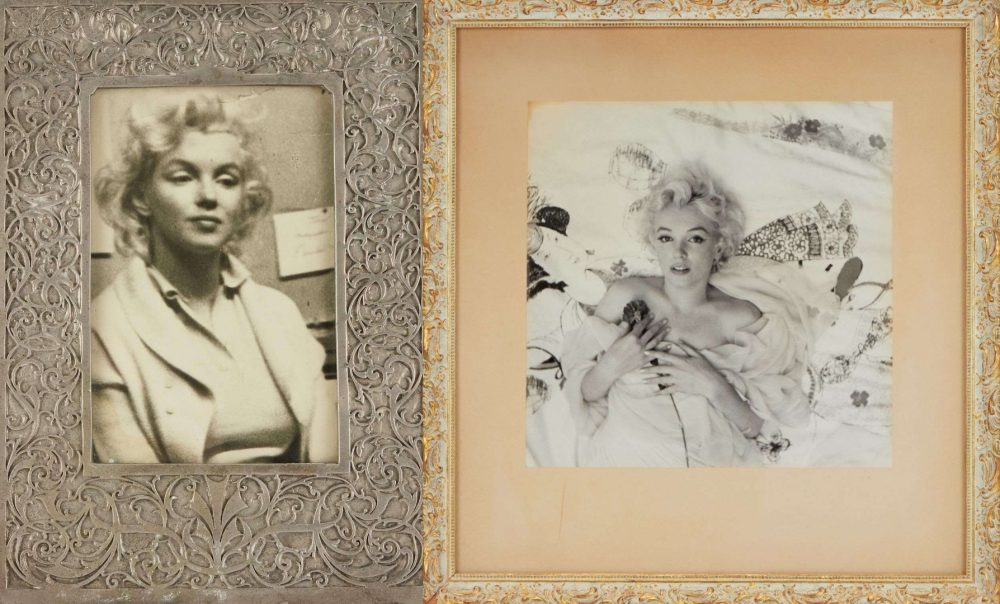
Two framed photographs kept in the Strasbergs’ apartment: at left, Marilyn at the Actors Studio by Roy Schatt, 1955; and at right, an image from her 1956 shoot with Cecil Beaton. A personal favourite of Marilyn’s, she often gifted prints to friends.
Schatt SOLD for $2,560; Beaton SOLD for $11,520
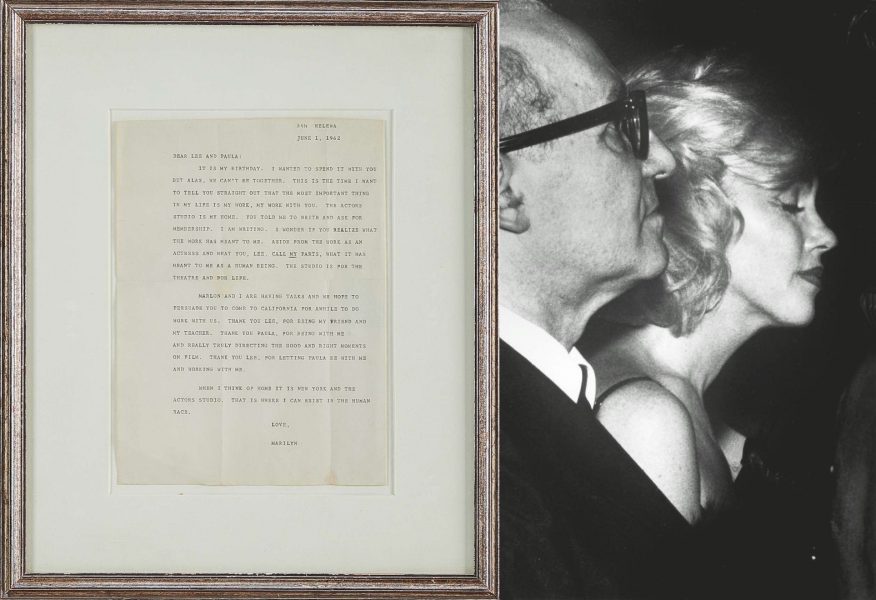
A typewritten letter from Marilyn to Lee and his second wife, Paula Strasberg, who coached Marilyn through five movies. As noted in the listing, it’s ‘an especially poignant note knowing Monroe would pass away just two months later.’ Paula died in 1966, and Lee married Anna Strasberg two years later. A label from Margo Feiden Galleries (the official exhibitor of caricaturist Al Hirschfeld) is attached to the back of the frame.
SOLD for $7,680
“5th HELENA
JUNE 1, 1962
DEAR LEE AND PAULA:
IT IS MY BIRTHDAY. I WANTED TO SPEND IT WITH YOU BUT ALAS, WE CAN’T BE TOGETHER. THIS IS THE TIME I WANT TO TELL YOU STRAIGHT OUT THAT THE MOST IMPORTANT THING IN MY LIFE IS MY WORK, MY WORK WITH YOU. THE ACTORS STUDIO IS MY HOME. YOU TOLD ME TO WRITE AND ASK FOR I AM WRITING. MEMBERSHIP. I WONDER IF YOU REALIZE WHAT THE WORK HAS MEANT TO ME. ASIDE FROM THE WORK AS AN ACTRESS AND WHAT YOU, LEE, CALL MY PARTS, WHAT IT HAS MEANT TO ME AS A HUMAN BEING. THEATRE AND FOR LIFE. THE STUDIO IS FOR THE THEATRE AND FOR LIFE.
MARLON [Brando] AND I ARE HAVING TALKS AND WE HOPE TO PERSUADE YOU TO COME TO CALIFORNIA FOR AWHILE TO DO THANK YOU LEE, FOR BEING MY FRIEND AND WORK WITH US. MY TEACHER. THANK YOU PAULA, FOR BEING WITH ME AND REALLY TRULY DIRECTING THE GOOD AND RIGHT MOMENTS ON FILM. THANK YOU LEE, FOR LETTING PAULA BE WITH ΜΕ AND WORKING WITH ΜΕ.
WHEN I THINK OF HOME IT IS NEW YORK AND THE ACTORS STUDIO. THAT IS WHERE I CAN EXIST IN THE HUMAN RACE.
LOVE,
MARILYN”
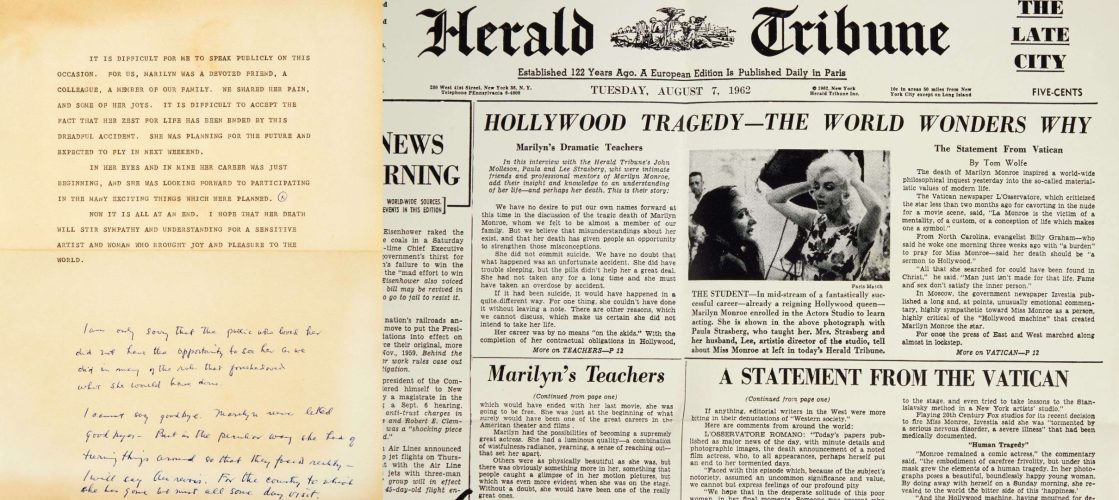
A group of six papers from Lee Strasberg’s files, relating to the eulogy he wrote for Marilyn’s funeral in Los Angeles on August 8, 1962. Includes a single page of half-typed and half-penned text in blue ballpoint ink, the written section starts with the part of the eulogy that reads ‘I am only sorry that the public who loved her did not have the opportunity to see her as we did,’ and ends with ‘I cannot say goodbye. Marilyn never liked goodbyes …’ Plus mimeographed copies of an article published in the New York Herald Tribune on August 7; and of the eulogy, from the August 9 edition.
SOLD for $12,800
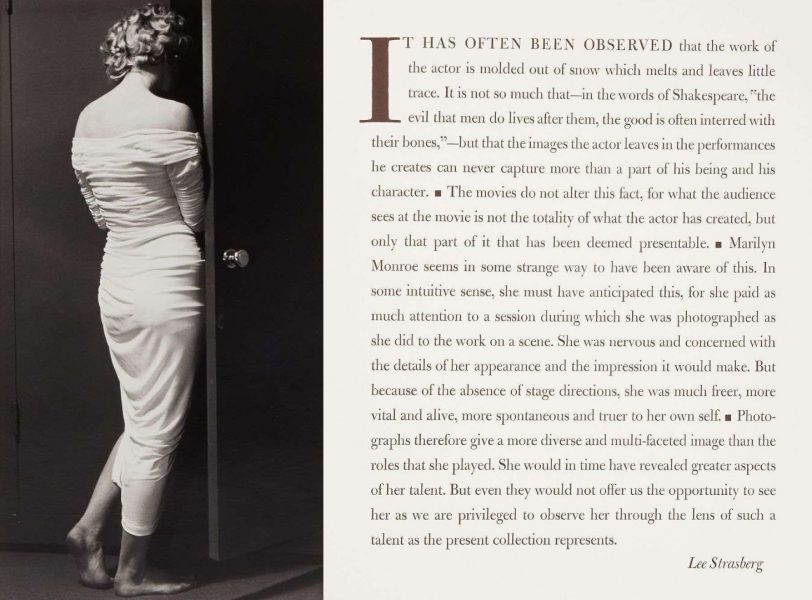
A portfolio produced in 1981, containing eleven prints of Marilyn by photographer Philippe Halsman, with a short text composed by Lee Strasberg, a year before his death.
SOLD for $7,680
“IT HAS OFTEN BEEN OBSERVED that the work of the actor is molded out of snow which melts and leaves little trace. It is not so much that-in the words of Shakespeare, ‘the evil that men do lives after them, the good is often interred with their bones,’ but that the images the actor leaves in the performances he creates can never capture more than a part of his being and his character. The movies do not alter this fact, for what the audience sees at the movie is not the totality of what the actor has created, but only that part of it that has been deemed presentable. Marilyn Monroe seems in some strange way to have been aware of this. In some intuitive sense, she must have anticipated this, for she paid as much attention to a session during which she was photographed as she did to the work on a scene. She was nervous and concerned with the details of her appearance and the impression it would make. But because of the absence of stage directions, she was much freer, more vital and alive, more spontaneous and truer to her own self. Photographs therefore give a more diverse and multi-faceted image than the roles that she played. She would in time have revealed greater aspects of her talent. But even they would not offer us the opportunity to see her as we are privileged to observe her through the lens of such a talent as the present collection represents.”
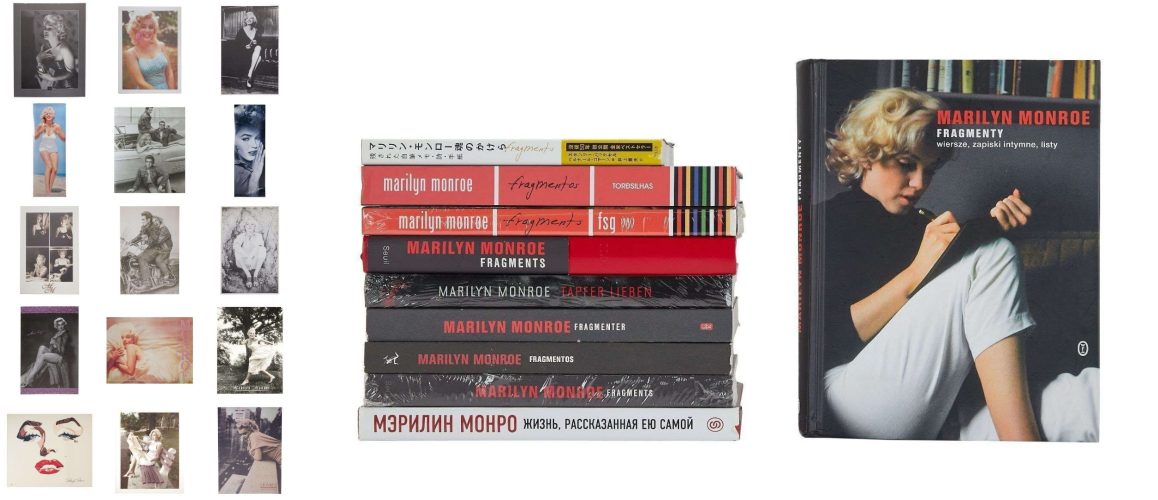
And last for now, two lots of authorised Monroe memorabilia: from a set of fifteen personality posters; and ten editions of Fragments (2010), a collection of Marilyn’s private writings, published in nine languages.
Posters SOLD for $192; books SOLD for $192
 The Marilyn Report
2 Comments
Comments are closed.