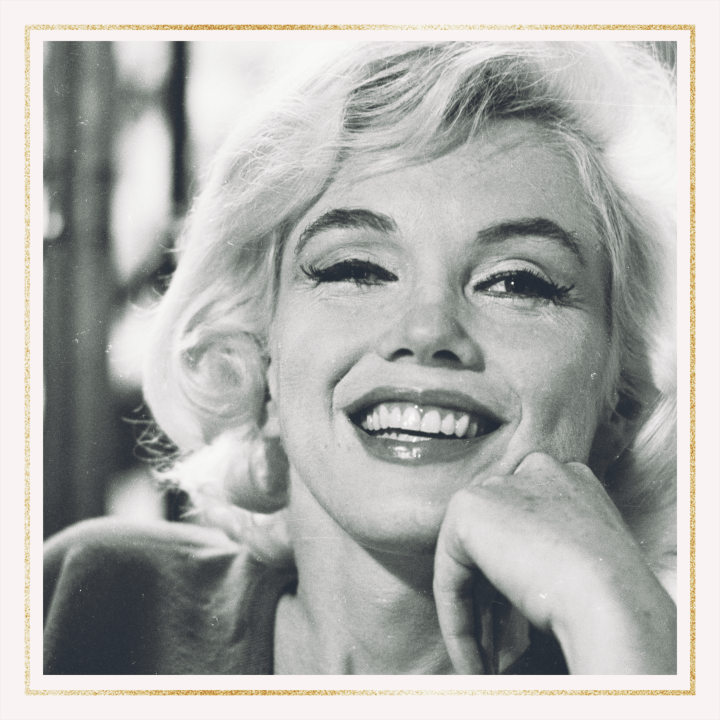
Marilyn is featured in the August issue of The Rake (#107, with Gal Gadot on the cover.) In ‘Portrait of a Lady’ – a headline she would surely have appreciated – Chris Flannery talks about his new book, Marilyn: The Lost Photographs, The Last Interview, which includes an expanded (though not complete) version of her conversation with LIFE journalist Richard Meryman and many unseen images shot concurrently inside her home at Fifth Helena Drive in Brentwood, Los Angeles by LIFE photographer Allan Grant. (Marilyn’s last appearance in The Rake was back in February 2023, with a twelve-page feature headlined ‘The Five Stages of Marilyn Monroe.’)
“The irony, with this extraordinary archive, is that it survived precisely because people at the time didn’t think it mattered. ‘There were unique circumstances involved,’ Flannery says. ‘Both Meryman and Grant were what we would call in the US. white shoe professionals, right at the top of their game. Allan had photographed Elizabeth Taylor, Audrey Hepburn, Dean Martin and Frank Sinatra. Meryman had access to whoever he wanted. This meant it was just another assignment for them. I’m not saying that Marilyn wasn’t important, but they didn’t know she was going to die, and I don’t think it took on the gravitas that it does now.’
This, Flannery argues, is the crucial point: today, Monroe’s final interview carries the weight of history. In July 1962, it was simply another celebrity profile. Another reason the archive was preserved by its own perceived obsolescence involves how profoundly the world changed in the 1960s. ‘The year the interview and shoot happened, 1962, and 1967 are five years but really decades apart,’ Flannery says. ‘In August of 1962 there’s no Beatles, no Beach Boys, everything’s in black and white: it’s the fifties in disguise. By 1967 it’s the Summer of Love in full colour, Sgt. Pepper, Pet Sounds.’ Monroe belonged to an America that had been relegated to the ‘yesteryear’ shelf. Youth culture had rewritten the rules, Hollywood’s golden age felt remote, and the final words and photographs of a deceased film star appeared to have little cachet.
And so, Grant being a staff photographer, the negatives belonged to Life, and they sat in the magazine’s archive for years. ‘Then, in 1967, Allan goes to the editor, Flannery continues, and says, “Hey, what are you doing with my Marilyns?” The editor says, “Have them. No one’s doing anything with them.” He bought them for a dollar. Grant licensed the occasional image, but he was, in Flannery’s words, ‘not a businessman’, and largely kept the treasure trove to himself.
Meryman’s interview materials, meanwhile, had been in Monroe’s possession (as agreed prior to the meeting), and were eventually returned to him by her estate, largely Grant by her acting coach and mentor Lee Strasberg … Flannery and Jason Greene were introduced to Allan Grant’s widow, Karin, by the photographer Neal Preston, gaining access to Grant’s complete archive of unpublished negatives. During that process they also learned that Richard Meryman’s family still possessed the original reel-to-reel recordings of Monroe’s final interview, which they tracked down, restored and ascribed, finally reuniting the photographs and conversation. Flannery believes the archive reveals the woman Monroe herself hoped the public would eventually meet. ‘Sometimes historical sources are hiding in plain sight, he says. “This story is like a babushka, this is a Russian doll. Because each time you take a piece off, there’s another story inside.’
He’ll get no quarrel from Scott Fortner, a Monroe scholar and collector, and a leading authority on her artefacts and personal history. He tells The Rake: ‘Marilyn: The Lost Photographs, The Last Interview in many ways serves as Marilyn’s own autobiography … She reflects on her childhood, family, career, and the extraordinary experience of living as one of the most famous women in the world. The photographs, taken by Allan Grant in the dining room of Marilyn’s newly purchased home, reveal the remarkable range of her talent before the camera … this book is an important historical record that brings readers closer to Marilyn’s own voice than ever before.'”
Marilyn: The Lost Photographs was also featured in People magazine back in May, although the cover image is by Alfred Eisenstaedt, not Grant. Inside, a ten-page article includes quotes from Marilyn on various topics; while James Haspiel, the teenage superfan turned author and archivist, recalled his days of following her around in 1950s New York.
“I was brought up differently than the average American child. Happiness wasn’t anything I ever took for granted. Sometimes I think all I’ve ever wanted in the world is to settle for being a happily married woman with a wonderful family, but I don’t think I would trade that for what I’ve learned … I’ve learned a lot that I wouldn’t trade for anything. I wouldn’t want a child of mine to go through what I’ve been through. Maybe it just sounds like sour grapes because I didn’t have a happy family; but my life, this way of learning had to be my way. I hope to -ultimately be able, through my work, to illuminate for some people some things I’ve learned. Maybe it’s just a dream. But I’m also entitled to my dreams.”
Writing for The Times magazine, Melissa Denes took a closer look at Marilyn’s final interview.
“This is Monroe as we’ve never heard her before, in a candid interview recorded over two days, June 28 and 29, 1962, for LIFE magazine. The article came out on August 3, the day before she died of a barbiturate overdose, and several minutes of the recording featured in a 1992 HBO documentary — but most of it has never been heard until now. Later this month it will be published in book form to mark what would have been her 100th birthday, alongside audio excerpts and hundreds of unseen images from LIFE photographer Allan Grant’s shoot.
And what a conversation it is, which I was lucky enough to hear in its entirety. LIFE’s associate editor, Richard Meryman, was mainly interested in fame — what it feels like, how it shapes you — but Monroe wanted to go much deeper, proving to the 20th Century Fox executives who had just fired her from Something’s Got to Give that she was still a force to be reckoned with: smart, funny, self-aware, adored by her public. She throws shade on her Some Like It Hot co-star Tony Curtis and reflects on sex scenes, her nude calendar, Hollywood ‘catfights’, ageing and singing for John F Kennedy. She was in negotiations with Fox lawyers […] and the interview was to be part of her comeback. ‘Please don’t make me look like a joke,’ Monroe tells Meryman. ‘I don’t mind making jokes … It’s just the way it could be done.’ It was the way it often had been done.
The interview took place on terms negotiated by Monroe and Newcomb: it would be published in her own words and she would see the edited transcript and be able to make changes. There were very few, Meryman wrote in LIFE two weeks after her death. ‘On the steps of the house, she showed me changes she had pencilled in, all of them small. She asked me to take out a remark about quietly giving money to needy individuals.’ Monroe kept in every “Gee!” and “Well”, the kinda, sorta looseness of real speech, knowing it would sound like her. She really wanted to get somewhere with this conversation, she told Meryman — “Come on, let’s get down to it” — and so they talked about the rot in the studios, feeling betrayed and the roots of her chronic lateness.
After Monroe’s death, Meryman retitled their conversation ‘A Last Long Talk with a Lonely Girl’, and it is true that she sometimes sounds tired and hurt. Late at night, drinking champagne, her speech becomes slower and more looping, running over past injustices. But whose doesn’t? The 64-year-old recording is imperfect, though digitally improved, with stops and starts and knocks to the machine.
Though it is Meryman who asks the questions, it is Monroe who is in charge — the star who could pull the plug at any moment. At one point, he asks her about ‘the business of cranking yourself up to appear before the camera’, and she loses her temper, her voice rising. ‘I don’t crank anything! You know, I’m not a Model T. I think it’s kind of disrespectful to refer to it that way.’ It was slang, he says. ‘OK, well, don’t slang in the article.’ A minute later she softens: ‘Say, would you like a drink?’
It’s one of many moments that didn’t make it into print, and raises the question of what Monroe might make of all this surfacing now. Wouldn’t she have thought it kind of disrespectful, I ask Chris Flannery and Jason Greene, the business partners who negotiated the rights to Grant’s pictures and Meryman’s text a year ago.
‘I think the reverse,’ Flannery says. ‘I think her identity got lost because of the focus on some of the negatives and her vulnerabilities. This may be the best retort, which is, here’s what she had to say, no guesswork.’ After all the myths and conspiracy theories, they argue, this is her last great reveal — Monroe by Monroe — and she’s sharper, subtler and more compelling than anyone else’s version.”
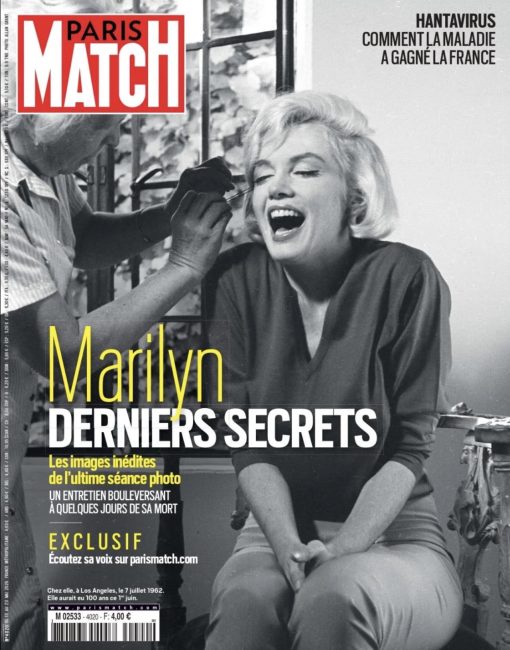
And finally, another of Allan Grant’s photographs led a May cover story for Paris Match: but as the twelve-page feature includes an intrusive image of Marilyn shot after her autopsy, I won’t include it here.
Thanks to Fraser

