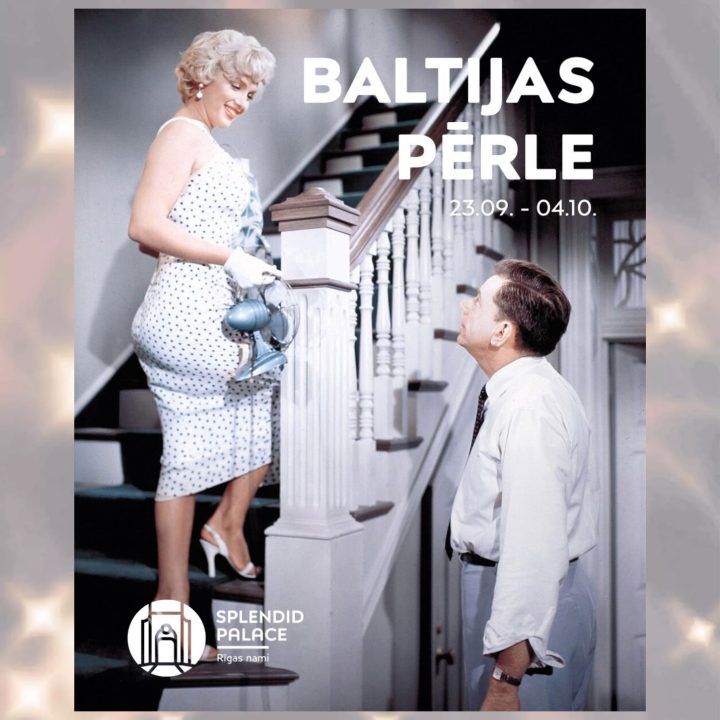
The Seven Year Itch is showing at the historic Splendid Palace Cinema in Riga, Latvia on Wednesday, September 23 at 6:10 pm – and again on September 30 at 6:00 pm – as part of this year’s Baltic Pearl Film Festival.
“This year, the world marks the 100th anniversary of the birth of the actress who forever changed the history of cinema. To commemorate the occasion, major cinematheques and film festivals around the world are presenting special programs, exhibitions and retrospectives dedicated to Marilyn Monroe.
Paying tribute to the actress, the Baltic Pearl Film Festival opens its film programme with one of the most celebrated comedies in cinema history – Billy Wilder’s The Seven Year Itch. A brilliantly witty story of a respectable advertising executive, an imagination running wild, sexual fantasies, and an irresistible upstairs neighbour.
It was this film that gave the world a scene that became one of the most iconic images in the history of cinema: Marilyn’s white dress billowing above a New York subway grate.
There are two types of men: those who are faithful, and those who are simply home alone for the time being. Richard Sherman belongs to the second category … Summer in New York is a dangerous time. The city is so sweltering with heat that not only the asphalt melts, but also good intentions. Not to mention moral principles. Having sent his wife and child to Maine, Richard is left alone with his illusions and heightened imagination.
It’s a foreshadowing, you might say. And then she comes downstairs from upstairs … Not so much a woman as a disaster that has befallen his self-confidence. She doesn’t seduce – she simply exists, and that’s enough to destroy even the strongest marriage.
Although in the end this story is not about infidelity at all, but about how difficult it is to maintain moral principles when a person has a dangerously rich fantasy. And then everything is simple: either you return to reality, or you stay where you have already allowed yourself almost everything in your imagination …”
And the 2012 documentary Love, Marilyn follows on Friday, October 2 at 8:15 pm.
“‘When they ask you what I was really like… what Marilyn Monroe was really like – what will you say?’
Time proved powerless against her: she never had the chance to grow old. Wrinkles and illness never left their destructive mark on her beautiful face and body. Her beauty and femininity became the stuff of myth.
Even today, so many years later, fantasy and reality continue to intertwine in countless biographies and studies, as though fact and fiction could not exist without one another. Herein lies the central contradiction of Marilyn herself: the real woman and the ever-expanding legend that, perhaps, ultimately broke her.
She lived for only thirty-six years and became immortal. This ‘sunniest blonde in Hollywood’ always remained ‘the saddest girl I ever met,’ as Arthur Miller called her.
The sensational discovery at the heart of this film compels us to realise not only how little we truly know about Marilyn Monroe, but also that much of what we think we know is little more than a carefully constructed illusion rather than reality itself. Prepare for a revelation: an unexpected perspective, an intimate dialogue, a deeply personal encounter.
Unique materials – letters and photographs […] together with personal diaries, poems, notes, and rare behind-the-scenes footage entrusted by Marilyn to Lee Strasberg, her longtime mentor and close friend – have finally become accessible to the public and provide the foundation for a profound re-examination of her image and legacy. This bold cinematic journey creates the rare privilege of looking behind the curtain of history, transforming documentary investigation into a deeply personal experience – a sentimental journey into the past. To a place where the legend fades and a lonely woman remains, one who spent her life searching for her dream.
Vulnerability, a painful sense of inadequacy, inner conflict, and hidden anxiety emerge here with striking clarity.
We have long passed the point where Marilyn Monroe’s intelligence and sensitivity require defending. Even while playing the ‘dumb blonde’, she was never a caricature. There was always a subtle, almost imperceptible irony in her performances – too delicate to be accidental: ‘I can be smart when it’s important, but most men don’t like it.’
The film unfolds as a richly layered tapestry in which Marilyn appears not only as an enduring symbol of sensuality, but as a heroine who could have stepped out of a play by Tennessee Williams – a living, vulnerable woman of quiet strength, sustained by dignity and a longing for understanding and human tenderness. Elegant and artistically refined, the film becomes both an inventive exploration of destiny and a tender love letter to the blonde the world longed to adore.”
 The Marilyn Report