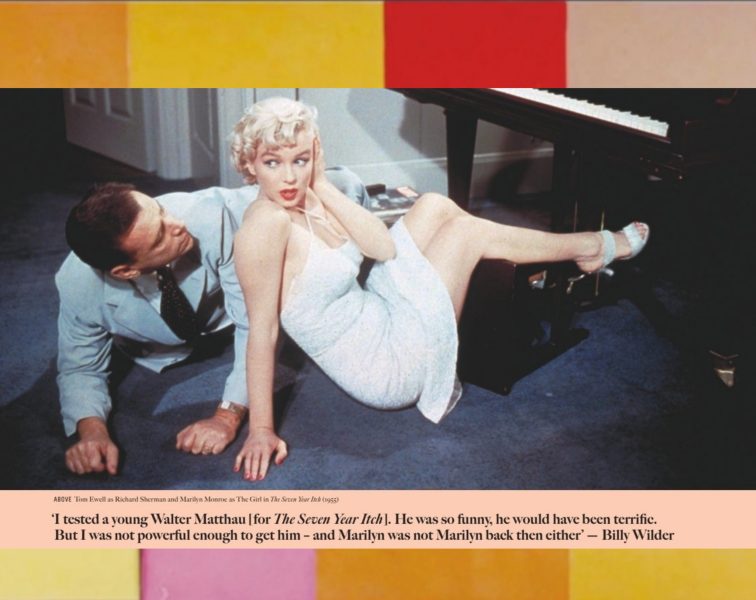
The November 2026 issue of UK magazine Sight & Sound includes an archive interview with filmmaker Billy Wilder and graphic designer Saul Bass, who created the innovative opening title sequence for The Seven Year Itch (1955.)
Billy, when you hired Saul for The Seven Year Itch did you set a tight brief or did you give this new talent a fairly free hand?
BW: “I forget now. But in another area we were absolute idiots not to capitalise on what 30 or 40 years later is the symbol for that film. You know, Marilyn’s frock blowing up. We had it there but it didn’t occur to us to use it. I forget what the actual advertising campaign was now. Actually The Seven Year Itch wasn’t a very good picture. Well, it was all right.”
SB: “What are you talking about? The Seven Year Itch was a wonderful film!”
BW: “I’ll tell you what I’m talking about. First of all I went to New York to test, because we knew we had Marilyn Monroe but we didn’t have a leading man. And I tested a guy, a very young man who was improvising this scene. He was so funny, I just screamed with laughter. I thought I must have this guy because he’s so interesting. The guy was Walter Matthau and he would have been absolutely terrific. But the producers said, ‘Why do you make it so difficult? Tom Ewell has played that part now 900 times [in the original stage version], he knows all the words, knows where all the laughs are.’ But I was not powerful enough to get Matthau – and Marilyn Monroe was not Marilyn Monroe back then either.

“I said to them, look, this thing is only good in that there is what in German they call a ‘straw widower’ [ie, a husband temporarily separated from his wife). The family goes into the country for the summer months and now you go crazy. There are two things we need to plan very, very well. One is that the guy who has all those daydreams should not be very attractive at all, and the other that the girl upstairs must be extremely sexy and must want something from him so that he thinks she wants him. And that object is an air conditioner. That way she can say, ‘Can I sleep here tonight?’ and he goes crazy. She says, ‘I can’t sleep in that heat, I’ll just go upstairs and get my underwear from the refrigidaire.’ He says, ‘Wow! From where?’
Censorship was a problem. I argued that at a certain point we must say it, see it, feel it: that he slept with Marilyn Monroe. ‘Oh my God, Mary, Mary,’ the studio said. Censorship, censorship. I remember spending a night wondering what to do. I had to come up with something. I finally said, ‘There is one thing we can do that will be subtle enough for the censors not to object. Try this: there is a room maid who is making up the bed, and there is a hairpin, which she simply picks up and then throws away.’ A hairpin, that is all. That is all I wanted. But I couldn’t get it. I had a tough time, I had a less tough time with Some Like It Hot [1959] but that was better material. The Seven Year Itch could certainly have been ten times as good.”
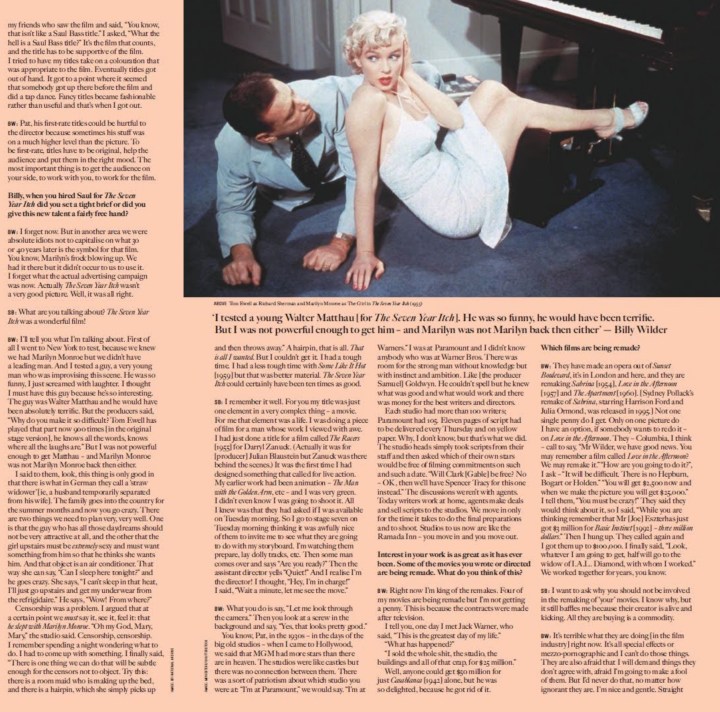
It’s interesting that Wilder said ‘Marilyn Monroe was not Marilyn Monroe’ when she made The Seven Year Itch. Actually, she was already a huge star at the time; but under her restrictive contract at Twentieth Century-Fox, she didn’t have the clout to choose her leading men or fight censorship.
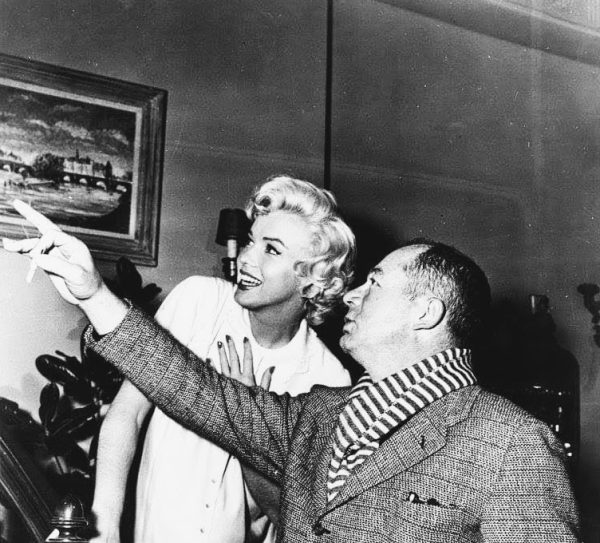
Although Wilder claimed that the publicity campaign didn’t capitalise on the film’s iconic ‘subway grate scene’, a giant image of Marilyn with her skirt blown up was reproduced at the New York cinema where The Seven Year Itch premiered, and at venues across the U.S.
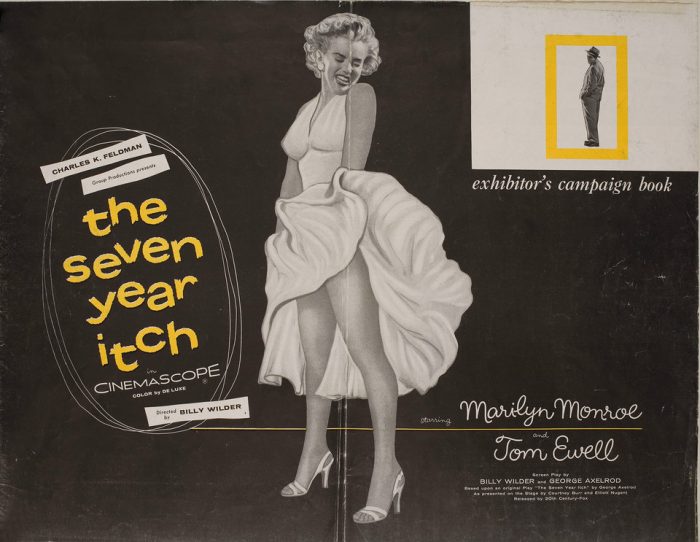
By the time of Some Like It Hot Marilyn had more freedom, enabling her to work for other studios – and she also received a percentage of the profits. The film was released without approval and in defiance of the Motion Picture Production Code, which was finally replaced by the certification system in 1968.
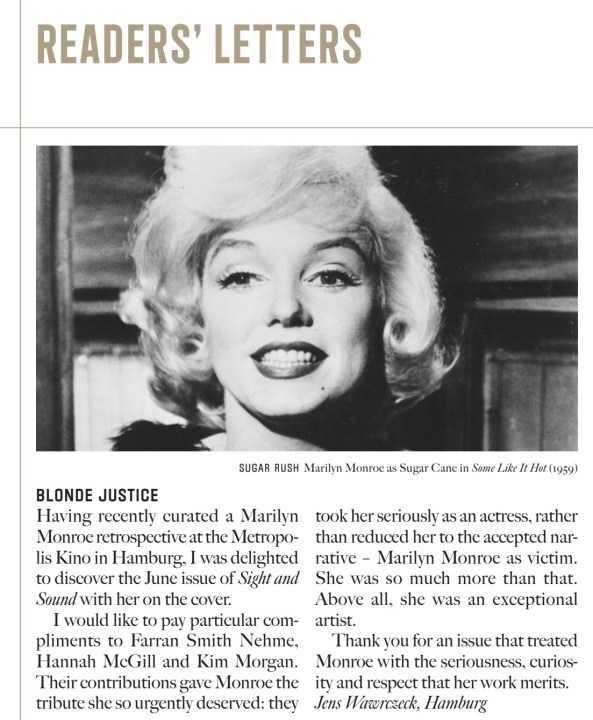
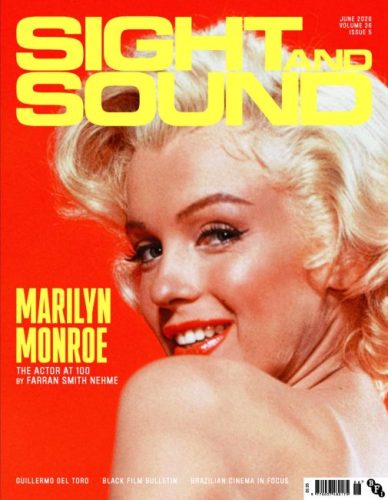
Elsewhere in Sight & Sound, reader Jens Wawrczeck – who curated a Monroe retrospective in Hamburg this summer – congratulates the magazine on its recent cover story celebrating Marilyn’s centenary (and you can order the June issue here.)
And finally, Some Like It Hot is featured among 30 films in Almost Perfect: The Films of Billy Wilder, opening at BFI Southbank in London this October.

