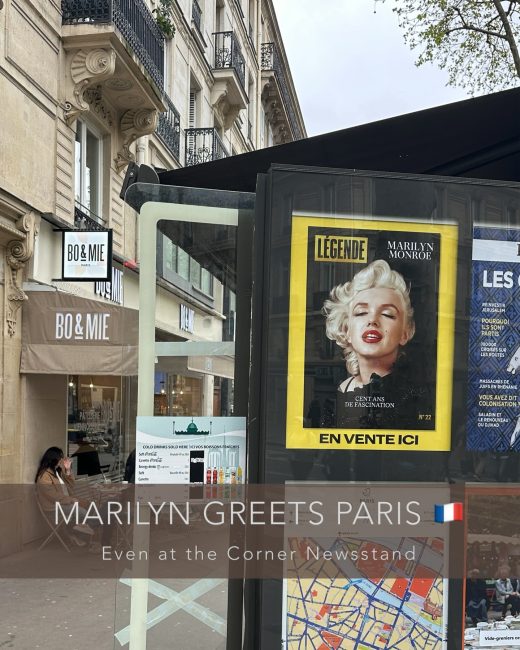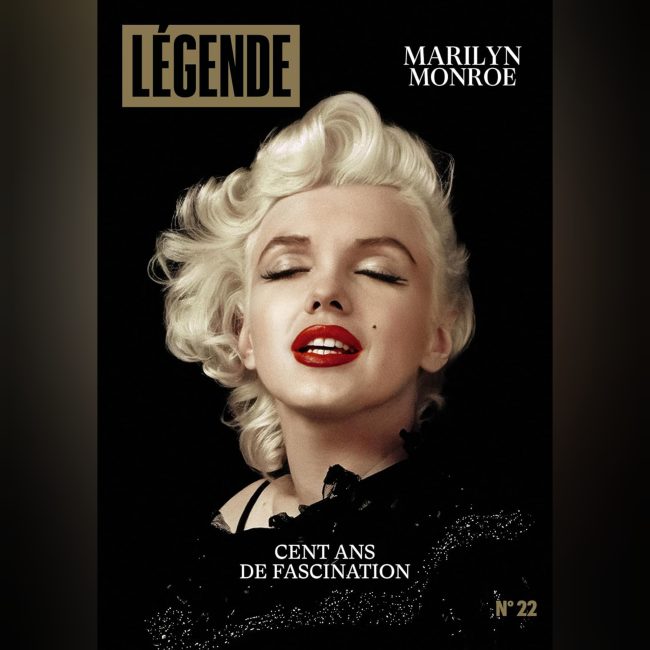
The French magazine Légende has published a Marilyn-themed issue for Spring 2026 (#22), also available via Amazon. (The cover photo is an outtake from her 1955 ‘black cape sitting’ for Milton Greene.)
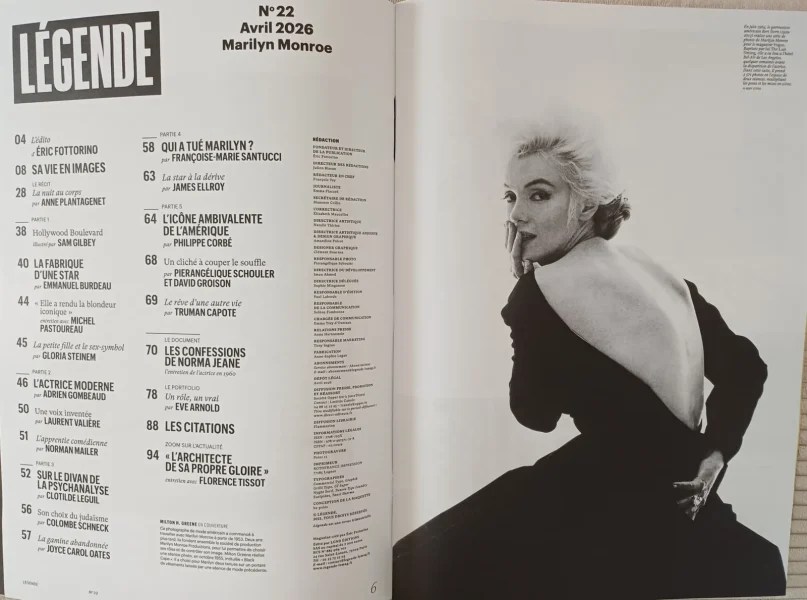
The tribute begins with an editorial from Éric Fottorino.
“To say that Marilyn would have been 100 years old is, first and foremost, a dizzying thought, so perfectly is the icon immortalised on film in an eternal youth that masks unfathomable torments. The words ‘curves,’ ‘sensuality,’ and ‘glamour’ seemed to have been invented for her, as did the adjective ‘blonde,’ chosen by the writer Joyce Carol Oates for her novel exploring the star’s soul. Behind the gilded or hand-embroidered legend, like the flesh-colored silk dress she wore on the evening of John Fitzgerald Kennedy’s birthday in 1962, remains Norma Jeane Baker … The gap between the stuttering girl and the ‘creature’ who would impose herself everywhere and forever as Marilyn Monroe, or simply by that name: Marilyn, is not so wide. Despite the fame and success, having become a Hollywood queen with some landmark films in cinematic history, one question remains: from depressions to miscarriages, from breakups to suicide attempts, from pain to melancholy, how did Norma Jeane and Marilyn coexist in this all-too-brief life?'”
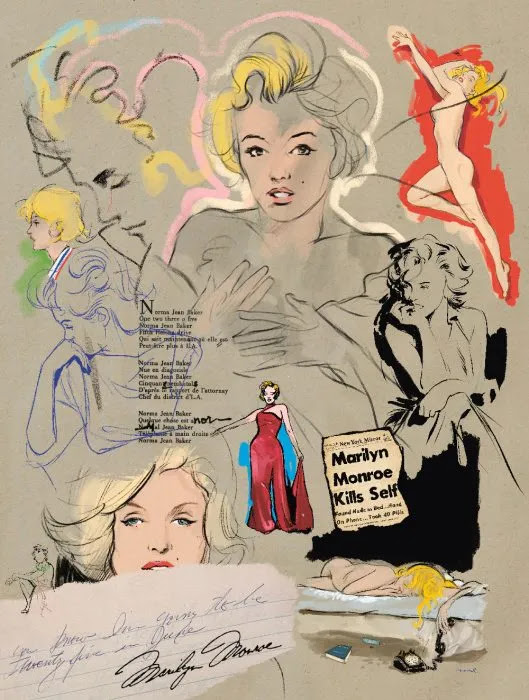
We then follow Marilyn’s life in pictures, while Monroe biographer Anne Plantagenet charts Norma Jeane’s discovery.
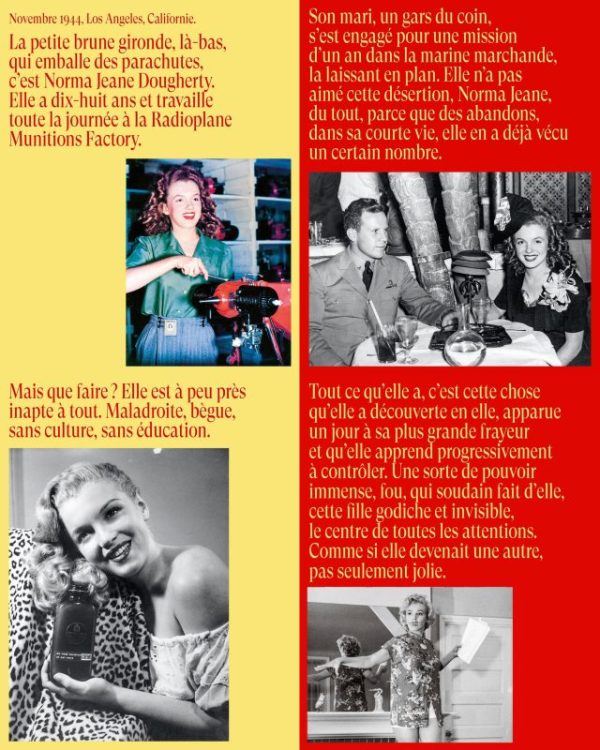
“November 1944, Los Angeles, California. The petite, curvy brunette over there, packing parachutes, is Norma Jeane Dougherty. She’s eighteen and works all day at the Radioplane Munitions Factory. Her husband, a local guy, has signed up for a year-long tour in the Merchant Marine, leaving her stranded. Norma Jeane didn’t take kindly to this desertion, not at all, because she’d already experienced her fair share of abandonment …
All she has is this thing she discovered within herself, which appeared one day to her utter terror and which she’s gradually learning to control. A kind of immense, mad power that suddenly makes her, this awkward, invisible girl, the center of attention. As if she were becoming someone else, not just pretty. Cute, curvy girls abound in California, eyeing Hollywood and dyeing their wavy hair in the hope of being noticed. But she’s different. When the other side of her emerges, Norma Jeane transforms into a fascinating creature … Perhaps it is there that everything is decided this November morning, when Sergeant David Conover, an army photographer, arrives to take pictures of young American women delighted to be contributing to the war effort.
In the surrounding greyness, his gaze is drawn to a bright point, an extraordinary gleam. It is Norma Jeane Baker, wife of Jim Dougherty, with her white skin and dark brown curls, wearing overalls like no one else and seeming completely naked amidst the others. Without hesitation, Conover walks towards her and asks permission to photograph her. She readily agrees and poses for the camera as if she had been doing it all her life.”
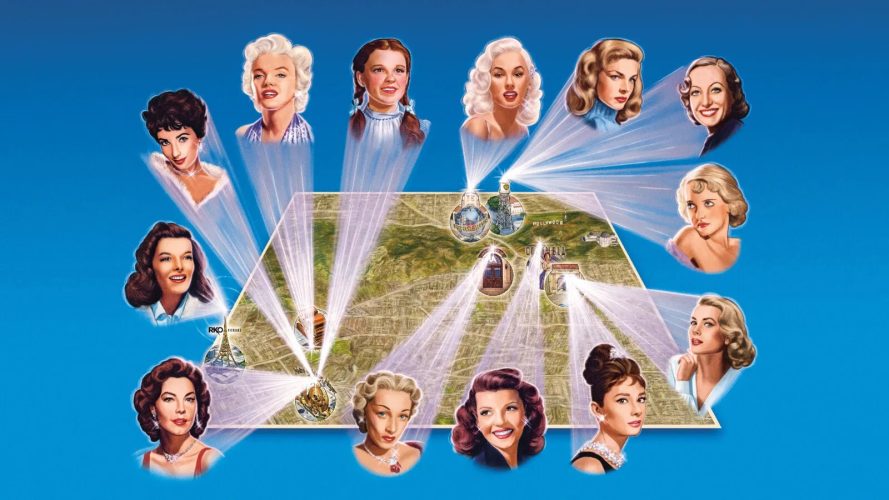
After years of modelling jobs and bit parts in B-movies, Marilyn’s big break came in All About Eve (1950.) Illustrator Sam Gilbey places her among peers and rivals on Hollywood Boulevard.
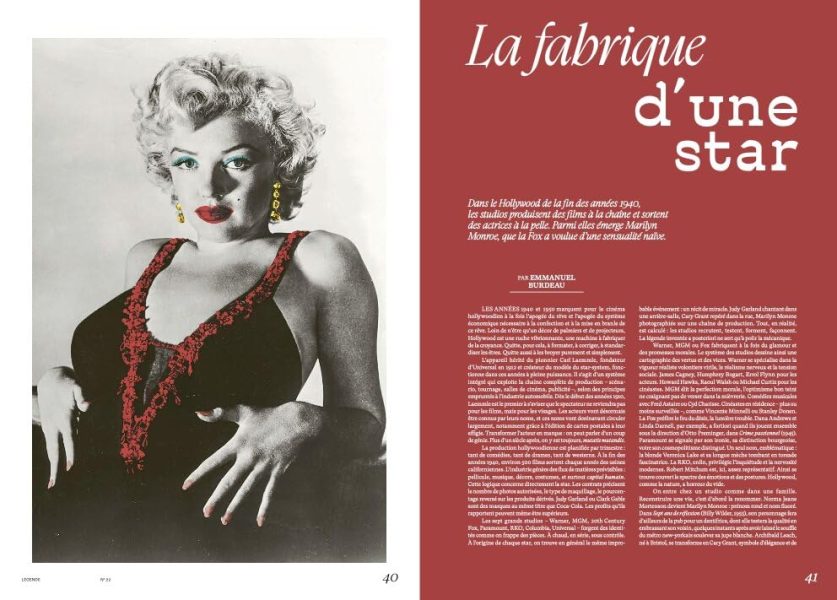
Next up, Emmanuel Burdeau considers The Making of a Star.
The 1940s and 1950s marked for Hollywood cinema both the pinnacle of the dream and the pinnacle of the economic system necessary for its creation and implementation. Far from being merely a backdrop of palm trees and spotlights, Hollywood was a bustling hive, a machine for manufacturing belief. Even if it meant shaping, correcting, and standardising people. Even if it meant simply crushing them … Among them emerged Marilyn Monroe, whom Fox wanted to portray with a naive sensuality.”
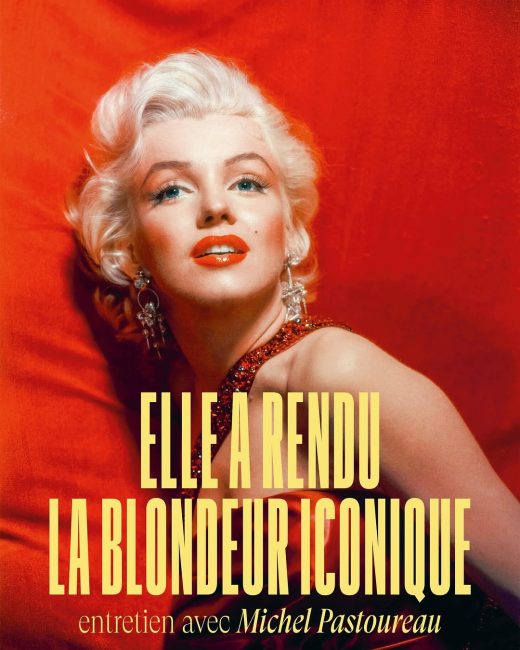
Historian Michel Pastoureau explores how She Made Blonde Hair Iconic.
“It began in the 1930s, with actresses like Jean Harlow. Blonde hair was already noticeable even in the era of black and white cinema. Then it became more pronounced in the 1950s, when Marilyn became an American icon.”
Gloria Steinem compares The Little Girl and the Sex Symbol.
“In Marilyn: Norma Jeane (1986), the American icon of feminism tracks down the silences of Norma Jeane under the mask of Marilyn, and highlights the Hollywood machine, which elevates as much as it crushes. ‘She had a panic-stricken fear of growing old. Her mind was so completely confined within the impenetrable prison of beauty that she dreaded aging more than death itself …'”
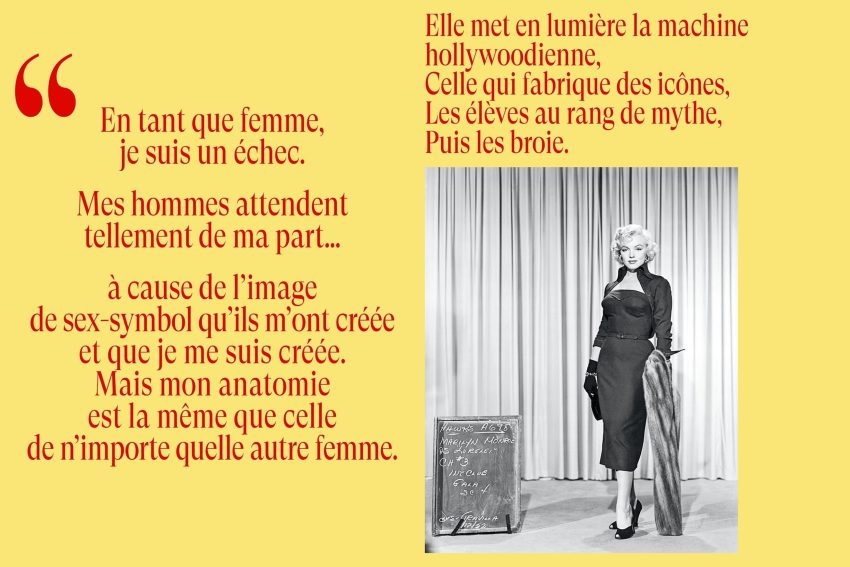
Adrien Gombeaud (author of A Blonde in Manhattan, 2011) focuses on Marilyn’s New York years in The Modern Actress.
“In late 1954, Marilyn Monroe headed to Los Angeles airport. In complete secrecy, she had decided to leave the city of studios and the Pacific Ocean to reinvent herself on the other side of the country, facing the Atlantic. She checked in wearing a black wig under the name Zelda Zonk. This night flight was to mark the beginning of a new life.
In Manhattan, the actress intends to create a production company and reinvent herself as an actress at the most prestigious drama school of her time. Love and work form the only realities of her existence.”
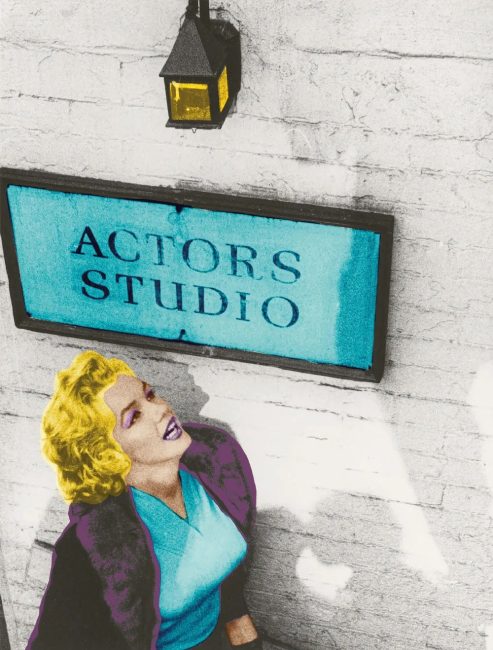
Meanwhile, filmmaker Laurent Valiére lends his ear to An Invented Voice.
“Everything about Marilyn Monroe was an invention, judged director George Cukor, for whom she starred in her last (unfinished) film, Something’s Got to Give. Everything, including that singing, hesitant, whispering voice, which is one of the most singular elements of her identity: ‘It happened to me once…'”
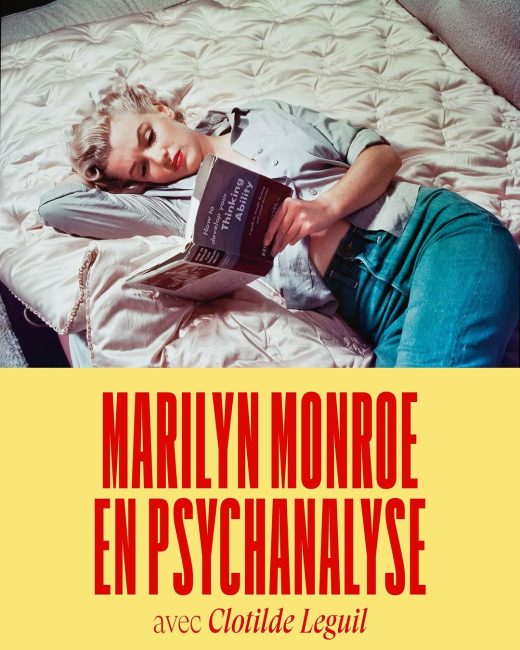
The Aspiring Actress, an extract from Norman Mailer’s fictionalised Monroe memoir (Of Women and Their Elegance, 1980), is followed with ‘On the Psychoanalytic Couch,’ by Clotilde Leguil, a philosopher and therapist.
“Marilyn Monroe’s encounter with psychoanalysis was inevitable. She needed a place to house her fragment of darkness, the part she kept so well hidden, hidden beneath the surface of her luminous persona. This fragment of darkness was named Norma Jeane Baker … This is the origin of the woman who would make a name for herself, develop a body, and establish herself.”
Writer and filmmaker Colombe Schneck ponders Marilyn’s conversion to Judaism.
“For Marilyn, as for me, being Jewish is finally about belonging . Judaism, in which I was raised, is defined by belonging. Because of the Nazi extermination policy, my parents lost grandparents, cousins, uncles, and aunts. How can one believe in God after the Holocaust?”
The Abandoned Girl, an extract from Joyce Carol Oates’ novel, Blonde, mourns the lifelong absence of Marilyn’s father; while crime novelist James Ellroy (The Enchanters) reframes the death of a Star Adrift.
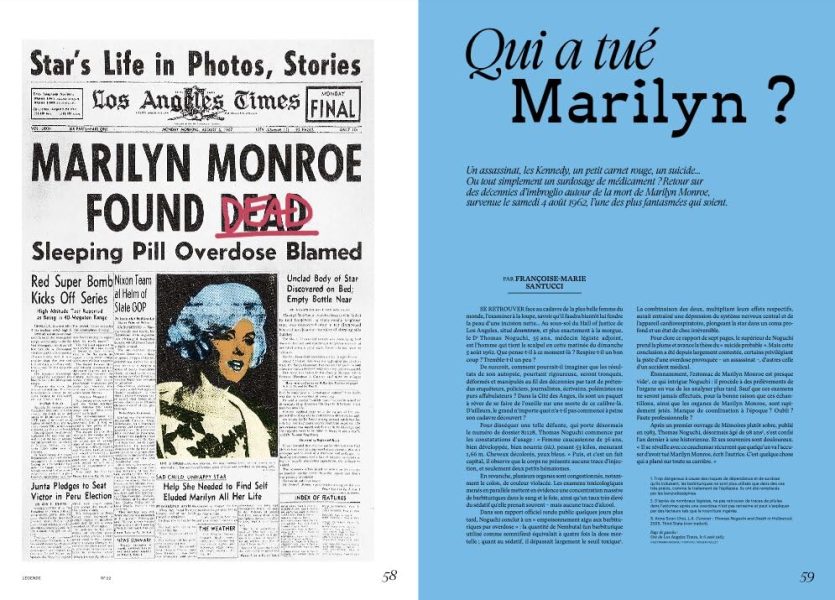
Françoise-Marie Santucci (author of Monroerama, 2012) asks, ‘Who Killed Marilyn?‘
“To find oneself face to face with the corpse of the most beautiful woman in the world, to examine it under a magnifying glass, knowing that one would soon have to cut her skin with a clean incision… In the basement of the Los Angeles Hall of Justice, located downtown, and more precisely in the morgue, Dr. Thomas Noguchi, 35 years old, assistant medical examiner, is the man holding the scalpel on this Sunday morning, August 5, 1962. What is he thinking at that moment? Is he taking a deep breath? Is he trembling a little?
Moreover, how could he have imagined that the results of his autopsy, rigorous as it was, would be truncated, distorted, and manipulated over the decades by so many self-proclaimed investigators, police officers, journalists, writers, polemicists, or outright fabulists? In the City of Angels, there are plenty of them dreaming of making a quick buck off a dead woman.”
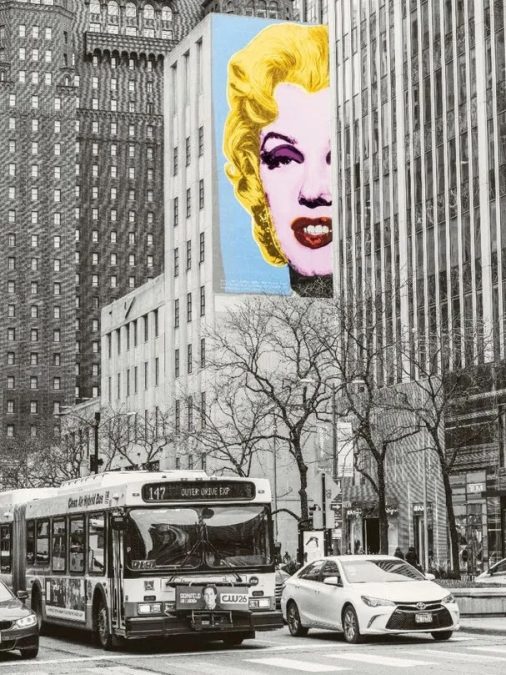
More than 60 years after Marilyn’s death, Philippe Corbé reflects on An Ambivalent Icon.
“The death of Marilyn Monroe marked the end of a golden age for the United States. A darling of the post-war era, the star embodied a certain carefree spirit and represented an ideal of social success. Now, on the centenary of her birth and the 250th anniversary of the American nation, a re-examination of the myth has become necessary.”
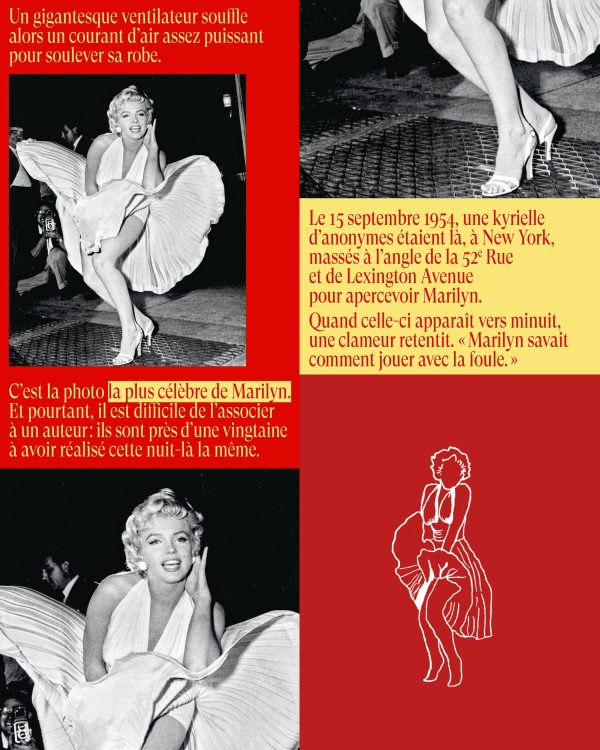
David Groison and Pierangélique Schouler take a closer look at Sam Shaw’s Breathtaking Photo – one of many taken during one night of shooting The Seven Year Itch in Manhattan, as Marilyn stood over a breezy subway grate.
Marilyn’s friend, the author Truman Capote, recalls The Dream of Another Life; and an extract from one of Marilyn’s most revealing interviews is headlined ‘The Confessions of Norma Jeane.’ Interestingly, she kept her father’s true identity secret – he was Charles Stanley Gifford, a former co-worker of her mother – and only mentioned Gladys’ two ex-husbands, whose names she took as a child.
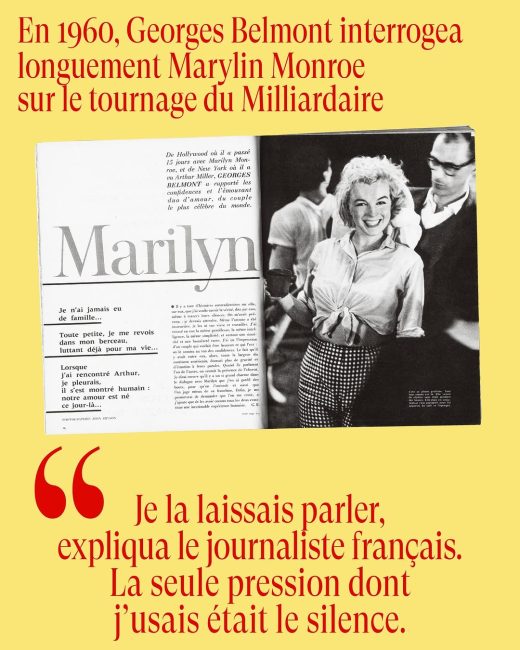
“French journalist Georges Belmont conducted a lengthy interview with the actress on the set of Let’s Make Love, a wide-ranging conversation published in October 1960 in Marie Claire. ‘I let her talk,’ he explained. ‘The only pressure I used was silence. When she stopped talking, I said nothing, and at the end of the silence, when she couldn’t speak any longer, what came out was often crucial and almost always terribly moving.’ Here are excerpts from this exchange, in which Marilyn Monroe opens up like never before.
‘For a long time, my past, my life, remained completely unknown. I never spoke of it. For no particular reason. I simply felt it was my business and not anyone else’s. […] My first memory?… It’s a memory of struggling for life. I was very small… a baby in a little bed, yes, and I was fighting for my life. […] Then, as far back as I can remember, I see myself in a stroller, in a long white dress, on the sidewalk outside the house where I lived with a family that wasn’t my own.
It is a fact that I am an illegitimate child. But everything that has been said about my father, or fathers, is false. My mother’s first husband was named Baker. The second, Mortenson. But she had long since divorced both of them by the time I was born. It has been said that my father was Norwegian, no doubt because of the name Mortenson, and that he died in a motorcycle accident shortly after my birth. I don’t know if this is true of Mortenson, as I have never had any relation to him. […]
There are two things that might explain some of the confusion. First, I was always told in my early childhood that my father had died in a car accident in New York before I was born. Second, curiously, my birth certificate lists, in response to the entry for “Occupation,” the word Baker, which was the name of my mother’s first husband, but which also means “baker.” When I was born, an illegitimate child as I mentioned, my mother had to give me a name. My feeling is that, forced to think quickly, she gave me “Baker.” Pure coincidence.”
And finally, ‘A Role, A Real One‘ showcases Eve Arnold’s photos from the Misfits set; a selection of Quotes from Marilyn herself; and Florence Tissot, curator of the Cinémathèque Française exhibition in Paris, hails ‘The Architect of Her Own Glory.’