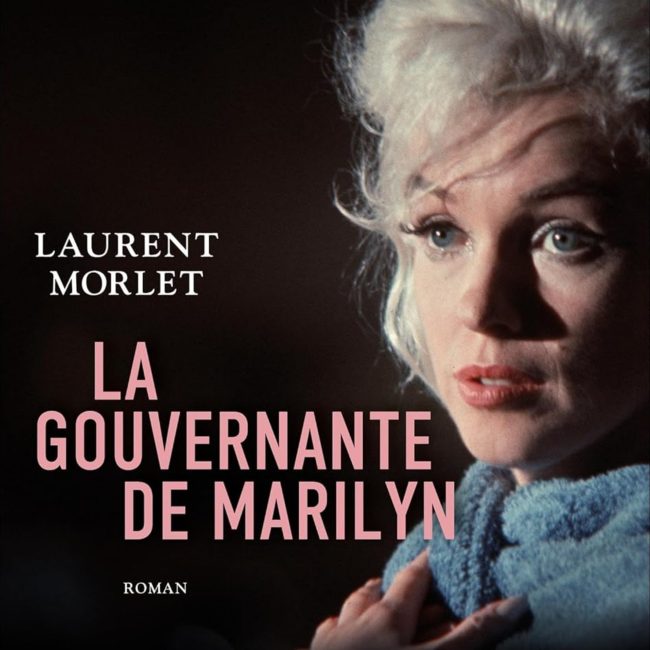
La Gouvernante de Marilyn (or ‘Marilyn’s Housekeeper’) is a new novel by French-born author and filmmaker Laurent Morlet – with a cover photo is by Lawrence Schiller, taken during filming of the legendary ‘pool scene’ from Marilyn’s last, unfinished movie, Something’s Got to Give.
“August 5, 1962. In a letter to her sister, Marilyn Monroe’s housekeeper wonders: ‘Did I kill her?’
Nothing predestined Eunice Murray, from a very devout Chicago family, to be close to the greatest Hollywood star of all time. Yet, on the cusp of sixty, after a life of wandering and loss, luck finally seemed to smile upon her when she entered Marilyn’s service.
In the intimacy of the Helena Drive hacienda, the two women grew close. For nine months, Eunice shared the actress’s joys and sorrows like no one before her. Until the day she found Marilyn lifeless in her bed. What truly happened on the night of August 4-5, 1962, when they were alone in the house?”
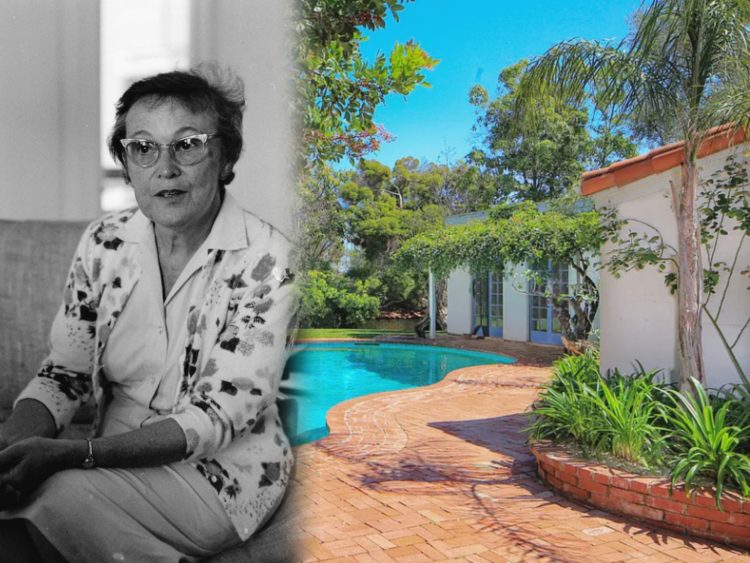
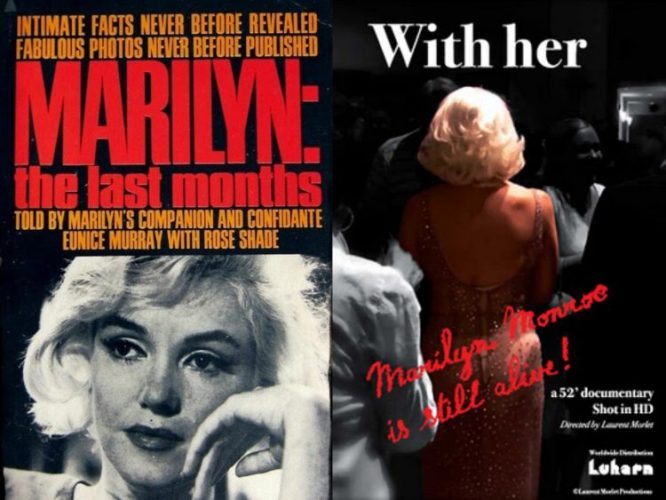
As the first person to discover Marilyn’s body, Eunice Murray is often treated with suspicion by Monroe fans. A rather unworldly older woman thrust into the spotlight, she appeared vague and inconsistent when talking about Marilyn’s death. Nonetheless, her own memoir, Marilyn: The Last Months (1975), is a poignant account of Marilyn’s daily life during their all-too-brief acquaintance.
Laurent Morlet is no stranger to Monroe lore himself, having produced a documentary, With Her (2012), about the Marilyn Remembered group in Los Angeles, where he now lives. For the May issue of VSD magazine, he spoke at length with Sylvain Monier about Marilyn’s Housekeeper as part of a cover story marking her centenary.
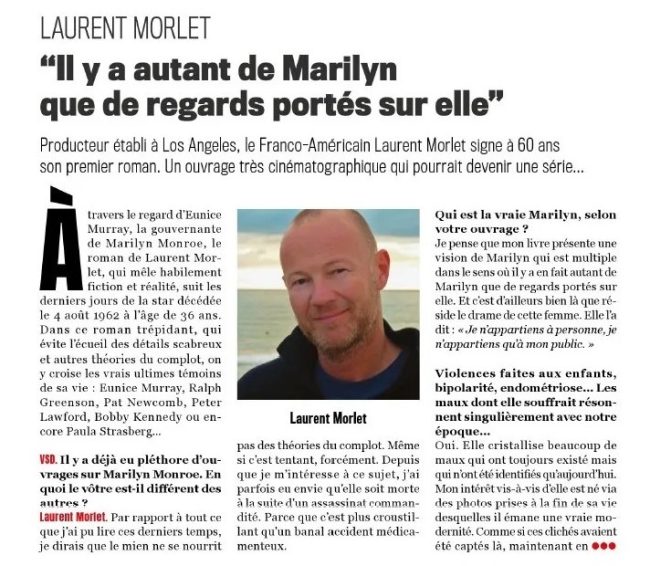
‘There are as many Marilyns as there are ways of looking at her.’
“A producer based in Los Angeles, the Franco-American Laurent Morlet has published his first novel at the age of 60. A highly cinematic work that could easily become a series…
Through the eyes of Eunice Murray, Marilyn Monroe’s housekeeper, Laurent Mortet’s novel, which skillfully blends fiction and reality, follows the final days of the star who died on August 4, 1962, at the age of 36. In this fast-paced novel, which avoids the pitfalls of lurid details and conspiracy theories, we encounter the true final witnesses of her life: Eunice Murray, Ralph Greenson, Pat Newcomb, Peter Lawford, Bobby Kennedy, and Paula Strasberg…
VSD: There have already been a plethora of books about Marilyn Monroe. How is yours different from the others?
Laurent Morlet: Compared to everything I’ve read lately… Not conspiracy theories. Even if it’s tempting, of course. Since I’ve become interested in this subject, I’ve sometimes wished she had died as a result of a contract killing. Because it’s more compelling than a simple medical accident.
Who is the real Marilyn, according to your book?
I think my book presents a multifaceted vision of Marilyn, in the sense that there are actually as many Marilyns as there are perspectives on her. And that’s precisely where the tragedy of this woman lies. She said it herself: ‘I belong to no one, I belong only to my public.’
Child abuse, bipolar disorder, endometriosis… The ailments she suffered from resonate strangely with our times…
Yes. She embodies many ills that have always existed but have only been identified today. My interest in her began with photos taken at the end of her life, which exude a real modernity. As if these snapshots had been captured right there, right now…2026. It’s certainly linked to the photographer’s talent, but there’s also something about her—in her gaze, her manner—that transcends time.
When did you first become interested in her?
In the mid-1980s, thanks to a certain 1950s revival, but not only that: she represented my American dream. As a teenager, I first fell in love with the United States through series like Columbo, Dallas, Charlie’s Angels, Starsky & Hutch, Hart to Hart… Funny thing is, I’ve since become friends with Stefanie Powers, anyway… At 18, I went there on my own and discovered Los Angeles, a city that looked exactly like the TV shows. Even today, it’s a city architecturally steeped in the past.
You visited Marilyn’s house in Brentwood, which is a character in its own right in your novel…
Yes, it’s a single-storey, Mexican-style house with a roof of red tiles, located at the end of a cul-de-sac. It wasn’t an upscale part of Brentwood back then. It’s certainly changed since. But the house has remained the same, with its kidney-shaped swimming pool.
Why did you make Eunice Murray, the housekeeper, the heroine of your novel?
Because there’s very little information about her. So I imagined her life and the conversations between her and Marilyn. Eunice Murray has always reminded me of my own grandmother, actually. She was 60 when she started working with Marilyn, and that’s the same age I am now. She’s in the photos taken on the night of the tragedy. I’ve always wondered who this woman was. And little by little, I became attached to her.
We learn that she belonged to a religious cult whose existence I was unaware of…
Yes, it’s the New Church, also called the Swedenborgian Church or the Church of Jerusalem. You could say we’re close to Jehovah’s Witnesses, in the sense that their precepts reject medication for illness. It’s not far from a cult, really.
She and Marilyn make an odd pair. Yet, you get the sense that the star doesn’t judge her housekeeper’s spiritual choices…
Yes, as Marilyn says when Eunice starts talking about spirituality: ‘My religion is Dom Pérignon!’ She wasn’t particularly interested in religion. She did convert to Judaism when she married Arthur Miller, but it was more out of convenience than belief. Yet it’s true, at no point does she judge or mock Eunice on this subject. She was very intelligent and very curious, you know. She was also quite a complex woman. For example, she criticised Elizabeth Taylor for having a plethora of gay friends, claiming they frightened her. Words that could be considered pure homophobia today. Yet, she was very close friends with Montgomery Clift.
Some claim that Eunice acted as the enforcer for Ralph Greenson, Marilyn’s psychiatrist. That she was a kind of matron for the star. What do you think?
I think it’s all true. She reported everything to Greenson. And she was indeed his enforcer. But In a good way. There was no intent to harm. This ‘monitoring’ was part of the therapy. That said, Marilyn had her own free will. She was the one who made the decision to hire Eunice, for example.
What medication was she taking? What kind of medication?
She couldn’t sleep, so the most hardcore meds were essentially tranquilisers and especially sleeping pills. And since at the time, they didn’t really have…A lack of knowledge regarding dosages could quickly lead to problems. And it did.
You also mention the press agent, Pat Newcomb. Can you tell us about her?
She was indeed her press agent initially, and over time, she became a friend. She was three years younger than Marilyn Monroe, and she didn’t mince words. In other words, she could tell the star exactly what she thought when things got out of hand. Eunice thought she was a lesbian, but according to my sources, that’s false. Pat didn’t much like Eunice, whom she found too intrusive. She still lives in LA. I tried to contact her, but she didn’t respond.
What is the balance between fact and fiction in your novel?
I only kept the known elements of Marilyn’s last days: the dress she wore on JFK’s birthday, the night of her death, the decor of her house, the comings and goings of certain people like Bobby Kennedy, Peter Lawford, or Pat Newcomb… The book begins with the night of that fateful August 4, 1962, and all the details recounted are true. It ends with Eunice’s life after the star’s death. And there, everything is indeed fictionalised.
Tell us about Paula Strasberg, who also appears in your book…
She was the wife of Lee Strasberg, the founder of the Actors Studio. She was his on-set coach on his last films. She was a very protective woman who was supposed to help her bring out her artistry. There were sometimes disagreements between her and the directors because she was the one who primarily directed Marilyn. Eunice needed Paula and Lee; she was the one who sought them out.
What did you think of Blonde, Andrew Dominik’s biopic about Marilyn?
I found it to be an interesting artistic gesture, but one that dwells a little too much on the misery aspect. Regarding Marilyn Monroe, I refuse to see things in black and white. She wasn’t as weak as all that. Did you know that she started her own production company [in 1955], following the advice of photographer Milton Greene? She wanted to break free from the major studios, which was very innovative at the time.
This is your first book, and you are also a producer-director. What’s your next project?
I’d like this book to become a five-episode mini-series titled Eunice, which, like the book, would be a story centered around this housekeeper, always taking place on the night of August 4th, interspersed with various flashbacks.”
UPDATE:
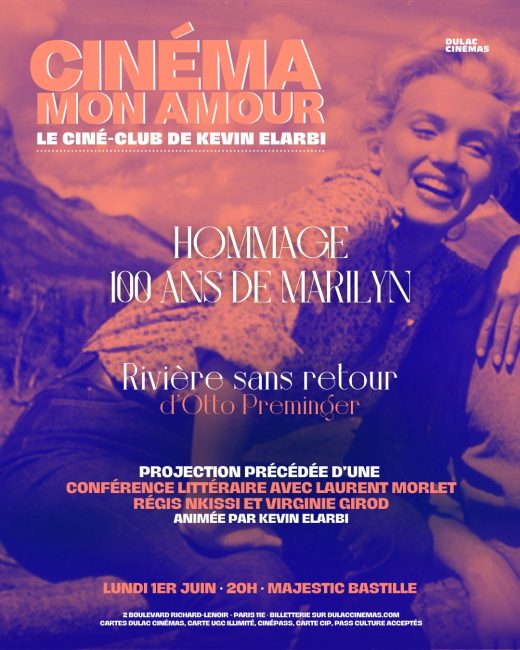
At 8 pm on Monday, June 1 – Marilyn’s 100th birthday – River of No Return is showing at the Majestic Bastille cinema. This screening will be preceded by a panel discussion with writer and filmmaker Laurent Morlet (With Her, Marilyn’s Housekeeper); Régis NKissi (author of How Marilyn Saved My Life); and historian and broadcaster Virginie Girod (who presented the Europe1 radio documentary, Marilyn Monroe: Birth of a Star), hosted by Kevin Elarbi.
 The Marilyn Report
2 Comments
Comments are closed.